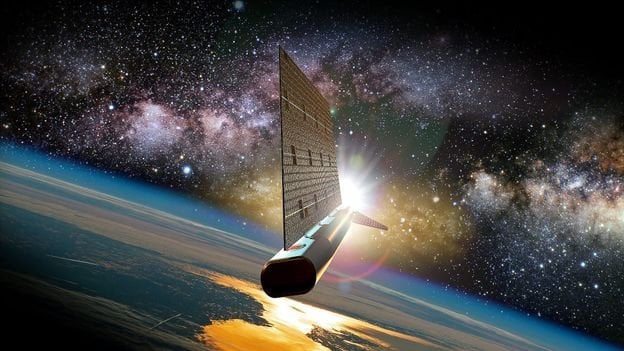
Sky skimmers: The race to fly satellites in the lowest orbits yet
https://www.bbc.com/future/article/20250207-sky-skimmers-the-race-to-send-satellites-into-very-low-earth-orbits

Sky skimmers: The race to fly satellites in the lowest orbits yet
https://www.bbc.com/future/article/20250207-sky-skimmers-the-race-to-send-satellites-into-very-low-earth-orbits
4 Comments
whats the feasibility of solar sail extending lower orbit satellite paths?
Companies are racing to build satellites that fly super low in space, just above Earth’s atmosphere. Normally, they’d fall back fast, but new tech lets them stay up forever by using air as fuel. This could mean sharper images, faster internet, and better climate research—if they can pull it off.
Hmmmmm, I wonder which company would benefit the most from lowering their satellite altitude even further.
I also wonder whether this same company, known for its innovation in utilizing newer, cheaper, and (arguably) better propellant for their satellite’s ion engine, would be best suited to tackle this challenge.
Also, they are known for mass producing satellite and are VERY willing to sacrifice some hardware in the name of iterative development.
So do they have a clean up plan for the discarded satellites when they’ve reached their end? Anything better than the ‘let it burn up in the atmosphere and destroy the ozone layer with aluminum?’
>Peer-reviewed science paper from PNAS: Metals from spacecraft reentry in stratospheric aerosol particles
>Abstract
Large increases in the number of low earth orbit satellites are projected in the coming decades [L. Schulz, K.-H. Glassmeier, Adv. Space Res. 67, 1002–1025 (2021)] with perhaps 50,000 additional satellites in orbit by 2030 [GAO, Large constellations of satellites: Mitigating environmental and other effects (2022)]. When spent rocket bodies and defunct satellites reenter the atmosphere, they produce metal vapors that condense into aerosol particles that descend into the stratosphere. So far, models of spacecraft reentry have focused on understanding the hazard presented by objects that survive to the surface rather than on the fate of the metals that vaporize. Here, we show that metals that vaporized during spacecraft reentries can be clearly measured in stratospheric sulfuric acid particles. Over 20 elements from reentry re detected and were present in ratios consistent with alloys used in spacecraft. The mass of lithium, aluminum, copper, and lead from the reentry of spacecraft was found to exceed the cosmic dust influx of those metals. About 10% of stratospheric sulfuric acid particles larger than 120 nm in diameter contain aluminum and other elements from spacecraft reentry. Planned increases in the number of low earth orbit satellites within the next
few decades could cause up to half of stratospheric sulfuric acid particles to contain metals from reentry. The influence of this level of metallic content on the properties of stratospheric aerosol is unknown.
https://www.pnas.org/doi/pdf/10.1073/pnas.2313374120
>Peer-reviewed paper from Geophysical Research Letters journal:
Potential Ozone Depletion From Satellite Demise During Atmospheric Reentry in the Era of Mega‐Constellations
>Abstract
Large constellations of small satellites will significantly increase the number of objects orbiting the Earth. Satellites burn up at the end of service life during reentry, generating aluminum oxides as the main by product. These are known catalysts for chlorine activation that depletes ozone in the stratosphere. We present the first atomic‐scale molecular dynamics simulation study to resolve the oxidation process of the satellite’s aluminum structure during mesospheric reentry, and investigate the ozone depletion potential from aluminum oxides. We find that the demise of a typical 250‐kg satellite can generate around 30 kg of aluminum oxide nanoparticles, which may endure for decades in the atmosphere. Aluminum oxide compounds generated by the entire population of satellite reentering the atmosphere in 2022 are estimated at around 17 metric tons. Reentry scenarios involving mega‐constellations point to over 360 metric tons of aluminum oxide compounds per year, which can lead to significant ozone depletion.
https://agupubs.onlinelibrary.wiley.com/doi/epdf/10.1029/2024GL109280