
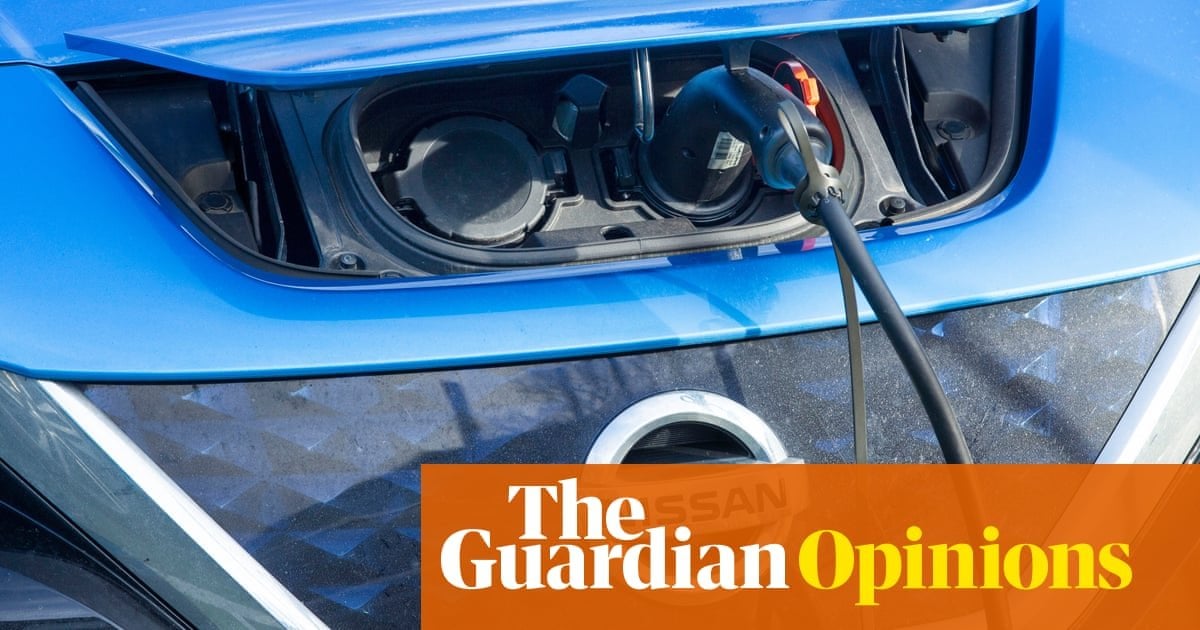
Fewer than 10 people across Australia actually do this, because the technology – known as vehicle-to-grid (V2G) – is very new. ‘A house battery you can drive around’.
https://www.theguardian.com/australia-news/commentisfree/2025/feb/13/a-house-battery-you-can-drive-around-how-some-australians-are-selling-power-from-their-cars-back-to-the-grid
8 Comments
“Bidirectional EV charging allows for EV batteries to be used for purposes including solar-self-consumption, back-up power and supporting the grid. With the right policy settings, hundreds of thousands of Australian households could be using this technology to reduce their power bills by 2030, and millions by 2040.”
Quote from [this report](https://arena.gov.au/assets/2025/02/Bidirectional-Bidi-ROADMAP-2025-01-15-1.pdf) linked by the Guardian article. Report published by [Australian Renewable Energy Agency – National Roadmap for Bidirectional EV Charging in Australia](https://arena.gov.au/knowledge-bank/national-roadmap-for-bidirectional-ev-charging-in-australia/)
I don’t want to sell it to the grid as much as use it myself to collect excess solar during the day and use it at night. I don’t drive to work so my car is at home 90% of the time.
Does the increased use/discharge affect the lifetime of the battery?
One day it would be nice if all EVs were connected to the grid at all times when parked. They alone maybe could provide all the storage we need to be fully supported by fickle renewables of wind and solar. But in order to convince EV drivers to do it, they have to be able to sell electricity for more than they bought it from (probably buy during the day, sell at night). Wouldn’t it be neat if governments made a law that the electric company can set whatever price they want for electricity, but they have to accept buys and sells for that price. Kind of like buying or selling a stock at a given price (similarities end there). I wonder if this would be a good idea for governments to pass this law.
I recently had a conversation with a few people about power outages where we live and they were saying that they are glad they have a regular car as they couldn’t charge an EV during a power outage.
They hadn’t heard of VtL. They changed their minds when they realised they would still have power for essentials for a few days and can drive to a charge point and come back and get another few days.
Afaik, only one state, South Australia, has implemented the policy settings.
Pilot sites have been established and are effective but until the rest of the market joins in the technology providers aren’t rolling out
Another issue is the fairly short list of vehicles that provide V2H (Vehicle to Home) or V2G (Vehicle to Grid) from the factory.
Tesla has stated they have no interest in providing the feature. Toyota doesn’t seem to be interested either.
Granted, this list is for the US, [https://www.cnet.com/home/electric-vehicles/bidirectional-charging-and-evs-how-does-it-work-and-which-cars-have-it/](https://www.cnet.com/home/electric-vehicles/bidirectional-charging-and-evs-how-does-it-work-and-which-cars-have-it/)
I’m not sure what’s available in Australia. Are the Aussies getting BYD cars? That company has a lot of bidirectional charging capable cars.
An example of how technology makes the rich richer and the poor poorer.
These people use their money to make more money out of poor people who can’t afford any of this and are gouged out of their meager income.