Nice. I’d love to see this but relative to US workforce.
ranger934 on
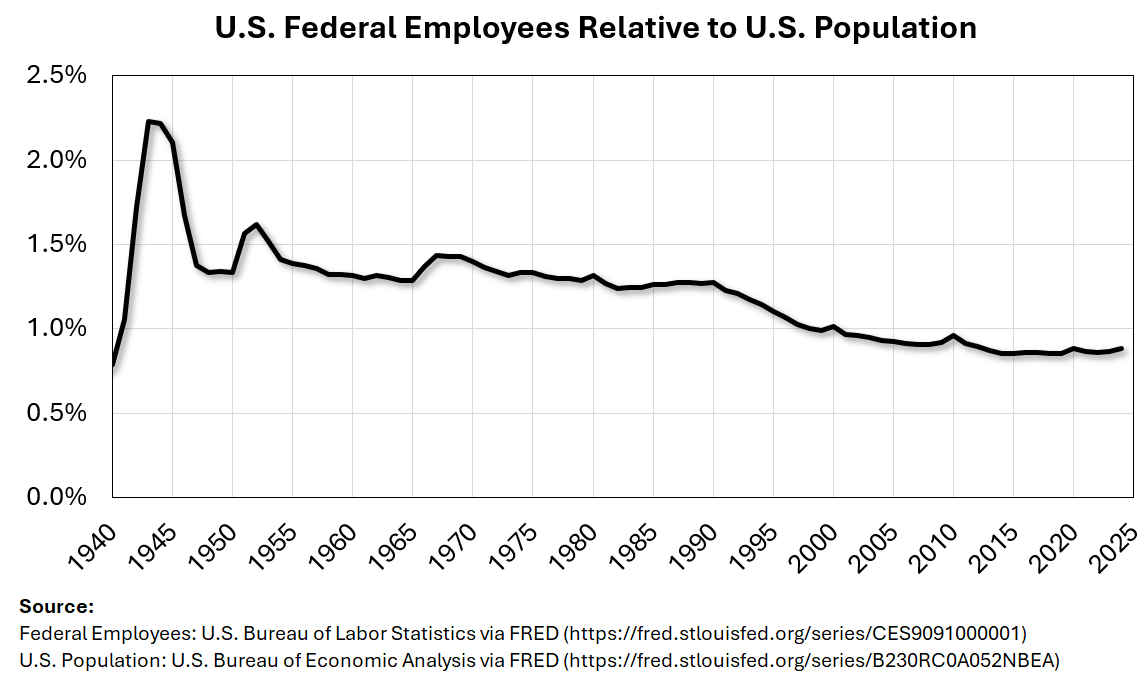
I dislike the starting date for this graph, why did you pick 1940? Why didn’t you start at 1900? Or 1950? You added world war 2 to the sample which makes everything else look like its decreasing but is an outlier because America was in a wartime economy.
imperialistt on
This is interesting info and definitely paints a different picture than that suggested by those saying the government is bloated. I feel like it would be interesting to compare this to a few other charts for example: Federal Spending as a % of GDP, federal employee wages/benefits expense as a % of GDP, and federal tax receipts as a % of GDP. The government clearly has a deficit problem, the question is that due to low revenue? Too many highly paid employees? Or too much spending on programs?
zeroscout on
Reduction of consumers in a supply-side economy
carc on
Now do the military budget
LinguisticsNerd42 on
It’s interesting seeing the little baby spikes in census years
Yay4sean on
Even though it’s true that there really aren’t that many federal employees, it’s undeniable that the US gov’t funds a lot of the work that is done privately. After all, the US spends about 25% of the annual GDP. But that can go many places and much of that is not necessarily *jobs.*
timbrelyn on
This is exactly what Dr. Heather Cox Richardson who is a writer and historian says. America is being gaslit. After they destroy every government agency they will say the government doesn’t work and that’s why the US needs a dictator with an authoritarian regime to run the country properly.
iamplasma on
I doubt this is nearly as meaningful as it appears, given the trend to move services from directly-employed staff to contractors over the years.
Even with expenses that aren’t directly purchasing services, using the military as an example where stupid amounts of the expenditure there is on equipment, in practice that is largely paying for employees across the entire supply chain.
PoliticalBoomer on
Last year the U.S. Federal government employed 2,735,000 people. That’s about 1 Federal employee for every 123 citizens, all departments, all locations, all units, all desks and cars, etc. In contrast, state and local governments in the U.S. employed 20,217,000 people, about 1 for every 17 citizens. (That’s 1 local or state employee for the 18 people who live on my block. And 1 for the next block. And the next. Etc. Let’s keep things in perspective.)
ElliottClive on
Would be good to see this plus state workforce, since the federal government also pays the states to implement a lot of of its policy. In order to truly be apples to apples, you would also need to include employment from organizations the federal government gives to implement programs. And that would need to be standardized over time so that you’re comparing the same thing over time.
TLDR; just because the federal government employment rate has been declining, doesn’t mean that other people aren’t being employed other places and paid by the federal government indirectly.
fogonthecoast on
Here’s % of gov’t employment as % of total employment for OECD countries – we’re in the bottom third:
Now compare that to national debt over that time. Crazy crazy stuff.
nrthrnstar404 on
Include the number of contract workers on the payroll and that graph will tell a different story.
naughtyshark79 on
The question isn’t whether they represent a large portion of the population or workforce, it’s the value of their contributions. Do we need these positions to keep our lives afloat? Will these positions determine whether I get my mail, my social security, or my tax refund? Will these positions reduce the likelihood that I will die in a plane crash, drink poison water, eat toxic foods, or be hospitalized because of a preventable or avoidable virus? Their purpose was to support the many, but I know that we have some fat to trim, but blanket ledger firings is not the way to go.

![[OC] US Federal Employees Relative to US Population](https://www.byteseu.com/wp-content/uploads/2025/02/jo0iuqakvsje1-1024x608.png "[OC] US Federal Employees Relative to US Population")
23 Comments
Nice. I’d love to see this but relative to US workforce.
I dislike the starting date for this graph, why did you pick 1940? Why didn’t you start at 1900? Or 1950? You added world war 2 to the sample which makes everything else look like its decreasing but is an outlier because America was in a wartime economy.
This is interesting info and definitely paints a different picture than that suggested by those saying the government is bloated. I feel like it would be interesting to compare this to a few other charts for example: Federal Spending as a % of GDP, federal employee wages/benefits expense as a % of GDP, and federal tax receipts as a % of GDP. The government clearly has a deficit problem, the question is that due to low revenue? Too many highly paid employees? Or too much spending on programs?
Reduction of consumers in a supply-side economy
Now do the military budget
It’s interesting seeing the little baby spikes in census years
Even though it’s true that there really aren’t that many federal employees, it’s undeniable that the US gov’t funds a lot of the work that is done privately. After all, the US spends about 25% of the annual GDP. But that can go many places and much of that is not necessarily *jobs.*
This is exactly what Dr. Heather Cox Richardson who is a writer and historian says. America is being gaslit. After they destroy every government agency they will say the government doesn’t work and that’s why the US needs a dictator with an authoritarian regime to run the country properly.
I doubt this is nearly as meaningful as it appears, given the trend to move services from directly-employed staff to contractors over the years.
Even with expenses that aren’t directly purchasing services, using the military as an example where stupid amounts of the expenditure there is on equipment, in practice that is largely paying for employees across the entire supply chain.
Last year the U.S. Federal government employed 2,735,000 people. That’s about 1 Federal employee for every 123 citizens, all departments, all locations, all units, all desks and cars, etc. In contrast, state and local governments in the U.S. employed 20,217,000 people, about 1 for every 17 citizens. (That’s 1 local or state employee for the 18 people who live on my block. And 1 for the next block. And the next. Etc. Let’s keep things in perspective.)
Would be good to see this plus state workforce, since the federal government also pays the states to implement a lot of of its policy. In order to truly be apples to apples, you would also need to include employment from organizations the federal government gives to implement programs. And that would need to be standardized over time so that you’re comparing the same thing over time.
TLDR; just because the federal government employment rate has been declining, doesn’t mean that other people aren’t being employed other places and paid by the federal government indirectly.
Here’s % of gov’t employment as % of total employment for OECD countries – we’re in the bottom third:
https://preview.redd.it/2rgsx3wu0tje1.png?width=801&format=png&auto=webp&s=1cb61c63a84e98d997d1f6b01dd165691873e21e
Lots of other data in this OECD report – [OECD – Size and composition of public employment](https://www.oecd.org/content/dam/oecd/en/publications/reports/2024/12/size-and-composition-of-public-employment-data-sources-methods-and-gaps_f6c2babd/32c747be-en.pdf)
1% doesn’t seem like a lot until you compare it to private companies.
3.3 million federal workers is more than the top 3 largest employers combined. Walmart (1.6m US citizens), Amazon (1.1m) and UPS (433k).
https://www.ringover.com/blog/largest-employers-us
Show us from the founding. I dare you.
Now compare that to national debt over that time. Crazy crazy stuff.
Include the number of contract workers on the payroll and that graph will tell a different story.
The question isn’t whether they represent a large portion of the population or workforce, it’s the value of their contributions. Do we need these positions to keep our lives afloat? Will these positions determine whether I get my mail, my social security, or my tax refund? Will these positions reduce the likelihood that I will die in a plane crash, drink poison water, eat toxic foods, or be hospitalized because of a preventable or avoidable virus? Their purpose was to support the many, but I know that we have some fat to trim, but blanket ledger firings is not the way to go.
Yeah we’ve been fucked up since WW2.
~Four out of every ten people who work for the U.S. government are private contractors, and that’s been [going up for decades](https://www.pogo.org/analysis/contractors-and-true-size-of-government).
For us to understand whether or not government is lean or bloated, requires that we look at all forms of government time/labor.
Did WWII soldiers count as Federal employees? Honest question.
Would be cool to compare this to other similar countries like Canada.
1990 started a slow decline. Any idea what took place around then that would have caused that? Gulf War maybe?
It just means that federal employees and our government have not as grown as fast as the population.