

At the heart of Europe’s rail network, a quiet revolution is brewing. While much attention is given to high-speed rail and new locomotives, the real engine of change might be the invisible signals and communications systems that keep everything running smoothly and safely. FRMCS is soon set to become that engine. And according to Carole Coune, Secretary General of the Association of European Rail Rolling Stock Lessors (AERRL), it’s vital for the future of rail in Europe.
AERRL, established in 2021, represents the nine-member companies that lease rolling stock across Europe. These lessors have invested heavily in the European rail sector, with current investments at 800 million euros annually and plans to increase that to 1 billion euros by 2027. As Coune explains, one of AERRL’s primary goals is to support the EU’s vision of a single, interoperable, and safe European railway area. This involves collaborating with other railway stakeholders and European institutions to overcome challenges and seize opportunities.
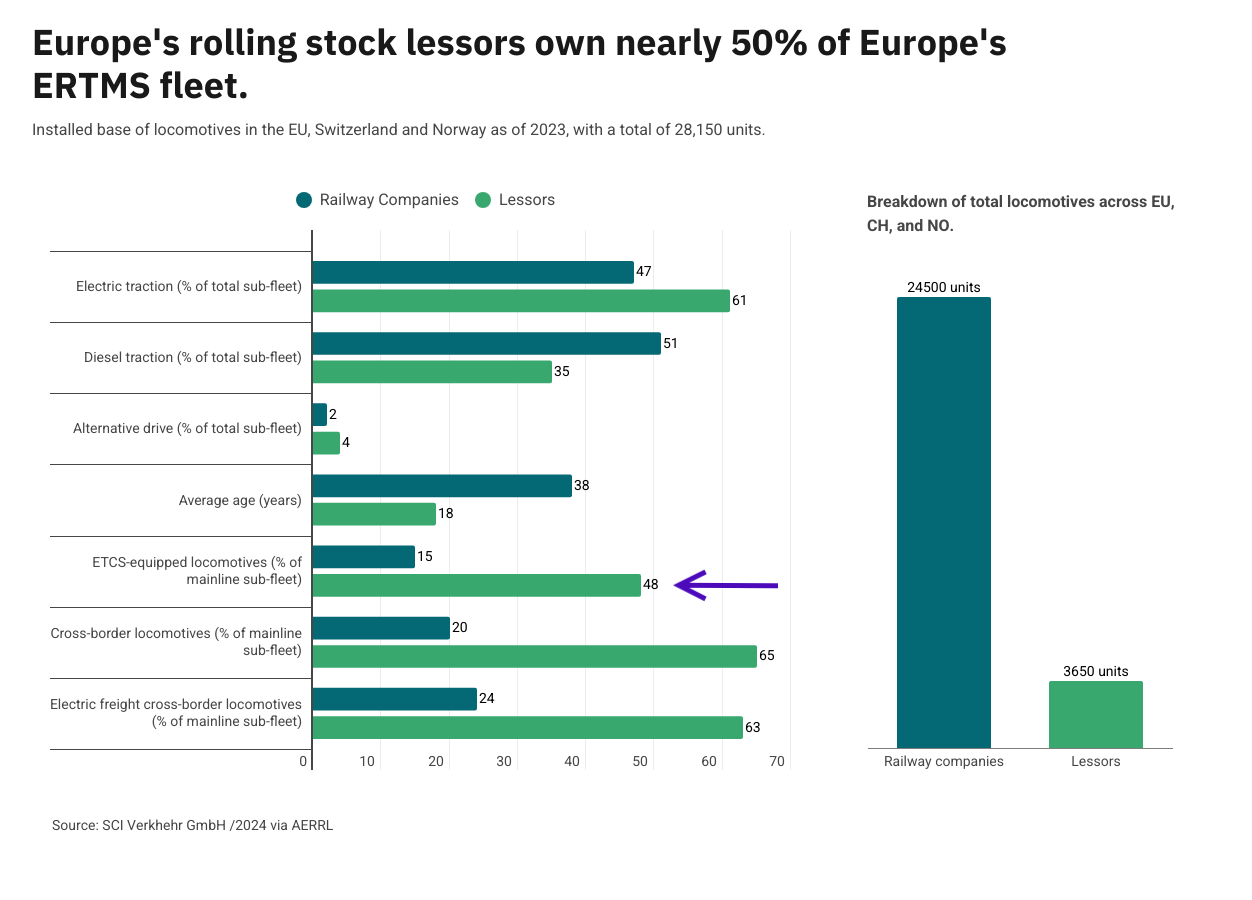 Europe’s rolling stock lessors own about 50 per cent of Europe’s ERTMS fleet. © RailTech
One of the most significant challenges facing the rail industry today is the transition to a harmonised European Rail Traffic Management System (ERTMS). AERRL is currently strongly advocating for the deployment of a single, standardised European Train Control System (ETCS) technology across Europe, specifically Baseline 3.4 (You can read our deep-dive into the issue below).
That’s in part because together they own about 50 per cent of the European ERTMS fleet. It’s no surprise then that they are aiming to avoid the current fragmented approach with different baselines and levels in various countries. But while a standardised ETCS rollout is crucial, the Future Railway Mobile Communication System (FRMCS), the successor to GSM-R, is where Coune says the future of rail is.
Luckily, these challenges and opportunities will be a key focus at our RailTech Belgium conference in March, where industry leaders, policymakers, and innovators will discuss the future of European rail, particularly the transition to the 5G-driven communication system. As digitalisation reshapes the sector, our summit will provide a crucial platform for exploring how FRMCS and other next-generation technologies can drive efficiency and interoperability across European rail networks. Find out more below and don’t forget to look out for our full video interview with Coune coming soon….

FRMCS: the future of rail
“FRMCS is a more advanced product than GSM-R,” Coune tells RailTech, referring to the current system used for train-to-ground communication. “GSM-R has been a wonderful technology, very stable for a long time, and having offered a lot of services. Now with FRMCS, the goal is to have the same success story but with even more reliability and functions.”
GSM-R (Global System for Mobile Communications – Railway) is the current main radio communication system used in European railways for driver-to-control centre communication, train signalling, and safety operations. As Coune states, it’s done a great job, and it has been a major step up for safety. However, it is based on increasingly outdated 2G technology, which is slow to handle modern data demands.
Indeed, telecom providers and rail networks are moving to phase out 2G-based systems, which is expected to happen over the next decade – especially as they lack the capacity to support major future rail innovations like autonomous trains and AI-driven monitoring. AERRL’s concern is that while GSM-R was a standardised and stable technology, it will soon gradually give way to newer technology, and there is a clear need for consistency in the transition between communication networks, as well as their ability to talk to existing ETCS technologies.

From GSM-R to FRMCS
To start with the older system, she highlights that the deployment of GSM-R is still not uniform across Europe. Most of Poland’s network, for instance, is not yet equipped with GSM-R; meanwhile, other countries are preparing to trade in the system to deploy FRMCS. For AERRL, the deployment of a standard technology throughout the European network is key. Therefore, for them, it’s either necessary to ensure a coordinated deployment of a single technology or to guarantee that locomotives can operate with both GSM-R and FRMCS. Basically, what they’re after is either uniformity or compatibility.
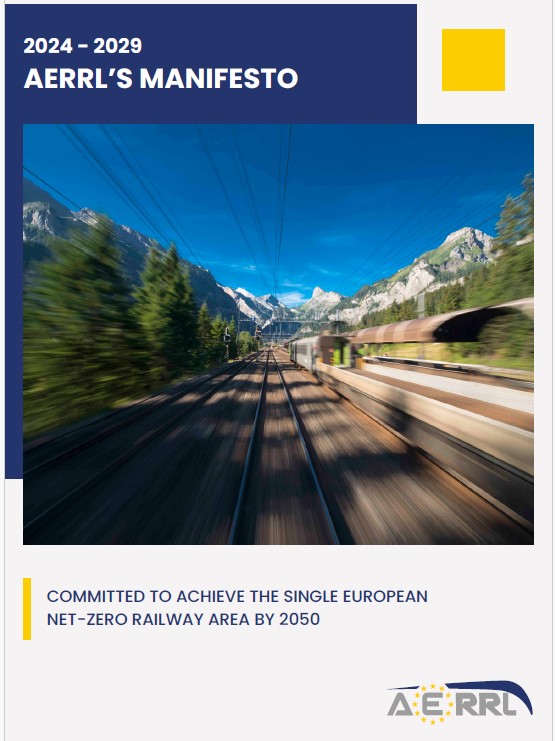 The AERRL Manifesto. © AERRL
The new 5G-based system provides faster, more secure, and data-rich communication, enabling better real-time video monitoring, predictive maintenance, and fully digital train operations. Germany is forging ahead with Deutsche Bahn testing FRMCS on key routes, including the Stuttgart Digital Node project. France has also begun trials, with SNCF integrating FRMCS into high-speed rail corridors, while Switzerland is piloting the system as part of its national railway modernisation.
The coming hurdles for going 5G
However, the transition to FRMCS comes with major challenges. Cost is obviously a big hurdle, as upgrading from GSM-R requires extensive infrastructure changes, including new radio towers, on-board equipment, and network integration. Beyond money, changing communication systems can disrupt daily rail operations, while trains running on legacy GSM-R networks could face compatibility issues.
All this requires careful coordination and testing to prevent safety risks and operational headaches. And just like ETCS, the FRMCS rollout is shaping up to look highly fragmented, as some countries aggressively pursue deployment while others lag way behind. All this puts AERRL and the EU’s goal of seamless interoperability at stake. That’s particularly the case now that the European Commission is allegedly pushing to terminate the EU’s dedicated investment mechanism for transport, Connecting Europe Facility (CEF), while at the same time indicating that future funding for rail projects, including FRMCS, may face uncertainties.

In the meantime, AERRL is calling for clear deadlines, cost estimates, and compatibility information to be made available on what the rollout of FRMCS will look like in Europe. “We don’t know yet exactly the cost,” Coune admits. “So the final specifications are not available yet, if I’m not wrong, so we think that we will need subsidies.” Essentially, because the costs, technical details, timing and standards have been unclear, and the implementation of FRMCS was not initially factored into existing budgets, EU financial support will be crucial to its success.
Separate ETCS and FRMCS rollout
And the lack of clarity is proving to be a significant concern for rolling stock lessors. “As long as you don’t have clear deadlines, you can’t plan, organise your investments,” Coune states. “And this is a problem for investors,” such as the rolling stock lessors.
Interestingly, while AERRL stresses the importance of FRMCS compatibility with ETCS, it still wants to implement the former separately from the latter to avoid expensive upgrades that would inevitably accompany each ETCS baseline update, thus delaying the rollout of FRMCS. The ETCS 3.4 baseline needs to be able to talk to both GSM-R and FRMCS, so it makes sense not to focus on updating the current ETCS when deploying FRMCS, but rather to provide an interface between BL 3.4 and FRMCS.
“Very, very clearly what we want is FRMCS implemented as soon as possible but independently of ETCS,” Coune asserts. “We want to be able to use FRMCS, but to prioritise ETCS Baseline 3, and in particular Baseline 3.4 because we think that it should really be the standard.”
A truly European product
Beyond practicalities, FRMCS is not just about technical upgrades; it’s about the future of European rail. Coune believes that the 5G-driven system could be a “wonderful example of European innovation and European technologies” that could be exported worldwide. But to achieve this, successful deployment in Europe is essential.
In the next five years, AERRL’s vision for European rail hinges on the successful and standardised deployment of ERTMS technology, with FRMCS playing a central role. The call for definitive timelines, detailed cost projections, and assured compatibility guidelines from the EU is not just a plea for administrative efficiency; it’s a call for the future-proofing of a vital transportation network. As Coune succinctly puts it, the key is “the deployment of a single standardised ERTMS technology.” With FRMCS soon to be part of its core, it’s essentially time to start approaching the technology more holistically.
With plenty of other panels and workshops on the hot topics of our sector, join us at RailTech Belgium 2025 to gain actionable insights, connect with industry leaders, and shape the future of rail in Belgium and beyond. Check out our conference programme and secure your spot today – registrations are now open!
Read more: