
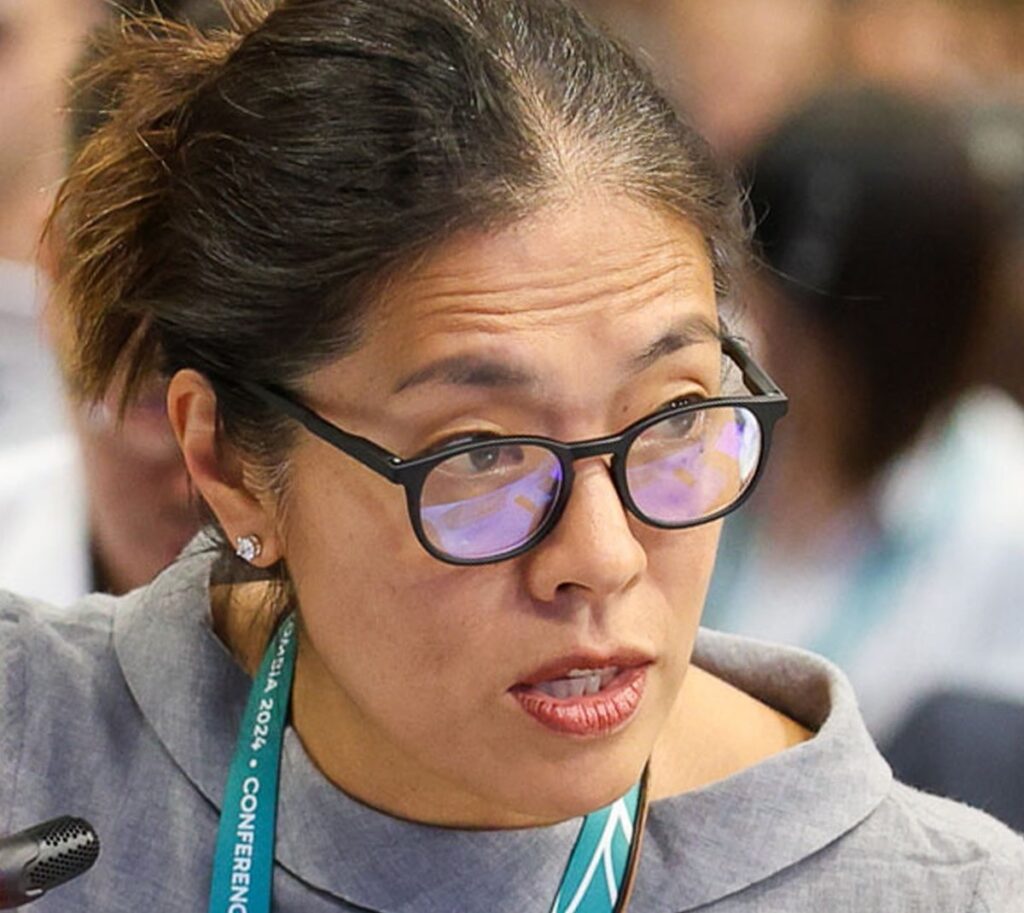
The United Nations Conference on Biodiversity, which ended without an agreement in Cali, Colombia, in October, resumes on February 25 at the UN Food and Agriculture Organization (FAO) headquarters in Rome, focusing once again on financial commitments to halt global biodiversity loss. Ambassador Maria Angelica Ikeda, director of the Department of Environment at the Brazilian Ministry of Foreign Affairs, who is heading the Brazilian delegation in Rome, expresses optimism.
“I believe that the countries which were held accountable for what happened are very concerned about this responsibility. I hope they come to the table with more openness,” she said.
Developed countries, particularly the European Union, Canada, and Japan, blocked the review of a text in Cali regarding resource mobilization for biodiversity. Agreements previously made in 2022 in Montreal involve wealthy countries mobilizing $20 billion annually by 2025 and reaching $30 billion by 2030 for conservation and sustainable development. Developing and megadiverse countries (argue that this goal is far from being met. Worse still, the necessary amount is significantly higher: at least $200 billion per year to prevent the destruction of nature.
Representatives from over 190 countries in Rome face the task of drafting a text proposing an assessment of existing funds, which are deemed insufficient or plagued by governance issues in the Global South. The goal is to agree on a clear timetable to create a financial mechanism dedicated to biodiversity, as stipulated in the Convention on Biological Diversity in 1992, but never realized.
The U.S. has not signed the Convention on Biological Diversity (CBD) and remains only an observer. Europe plays a significant role but is currently experiencing political turmoil and the ongoing war in Ukraine.
The Brazilian diplomat also hopes that “this COP will be democratic, adopting decisions by consensus, allowing everyone to participate in all necessary discussions.” She explains the concern: “We know that the Latin American and Caribbean region will have very few top diplomats in Rome, and meetings in Europe tend to have a greater concentration of European and developed country ambassadors, who find it easier to participate.” Read below edited excerpts from her interview with Valor:
Susana Muhamad informed us that she will preside over this reconvened session of the COP, COP 16.2. She will be there. (The former Colombian Minister for the Environment resigned two weeks ago amid a political crisis in the administration of President Gustavo Petro).
The contentious document is L.34, which was a draft decision reached in Cali on financial resource mobilization. We need to reach a decision and make adjustments, even though the draft, in my opinion, is perfect. It was what developing countries wanted.
In the last plenary session in Cali, on the morning of Saturday, November 1, after adopting several decisions overnight, including historic ones–such as the declaration on the contribution of Afro-descendant peoples to biodiversity conservation and the creation of a subsidiary body for indigenous peoples and local communities with relevant traditional knowledge for biodiversity conservation and sustainable use– unfortunately, when we were reviewing document L.34, a draft decision on financing biodiversity activities, some developed countries opposed adopting the decision. We were caught off guard because we had been negotiating this decision and had lengthy discussions between COP 15 and COP 16 on financing. Despite our efforts to negotiate something that could gain the consensus of the parties, unfortunately, these countries not only refused to adopt the decision but also did not point out at that time what the issues with the text were.
Then, after the issue arose, the Panamanian delegation requested a quorum count and found that there was no quorum to continue the meeting. Susana Mohamed, then Colombia’s Minister of Environment, suspended the session, which will be reconvened in Rome today.
Where does the session restart?
Our expectation is that the meeting will begin from the agenda point at which it was suspended. From the informal consultations conducted by Minister Mohamed in December, it became clear that the problems for the developed countries are paragraphs 19 to 25 and annex 2 of the draft. They would like to make some changes.
Paragraph 19 is where the decision to establish a financial instrument within the Convention on Biological Diversity is outlined. It also proposes establishing a process for the periods between the upcoming COPs on structuring this financial instrument, which would not necessarily be a specific fund.
In informal discussions with some developed countries, we have been outlining a kind of organizational chart of funds. We would see the future of the fund established by the Kunming-Montreal Global Framework, called GBF. What would be the future of the Cali Fund, the specific one that will receive resources from the use of digital sequence information (DSI), created in Cali, which has a different type of funding source? And also the GEF, the Global Environment Fund, which has been the provisional financing mechanism of the Convention on Biological Diversity, the CBD, since the 1990s.
We have never established the financial mechanism provided for by the convention since the 1990s. The GEF, which is the Global Environment Fund, is an interim mechanism of the CBD. It is not entirely bad, but there are deficiencies. We have to compete for funds for other environmental purposes when we would prefer to have something dedicated specifically to biodiversity conservation. Because biodiversity loss is an urgent crisis we need to address.
Now, what is the final financial architecture? We do not have a predefined result. Brazil wants to engage in this collective process starting from the end of COP 16.2 in Rome. Where all of us will participate to analyze all the funds we already have, how much they are financing, what their problems and virtues are, and thus we can design the financial mechanism responsible for the CBD. We have nothing against the GEF. We want institutions where developing countries, especially mega-diverse ones like Brazil, have greater decision-making power.
I would like to highlight that the GEF Council, which makes decisions on projects to be funded for various environmental areas–biodiversity, climate, mercury, chemicals–has seats occupied by only one developed country, for example, the US, Germany, or Japan, and seats shared by several developing countries. So, 20 Pacific islands share a seat. Brazil shares a seat with Colombia and Ecuador–three Amazonian and megadiverse countries, and we have to rotate among ourselves. There are 54 African countries sharing some seats.
This is wrong and does not signify equal decision-making power. The physical number of seats may be similar, but the underrepresentation of this vast group of developing countries is obvious.
That’s why President Lula’s government is raising the issue of reforming the global governance of international institutions in forums like the G20. We must makes the Bretton Woods system more equitable and fair so that the Global South can have a better-represented voice. We want greater decision-making power.
When a project is rejected at the GEF, the reasons are often unclear. So, if we are there making decisions, perhaps we can better influence these processes.
When Brazil advocates for a multilateral fund, whether in the CBD or in negotiations over the plastic pollution agreement, we do so because we are a very supportive developing country with other nations, especially those with relatively less development and small island developing states. We know that large developing countries like Brazil, India, and China can attract significant environmental funding due to their capacity to formulate projects, with larger teams and more experience. Many smaller countries facing serious problems like internal violence, civil war, and poverty are not as well-equipped to attract environmental funding. We understand that in a multilateral fund, as they say in English, everyone has a chance.
From what we perceive, developed countries have issues with the decision to establish this financial instrument. What we want is to co-write these decisions with the developed countries. We need to have a roadmap, a completely clear path, and to have this promise fulfilled in the end: that after this analysis, with clear criteria, we will have a result that is, finally, the establishment of the financial mechanism we have been awaiting for over 30 years. We cannot fall into a roadmap that does not lead us to a goal. We may spend possibly another four years conducting this analysis and having discussions, but there must be a direction.
We cannot be quote, unquote, deceived again. This happened at COP 15 in Montreal when we decided to create the fund, the GBF for the Global Framework, where very ambiguous language was adopted. Developing countries understood that there was room, for example, for the COP to have authority over the GBF, and later discovered that no, everything would be decided by this extremely unequal GEF council structure. We no longer want this kind of “constructive ambiguity,” as developed countries say. We want a clear decision, a clear roadmap, to achieve a clear result, which, as President Susana Muhamad says, really closes the financial gap, that is, to close and fill this funding gap so that biodiversity is finally at the center of attention.
In the case of the GBFF, we had a financing target for the Global Framework by 2025, and by 2030, to be filled by various sources, but a portion should be filled by developed countries.
What we notice in the promises for the GBF fund falls far short of those targets. What developed countries promised to fund, for example, during this year, does not even reach 1% or 2% of what would be the public financing target of developed countries for the implementation of the Global Framework.
The common response is: we don’t just put money into this multilateral fund. We also engage in bilateral funding. Very well.
So let’s analyze bilateral funding, already somewhat skeptical that it would finance 98% to 99% of this target, as we notice the percentage is very low. The problem with bilateral funding is that it is often unclear whether it is a donation if it is official development assistance, or on what basis it is being granted. Worse yet, double counting often occurs.
For instance, if I finance an action for forest conservation, it is often something beneficial for combating climate change because we are conserving carbon stock, and it also counts as biodiversity conservation because by preserving the tropical forest, we are conserving its biodiversity. So, to which goal will this project be attributed? For climate financing objectives or the Global Framework for Biodiversity target? This is never clear to us.