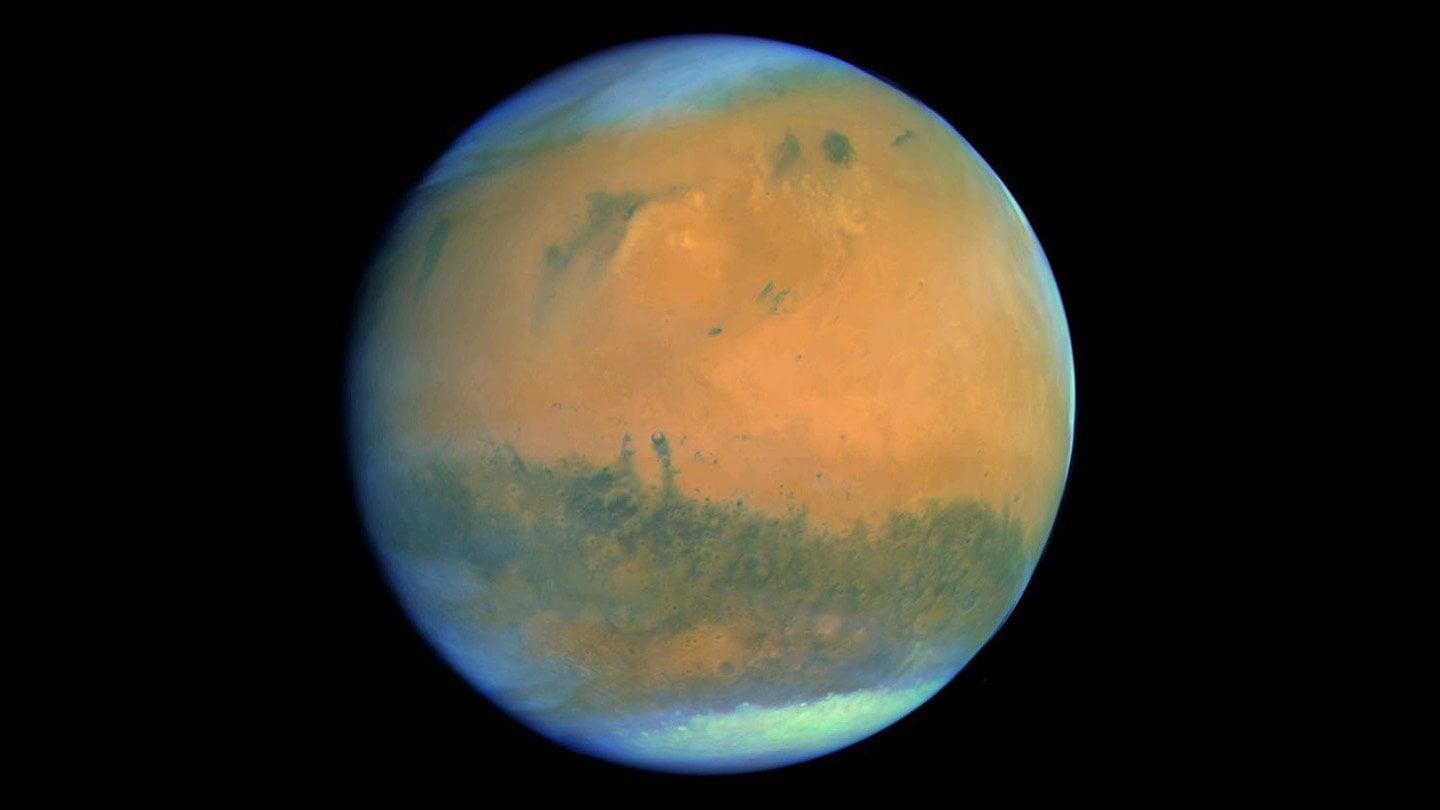
>Frigid water helped paint Mars red and may have shaped a vast coastline, two new studies into the planet’s history reveal.
>Scientists have detected a possible ancient beach in Mars’ northern hemisphere and identified a water-containing mineral responsible for the planet’s rosy hue. The findings reveal details about conditions on Mars when the planet last contained large volumes of liquid water more than 3 billion years ago.
>“Early Mars has historically been thought of as either ‘cold and dry’ or ‘warm and wet,’” says Alberto Fairén, an astrobiologist at the Center for Astrobiology in Madrid and at Cornell University who was not involved in the new work. “The two new studies, together, resolve the second part of the equation: Early Mars was wet; it was never dry.”
I feel the need to mention that mars didn’t neccesairly need to have a similar water cycle to us. Mars, especially in its early days, could likely have been far colder than earth. However, through, say, high pressure from the Martian ice caps and geothermal heat being reflected back into the lower ice cap, water could be liquidated where it would then flow to the equator, refreeze, sublimate, and then redeposit on the polar ice.
beeblebroxide on
I am so stoked about all the new stuff we’re learning, this is so much fun.

3 Comments
>Frigid water helped paint Mars red and may have shaped a vast coastline, two new studies into the planet’s history reveal.
>Scientists have detected a possible ancient beach in Mars’ northern hemisphere and identified a water-containing mineral responsible for the planet’s rosy hue. The findings reveal details about conditions on Mars when the planet last contained large volumes of liquid water more than 3 billion years ago.
>“Early Mars has historically been thought of as either ‘cold and dry’ or ‘warm and wet,’” says Alberto Fairén, an astrobiologist at the Center for Astrobiology in Madrid and at Cornell University who was not involved in the new work. “The two new studies, together, resolve the second part of the equation: Early Mars was wet; it was never dry.”
[Read more here](https://www.sciencenews.org/article/ancient-mars-wet-cold-planet), and read the [Feb. 24 research article here](https://www.pnas.org/cgi/doi/10.1073/pnas.2422213122) and [the Feb. 25 article here. ](http://dx.doi.org/10.1038/s41467-025-56970-z)
I feel the need to mention that mars didn’t neccesairly need to have a similar water cycle to us. Mars, especially in its early days, could likely have been far colder than earth. However, through, say, high pressure from the Martian ice caps and geothermal heat being reflected back into the lower ice cap, water could be liquidated where it would then flow to the equator, refreeze, sublimate, and then redeposit on the polar ice.
I am so stoked about all the new stuff we’re learning, this is so much fun.