
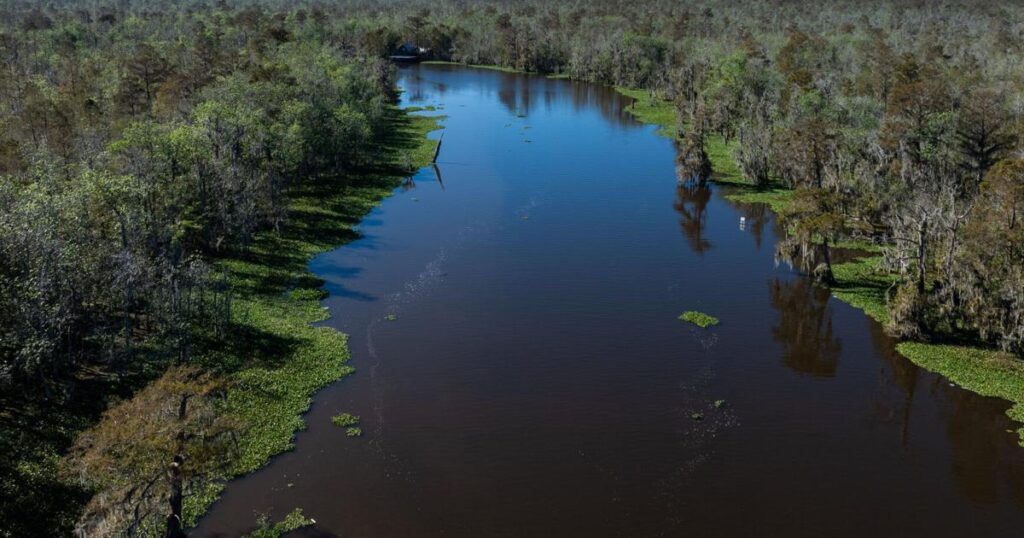
An environmental group has filed a lawsuit against Louisiana’s state government alleging it violated the law when it authorized a chemical manufacturing facility to construct a CO2 pipeline through the Maurepas Swamp, one of the largest forested wetlands in the nation.
Healthy Gulf, representing plaintiffs who use the swamp for fishing and other recreation, wants a state judge in Baton Rouge to cancel agreements with Air Products, a company building a hydrogen manufacturing complex in Ascension Parish.
To offset emissions, Air Products plans to store millions of tons of carbon dioxide deep under Lake Maurepas via a 40-mile-long pipeline stretching from the facility through the Maurepas Swamp, snaking through Ascension, St. James and St. John the Baptist parishes. The Louisiana Department of Wildlife and Fisheries (LDWF) and the Department of Energy and Natural Resources (DENR) approved the company’s requests for the pipeline and carbon storage in the publicly owned swamp and adjacent lake.
But Healthy Gulf, represented by the legal nonprofit Earthjustice, says these agreements violate laws meant to protect wildlife management areas from industrial development. The advocacy group filed the suit Monday in the 19th Judicial District Court.
“It doesn’t make sense to industrialize an area that’s only for fishing and wildlife,” said Scott Eustis, community science director for Healthy Gulf.
LDWF did not respond to requests for comment. DENR said the agency does not comment on pending litigation. In the wildlife agency’s approval of the pipeline last year, LDWF cited a law that allows the state to lease land for carbon storage.
A spokesperson for Air Products said the proposed pipeline will comply with all laws, regulations and donation conditions within the wildlife management area. The company is required to mitigate any environmental impacts from the pipeline, the company noted.
“Our pipeline route predominantly follows an existing pipeline corridor in the WMA and was developed after extensive consultation with state and federal agencies, including the Louisiana Department of Wildlife and Fisheries, the Office of Coastal Management and the U.S. Army Corps of Engineers,” spokesperson Christina Stephens said.
The heart of the case is four publicly owned tracts of land that make up the Maurepas Swamp Wildlife Management Area. When the state acquired the land, there were stipulations that the area would be used for conservation and public recreation, Healthy Gulf alleges.
For instance, the donation of one of the tracts prohibits commercial, industrial, agricultural use “or any other activity inconsistent with preserving the property’s natural state, flora, fauna and/or wetland ecological character,” the suit says. State law forbids breaching the terms of donations involving wildlife management areas.

A bald eagle perches in a tree above the Blind River in the Maurepas Swamp on Friday, November 15, 2024 in Gramercy, Louisiana.
STAFF PHOTO BY MICHAEL JOHNSON
The state agencies lacked the authority to approve the pipeline and storage agreement, Healthy Gulf alleges.
“The state’s approval of this pipeline flies in the face of why this land was set aside for wildlife management, conservation, and preservation and undermines the state’s credibility,” said Lauren Godshall, an attorney at Earthjustice.
CO2 pipelines spark worry
This lawsuit follows years of pushback over the proposed carbon storage project. After Air Products announced the plan in 2021, residents of Livingston, Ascension, Tangipahoa and other parishes expressed concerns over safety and public transparency. Some fishers and crabbers pulled traps from Lake Maurepas ahead of Air Products’ carbon storage testing in 2022.
Healthy Gulf’s Eustis regularly swims, hikes and canoes in the swamp. He’s concerned about the dangers that a ruptured CO2 pipeline could wreak on people miles from the pipeline itself, such as canoers on a day-long trek or groups searching for springtime irises far from an accessible road. In 2020, a CO2 pipeline ruptured in Satartia, Mississippi, causing hundreds to evacuate and hospitalizing dozens in the area.
The Our Lady of the Swamp Church sits along the Blind River in the Maurepas Swamp on Friday, November 15, 2024 in Gramercy, Louisiana.
STAFF PHOTO BY MICHAEL JOHNSON
The Maurepas Swamp is separately set to see an ecological revival through a diversion project that recently broke ground, which will reconnect the Mississippi River to the swamp after more than 80 years of separation. This project will resuscitate the cypress-tupelo swamp and encourage wildlife to return to a spot that was once a popular area for hunting and fishing.
“The idea of ramming another pipeline through this area is just more damage, more disease in a way,” said Richard Waller, a photographer who has catalogued the decline of the swamp ecosystem for years.