
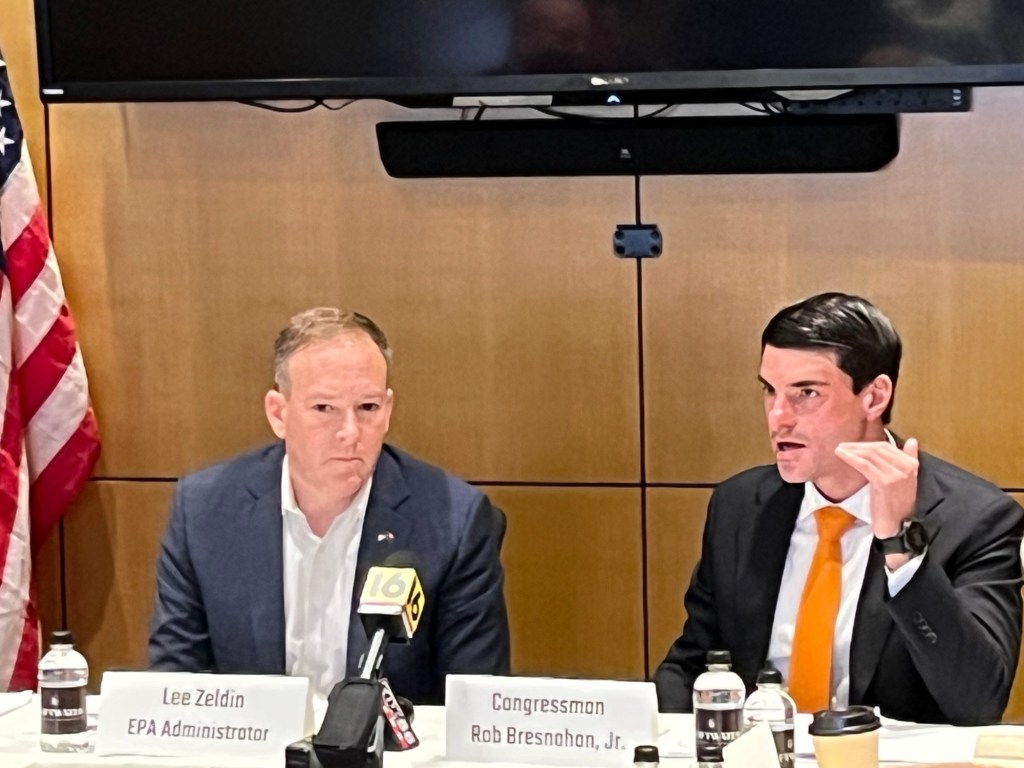
SWIFTWATER — A roundtable discussion in Monroe County on Sunday afternoon — centered on environmental concerns in the region — brought lawmakers and industry officials together to share thoughts and collaborate on ways to make improvements.
U.S. Rep. Rob Bresnahan, R-8, Dallas Twp., and U.S. Environmental Protection Agency Administrator Lee Zeldin led the program, which touched on a variety of issues, including the Delaware River basin and stormwater management.
Natural gas drilling reform was a hot-button topic among lawmakers and officials.
John Augustine, president/CEO of Penn’s Northeast, a regional economic development agency, who also served as community outreach manager for the Marcellus Shale Coalition for eight years, noted the region has the resources in place to harvest natural gas.
“We have the energy in the ground — it’s sitting there in the Marcellus — it’s just a matter of getting it out,” he said. “The problem is a lot of the regulations.”
The Delaware River Basin Commission voted in February 2021 to permanently ban natural gas drilling and fracking in the watershed, according to the Associated Press. The ban impacts Wayne and Pike counties.
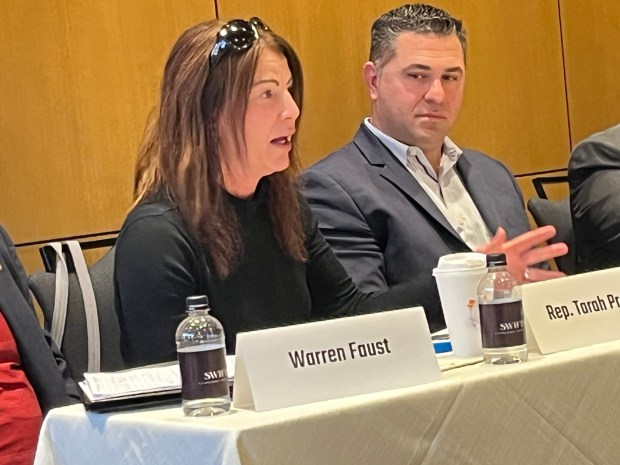 State Rep. Tarah Probst, D-189, Stroudsburg, provides remarks during an environmental roundtable Sunday afternoon at The Swiftwater in Monroe County. (ROBERT TOMKAVAGE/STAFF PHOTO)
Curt Coccodrilli, a senior adviser for the U.S. Department of Energy and a Wayne County landowner, also called for drilling in the region.
“To have seven layers of commercially viable shale under your feet right now and you can’t harvest them is a travesty,” he said. “A lot of our landowners feel like second-class citizens. It’s time to change that as best and as safely as we can.”
Bresnahan outlined the significant economic impact that drilling would bring to Northeast Pennsylvania communities.
“The ability to harvest natural gas right in our backyard would lead to almost a billion-dollar industry that would allow us to reinvest in our schools and public roads and recreation activities,” he said.
Zeldin also highlighted the potential employment benefits related to natural gas extraction.
“There are so many jobs to be had for this region if we’re putting more pipeline into the ground,” he said. “If we’re all understanding this is something we need more of to plan for America’s future, we should be doing more of it.”
On a separate issue, state Rep. Brenda Pugh, R-120, Dallas Twp., expressed her disapproval about inconsistencies regarding stormwater management fees.
“All of our residents are being taxed for it, but you have people north of us and south of us that aren’t doing it and don’t have to do it,” Pugh said. “Our residents are bearing the burden of following this federal order. If you look at the map of who is actually participating, it’s a very small section in the middle northeast section of our state. I want clean air and clean water just like everybody else, but I think we can do it in a much bigger way. It’s not fair the way it’s set up. It can’t just be a handful of people paying the bill.”
Zeldin stressed the importance of weighing a variety of factors before making final judgments on environmental issues.
“There are going to be a lot of decisions to make over the coming weeks and months to make sure we have the right policy to help unleash energy dominance,” he said. “We want to be smart about any regulations coming out of the federal government. Even if you’re an agency like the EPA where your core mission is protecting human health and the environment, you can’t be out of touch with the concerns across America about the state of this economy. We have some historic laws on the books that get celebrated on both sides of the aisle — the Clean Water Act, Safe Drinking Water Act and Clean Air Act — but they have to be applied the right way.”