
Strip Harold Pinter’s 1978 “Betrayal” down to the basics, and it’s a rather mundane tale of marital infidelity among upper-middle-class Brits. But factor in the mostly reverse chronological structure and an autobiographical backstory, and the 75-minute drama becomes a bit more tantalizing. Then add a contemporary female director’s fillip and an all-star cast, and you have a sure-fire box office hit: the Goodman Theatre production.
Most likely inspired by Pinter’s affair with television journalist Joan Bakewell from 1962 to 1969, when both of them were married to other people and had children, “Betrayal” chronicles the relationship between literary agent Jerry and gallery owner Emma, the wife of his one-time best friend (and best man at his wedding), Robert, a book publisher.
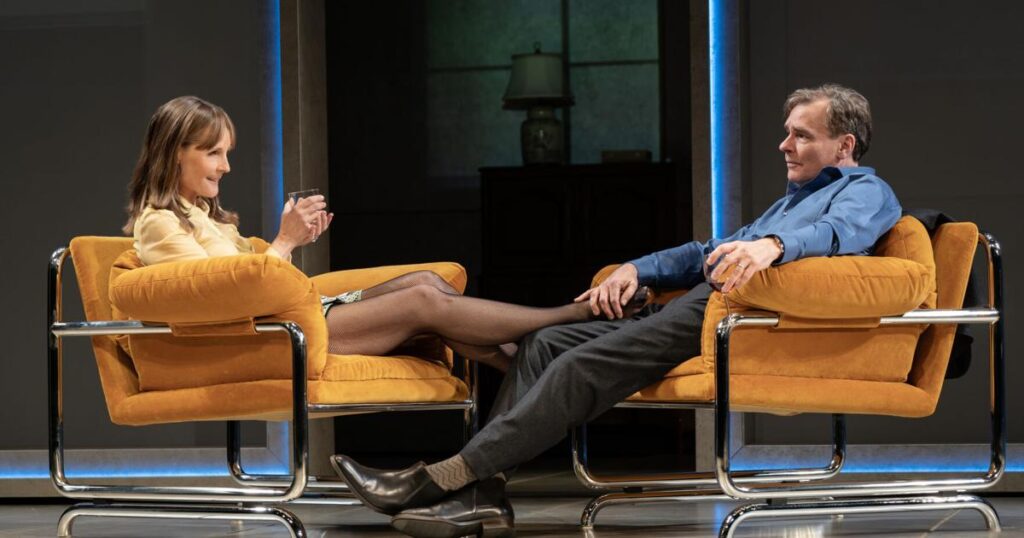
In a casting coup for director Susan V. Booth, they’re played by Tony Award-winner Robert Sean Leonard (“House,” “Dead Poets Society”), Oscar- and Emmy Award-winner Helen Hunt (“As Good As It Gets,” “Mad About You”) and Tony Award-nominee and Steppenwolf Theatre ensemble member Ian Barford, who is Robert here but was Jerry in the 2007 Steppenwolf production (with Tracy Letts and Amy Morton).
The action unfolds in nine scenes beginning in the Spring of 1977, about two years after Emma and Jerry’s seven-year-long extramarital affair has ended. At her request, they meet in a pub and, after a lot of awkward attempts at catching up and inquiries about each other’s families, friends and well-being, the main reason emerges. Emma and Robert are about to split up, and she’s distraught because she’s learned that he’s been unfaithful to her with other women for years.
Soon the web of lies, deceit and betrayal underlying what these three have told each other and themselves begins to unravel. Jerry’s sympathy for Emma takes a back seat to his need to know how much Robert knows about their affair, and Emma admits that, in their all-night discussion, she had to tell her husband everything.
But this isn’t true. In the second scene, which takes place at Jerry’s house a short time later, he’s asked Robert to come over. Jerry is very upset about the situation, but Robert acts like it doesn’t matter because it’s all in the past, and anyway he’s known about it for four years. This bombshell, as far as Jerry is concerned, unleashes a flood of doubts about their friendship, which Jerry thought was solid, though Robert reminds him that, for all their lunches together, they’ve never played squash.
As the mostly two-person scenes (replete with Pinteresque pauses) move backward in time, we see Jerry and Emma in 1975 break up and give up the flat they took together for their afternoon trysts, a crucial falling-out between Emma and Robert in Venice in 1973, the follow-up lunch between Robert and Jerry the same summer (with Nico Grelli providing comic relief as the waiter), Jerry and Emma’s attempts in 1971 to make the flat a home and, finally, their meeting at a party at Robert and Emma’s house in 1968.
The key change Booth has made is to age the characters. When the play begins in 1977, Pinter’s stage directions list Jerry and Robert as 40 and Emma as 38, so by the end in 1968, they are barely out of their 20s. At Goodman, the actors are roughly two decades older.
For most of the play, this makes the stakes higher. The characters’ dissatisfaction with their lives rings truer because the possibilities for change are becoming narrower. When Robert rants about his hatred for the modern novel, it’s easy to believe him, even though we know something else is on his mind. The lack of passion that pervades Jerry and Emma’s afternoon meetings seems real if we view them as older rather than in their prime. Responsibilities weigh heavily on everyone.
The catch is that the last scene doesn’t work. The drunken Jerry’s attempts at seducing Emma by declaring he should have “had” her in her “white” wedding dress before her wedding and then professing his passion: “I’m crazy about you. Can’t you see? These words I’m using, they’ve never been said before,” might be merely laughable in a man of 30, but in one who is about 50, they’re creepy stalker talk that would make any sensible woman cringe.
The truth is that these are very unhappy characters and not at all likable. Barford’s brilliantly acted Robert is a manipulative, mean-spirited piece of work who seethes with sarcasm that his victim Jerry doesn’t even understand, though his wife Emma, whom he admits to hitting a few times, certainly does.
The play is as much — or more — about the ruin of the men’s friendship than the love affair, and Leonard’s Jerry is the comparative innocent. He always seems uneasy and fidgets restlessly, often not knowing how to react to Robert, who is higher up in the publishing hierarchy. Even when he’s talking about his unseen doctor-wife Judith, he seems uncomfortable.
Hunt’s Emma comes across as cool as a cucumber. Even at her most open, in the early days of the affair, she’s surprisingly unemotional, guarded and never really lets loose.
One of the techniques Pinter uses is to introduce key images that keep cropping up throughout the play with different nuances. These include Jerry’s memory of tossing Emma and Robert’s daughter in the air when she was a toddler, details about the lover’s flat like the lace tablecloth Emma bought for it in Venice and anecdotes about a writer named Casey who may or may not be Emma’s current lover.
Neil Patel’s set design gives visual expression to these memories with opaque moving screens bearing Rasean Davonte Johnson’s grainy projections presumably of scenes from the characters’ lives (though some of them could be clearer). In the background are suggestions of the lovers’ flat with a central bed upstage, while downstage are a couple of period orange armchairs and a table. Xavier Pierce’s lighting casts a fuzzy glow, while Rob Milburn and Michael Bodeen’s music creates the mood. Linda Roethke’s costumes show the shifts in time and the characters’ ages with subtlety.
“Betrayal,” which already has been extended twice, is definitely worth seeing for its complexity and the cast. Just don’t expect too much.