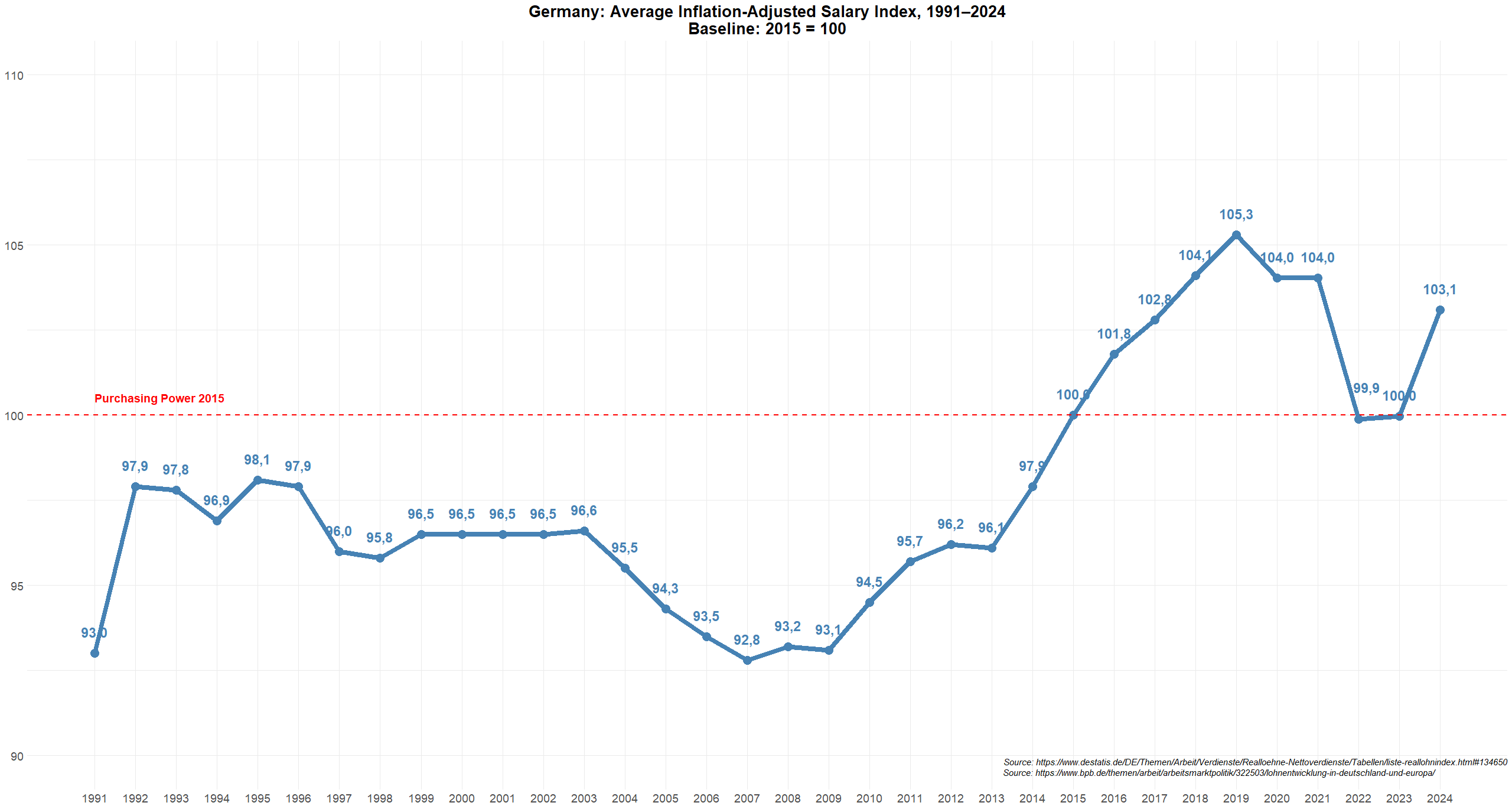
To my knowledge this is the only plot on the internet that consolidates these two datasets and provides a wholistic overview of how salaries have changed since 1991 (which is slightly past the reunification tbf). Overall, purchasing power is significantly up and the 3,1 % real wage gain in 2024 is the second largest on record. Unlike the US, Germany did suffer significant purchasing power losses in 2022 but the country is on track to recovery.
ledankmememaster on
Interesting. It seems like everybody in my immediate surroundings would agree, the days between 2006-2010 were „peak“ Germany. Obviously mostly based on nostalgia around the worldcup, but also our cars were the best, „made in Germany“ was a thing, popculture was interesting to say the least, also those were the days before the internet really popped off here and everyone was agitated all the time. Where a whole generation came up in the reunited Germany.
Apparently, at least by this indicator, this was the lowest point in terms of our relative average income. For sure there are more accurate correlations, but I feel like maybe there is some reason to believe buying power isn’t the only factor in happiness.
ThinNeighborhood2276 on
Interesting visualization! How do the trends compare between East and West Germany?
Zagrebian on
Does this mean that real salaries increased by only 10 or so percent in the past 35 years? That sounds unbelievable.
Fancy-Plankton9800 on
This is what happens when you lockdown.
pannous on
what these charts don’t reflect is that the things people can buy today would’ve been completely unaffordable back then. Famously the iPhone is worth a super computer of over $1 million from the last century but also televisions you can get for a few bucks now would’ve been some thousand dollars, even the most basic cars today would’ve been super expensive luxury cars etc.

![[OC] Germany: Inflation-Adjusted Salaries Since Reunification](https://www.byteseu.com/wp-content/uploads/2025/03/8588jy6dkime1-1536x821.png "[OC] Germany: Inflation-Adjusted Salaries Since Reunification")
6 Comments
Tool: R (ggplot2)
Sources:
1. [https://www.destatis.de/DE/Themen/Arbeit/Verdienste/Realloehne-Nettoverdienste/Tabellen/liste-reallohnindex.html#134650](https://www.destatis.de/DE/Themen/Arbeit/Verdienste/Realloehne-Nettoverdienste/Tabellen/liste-reallohnindex.html#134650)
2. [https://www.bpb.de/themen/arbeit/arbeitsmarktpolitik/322503/lohnentwicklung-in-deutschland-und-europa/](https://www.bpb.de/themen/arbeit/arbeitsmarktpolitik/322503/lohnentwicklung-in-deutschland-und-europa/)
To my knowledge this is the only plot on the internet that consolidates these two datasets and provides a wholistic overview of how salaries have changed since 1991 (which is slightly past the reunification tbf). Overall, purchasing power is significantly up and the 3,1 % real wage gain in 2024 is the second largest on record. Unlike the US, Germany did suffer significant purchasing power losses in 2022 but the country is on track to recovery.
Interesting. It seems like everybody in my immediate surroundings would agree, the days between 2006-2010 were „peak“ Germany. Obviously mostly based on nostalgia around the worldcup, but also our cars were the best, „made in Germany“ was a thing, popculture was interesting to say the least, also those were the days before the internet really popped off here and everyone was agitated all the time. Where a whole generation came up in the reunited Germany.
Apparently, at least by this indicator, this was the lowest point in terms of our relative average income. For sure there are more accurate correlations, but I feel like maybe there is some reason to believe buying power isn’t the only factor in happiness.
Interesting visualization! How do the trends compare between East and West Germany?
Does this mean that real salaries increased by only 10 or so percent in the past 35 years? That sounds unbelievable.
This is what happens when you lockdown.
what these charts don’t reflect is that the things people can buy today would’ve been completely unaffordable back then. Famously the iPhone is worth a super computer of over $1 million from the last century but also televisions you can get for a few bucks now would’ve been some thousand dollars, even the most basic cars today would’ve been super expensive luxury cars etc.