

“Rugove” spring water is regularly tested in the laboratories of the National Institute of Public Health of Kosovo (NIPHK) and “no bacteria harmful to the health of consumers have ever been found in it,” says Ergyl Binçe, director of the Water and Food Analysis Laboratories at this institution.
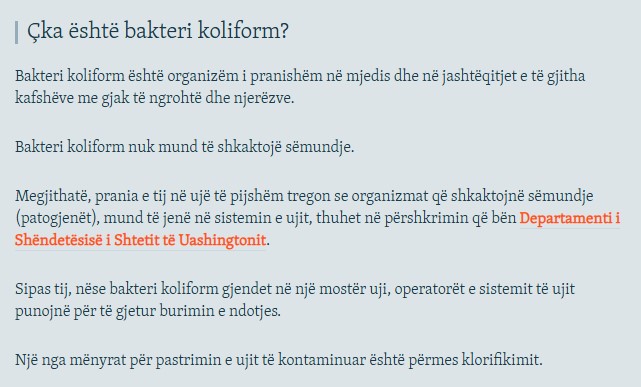
Radio Free Europe made his statement a day after the Food and Veterinary Agency of North Macedonia announced that it is inspecting all shipments of spring water from Kosovo, after, as it said, some previous analyses revealed the presence of coliform bacteria in a water sample.
Certain media outlets in this country published the agency’s decision, according to which it concerns “Rugove” water samples.
This Kosovo company confirmed to Radio Free Europe that its product is in order and that sales in the neighboring country are continuing.
The Kosovo Food and Veterinary Agency did not respond to questions regarding the concern raised by its counterpart agency in North Macedonia.
Similarly, the Sanitary Inspectorate, which operates within the Ministry of Health and is responsible, among other things, for certifying the quality of bottled water in Kosovo, did not respond.
What does the National Institute of Public Health say?
Binçe confirms that the company that produces “Rugove” water constantly conducts analyses at the National Institute of Public Health – “even for the stocks it exports abroad.”
He believes that the remarks made by the competent authorities of North Macedonia regarding the “presence of coliform bacteria” in the “Rugove” bottled water are unfounded.
“We have never found this bacteria they mention, not only in ‘Rugove’ water, but in any [bottled water from other Kosovar companies],” says Binçe.
He adds that it is important for the Kosovo Food and Veterinary Agency to take a more active role, by going to North Macedonia and independently verifying the source of the problem.
Water expert at the National Institute of Water Resources and Environmental Protection, Burbuqe Nushi-Latifi, expresses surprise at the findings of her Macedonian colleagues.
According to her, it could be “human error in the laboratory or in diagnostics.”
“During [water] processing, unwashed hands can carry [the bacteria]… just one colony, two, three or four. Then, they develop in the water, because water is vital not only for humans, but also for bacteria,” says Nushi-Latifi.
According to data from the Public Procurement Bureau of North Macedonia, there are 23 institutions in this country that, through a local company, are supplied with “Rugove” water.
Some of these institutions – such as the Ministry of Public Administration – confirmed in Skopje that they have consumed and continue to consume “Rugove” water.