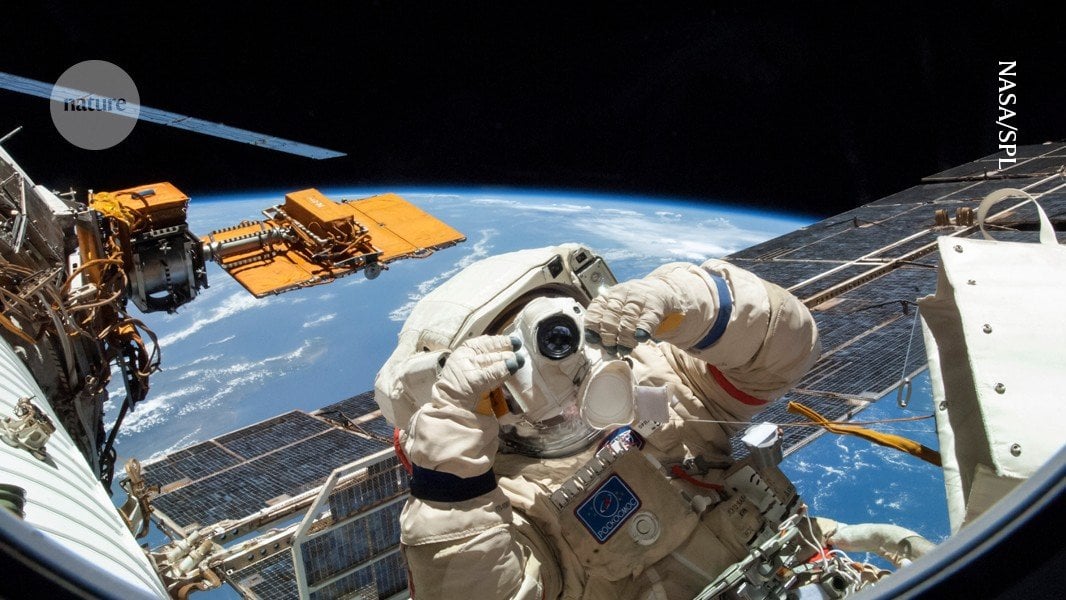
Eye problems cloud NASA’s vision of Mars | Mysterious syndrome remains a ‘red risk’ for long-term spaceflight.
https://www.nature.com/articles/d41586-025-00654-7

Eye problems cloud NASA’s vision of Mars | Mysterious syndrome remains a ‘red risk’ for long-term spaceflight.
https://www.nature.com/articles/d41586-025-00654-7
7 Comments
May have to plan on the manned missions being “tumbling ducks” or teather spinners.
What specific eye problems are astronauts experiencing, and how is NASA addressing them?
Artificial earth-like gravity will be a minimum requirement for long-term habitability and voyage in spacecraft.
it’s almost like we evolved specifically for this planet and going anywhere else will be really difficult lol.
Copy-and-pasting my comment from when this was posted last week:
Astronauts regularly spend 6+ months at a time on the ISS, sometimes 11-12 months. And they have been doing this for over 20 years. Many astronauts have done multiple stints on the ISS. A trip to Mars is only ~6-9 months each way for a minimum energy (Hohmann) transfer. (Contrary to the article, it doesn’t necessarily take 9 months to get to Mars, or back to Earth.) The time varies across different transfer windows because of Mars’s relatively elliptical orbit. Furthermore, even chemical rockets (e.g., Starship) can speed this up to consistently be less than or equal to the typical 6 month ISS stay.
The many health issues with continuous, long-term exposure to microgravity are a good argument against proposals that initial crewed Mars missions should be flybys (as free return trajectories would last 18+ months), or orbiters with surface sorties by some of the crew like Apollo. The health issues may also argue against the brief separation of stints in microgravity in a single-window “opposition class” mission, as that would involve only a brief ~1-3 month stay on Mars before returning to Earth. However, astronauts on the surface of Mars will experience significant gravity–almost 40% that of Earth’s surface–not anything close to microgravity.
Whether Mars gravity is sufficient to mitigate, prevent, and/or reverse the negative effects of microgravity, we do not know. And this article does not address this at all. The leap in logic required to conclude that a human Mars mission is infeasible based on what is in this article would also imply that what we have been doing for over two decades on the ISS is infeasible.
Being that Apollo missions used 3 PSI instead of 15, getting by on 1/5 G sounds possible.
NASA has no vision for Mars. SpaceX is the only organization in the world with a credible plan to get to Mars.