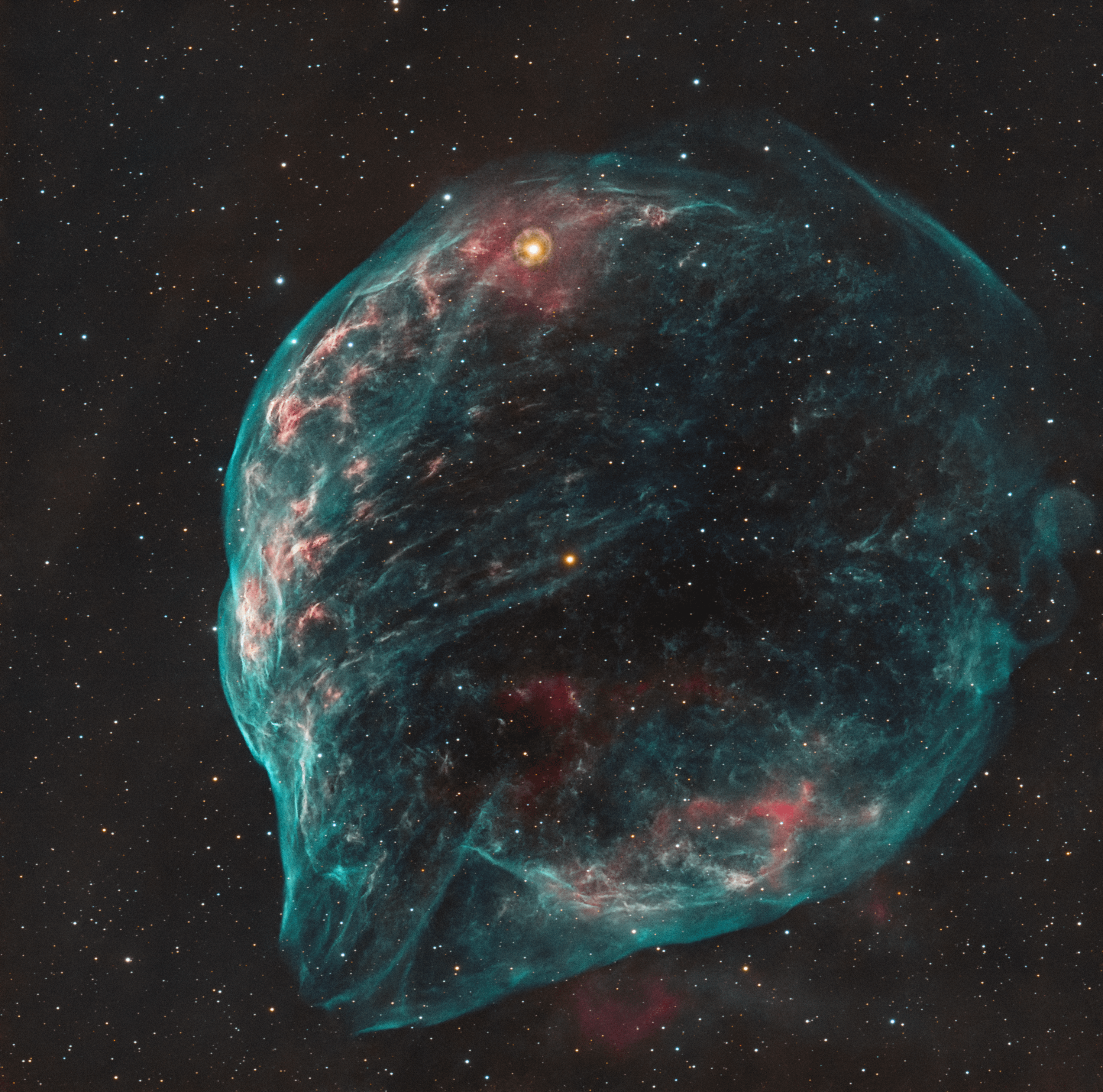
The Dolphin Head Nebula – 23 hours of pointing at the sky with my telescope and camera
https://i.redd.it/o96u5ys843pe1.png

The Dolphin Head Nebula – 23 hours of pointing at the sky with my telescope and camera
https://i.redd.it/o96u5ys843pe1.png
8 Comments
Taken over 5 nights with exposures of 5 mins at a time I was able to collect about 23 hours of light data for this image as I battled clouds and other atmospheric interference.
Taken with a ZWO Asi533MC Pro camera and Askar 103 Apo telescope sitting on my AM5N mount. Hope you like it!
Beautiful bubble. That star at the top seems to be extremely bright, what’s going on there?
This is outrageously beautiful.
And also beyond comprehension.
Question OP, something I’ve always wondered with these super long exposures. How exactly are you polling data from the same point across so many hours when the Earth is rotating [in several ways]? Pardon my ignorance. Plus, doesn’t the nebula itself have some movement/shift to its relative position?
I have a hunch my answer is “no” and it has something to do with the sheer scale of all of this.
But if the answer is “yes”, rotation/movement/shift affect these long exposure captures, can you speak to how you [presumably] address that in the data processing? Or point me to where I can learn more?
Bloody hell, this is gorgeous!
Are there any competitions you can enter this into? Because I genuinely think this looks better than [the 2024 winner of the Royal Museum Greenwich’s Astronomy Photographer of the Year](https://www.rmg.co.uk/whats-on/astronomy-photographer-year/galleries/stars-nebulae-2024)
This looks very beautiful, looks like a Millenium Falcon with camo.
Damn I really see the dolphins head. Although it kinda has a Geordie La Forge visor which I am really digging. Great work.
For those who don’t know, this nebula is actually inhabited by dolphins