
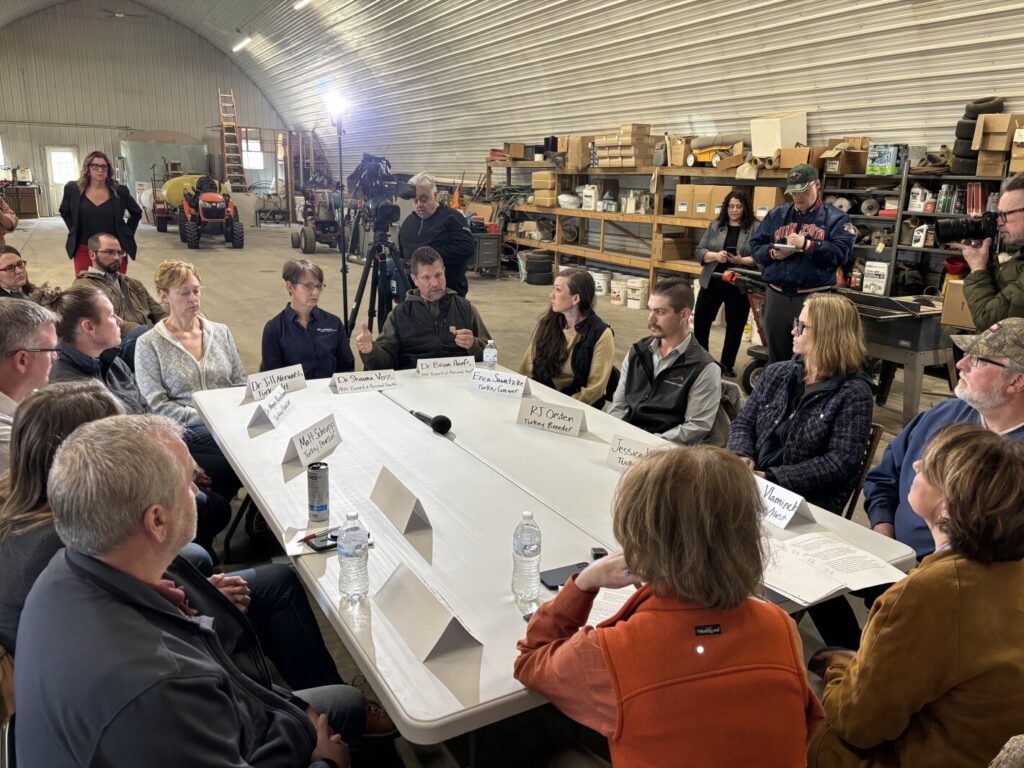
— Dealing with the two different viruses harming turkey production is their top concern, but turkey growers and processors told Minnesota’s U.S. Senators Amy Klobuchar and Tina Smith that there are a wide range of other worries for the industry.
The two Democrats, who are members of the Senate’s Agricultural Committee, hosted a roundtable session Tuesday with turkey industry representatives at the Fahlun Farms turkey barns south of Willmar. The start of the spring waterfowl migration makes the potential spread of the highly pathogenic
a top concern, participants said.
At Fahlun Farms, located about midway between Lakes Wakanda and Big Kandiyohi, two lasers beam streams of colored lights at the sky, both day and night. They’ve been effective, Jake Vlaminck, president of the Minnesota Turkey Growers Association and general manager of Fahlun Farms, told the senators. The wild birds perceive the random patterns of light as a threat, “so they don’t stop and keep going,” he said.
There are around 100 laser systems on turkey farms in Minnesota, and that has helped the state reduce its losses due to avian influenza while losses nationwide have not declined, according to Vlaminck.
The turkey industry is coping with bird losses due to both the highly pathogenic avian influenza, or H5N1, as well as an avian metapneumovirus that primarily infects breeder stock. Producers are relying on foreign-made vaccines to manage the avian metapneumovirus until a domestically produced vaccine is available.
expressed optimism that a waiver allowing the importation of the vaccine will be extended.

Tom Cherveny / West Central Tribune
Producers said they also want the federal government to support the development of a vaccine for the highly pathogenic avian influenza.
Highly pathogenic avian influenza is estimated to have reduced the supply of turkey by 5%, and the avian metapneumovirus by another 4%, Matt Schrupp, vice president of supply chain operations for
, told the senators.
It’s meant the loss of workdays for employees, Schrupp said, as there are fewer birds for processing. His company is trying to even out the loss of work time among its plants to reduce the economic impact on workers.
Some of the worst flock losses are occurring on independent farms in Minnesota that are located relatively close to one another, according to Michael Barber, a grower and member of the
Minnesota Turkey Research and Promotion Council
.
“I know two guys who already shut down,” he said.
Klobuchar said the
United States Department of Agriculture
“accidentally fired” employees involved in helping manage the disease, but that they have now been rehired. She is reaching out to Republican colleagues with turkey producers in their states to emphasize the importance of including the turkey industry in the federal response to the avian influenza.
The turkey industry is concerned that U.S. Agriculture Secretary Brooke Rollins did not directly mention turkeys when she outlined federal plans for avian influenza in a recent opinion piece published by the Wall Street Journal.
Roundtable participants expressed their concerns Tuesday about the biosecurity audits that are now being required as part of the National Poultry Impact Program. The audits are required at barns where avian influenza has infected flocks, and at farms in their vicinity. Erica Sawatzke, chair of the
Minnesota Board of Animal Health
, said producers told her the audits are “burdensome” and slow down the reintroduction of birds to the barns, while providing no value.

Tom Cherveny / West Central Tribune
At the session’s start, Klobuchar cited the economic value of turkey exports, and her concerns about the potential impact of tariffs. Minnesota is the nation’s leading turkey producer. Roughly 15% of the nation’s turkey production is exported. Mexico is the largest buyer, and Canada is an important customer as well, according to Klobuchar.
She said the threat of tariffs on Mexico, although now paused, is “like a dark cloud out there.”
Sen. Smith
said she is also concerned about the $300,000 USDA block grant that the federal government would usually provide the state for testing costs associated with the avian influenza response. Dr. Brian Hoefs, executive director of the Minnesota Board of Animal Health, said the state still expects to receive the funds, but the delay means the state had to cut some of its program contracts for testing. It also means growers are paying for testing costs, he said.
After the session, Klobuchar told reporters that she will redouble her efforts to enlist Republican support to address the vaccine and avian influenza concerns cited at the roundtable. In response to questions, she said there is no assurance that funding for indemnification will be part of a new farm bill.
“Everything is in some danger right now,” she said.
On the optimistic side, she said she had not known about the use of lasers and now will promote support for their use. Lasers are something she believes President Donald Trump would support.
A laser costs roughly $16,000, and two are recommended for a site, according to Vlaminck. Minnesota offers a grant for a cost-share program for lasers, and consequently more farms in Minnesota have adopted their use than in other states, according to Dr. Jill Nezworski, a poultry veterinarian.