
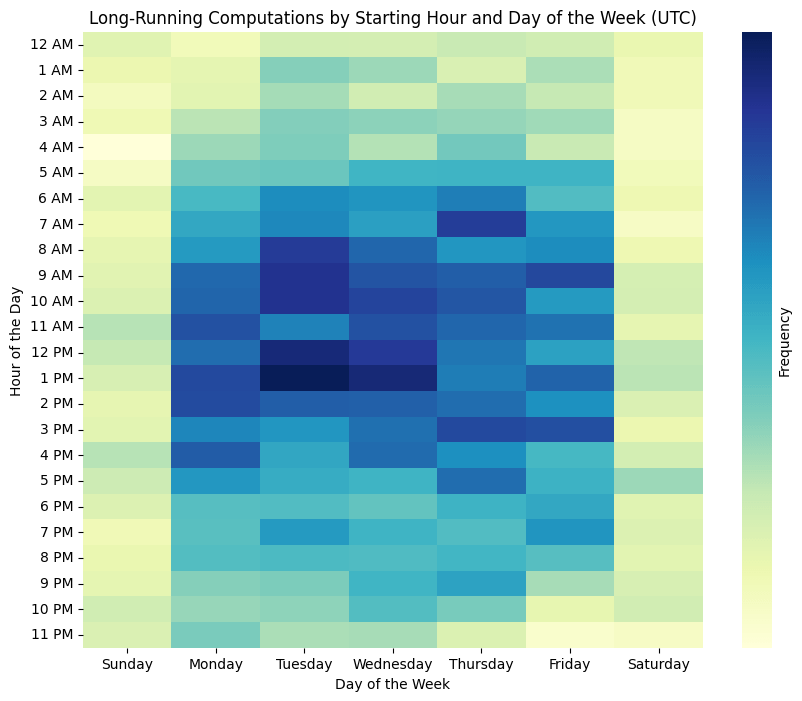
This data looks at when data scientists start running heavy computation processes throughout the week over the month of February 2025.
Made with Python, Pandas, and Seaborn. The data used is collected from https://meerkatio.com, a VS Code extension for data scientists that monitors code execution to trigger notifications. MeerkatIO does not log user data so all notifications are in UTC time and with users all over the world I did not try to localize the timezones, although that would also be an interesting plot.
Posted by dajmillz
9 Comments
This data looks at when data scientists start running heavy computation processes throughout the week over the month of February 2025.
Made with Python, Pandas, and Seaborn. The data used is collected from [https://meerkatio.com](https://meerkatio.com/), a VS Code extension for data scientists that monitors code execution to trigger notifications. MeerkatIO does not log user data so all notifications are in UTC time and with users all over the world I did not try to localize the timezones, although that would also be an interesting plot.
Everyone does everything on fuckin Tuesday.
Before I saw the explanation I thought you mean by “heavy lifting” is doing weights at a gym or something.
And the only explanation I can come up in my heads how us Nerdy Data Scientists do any sort of physical exercise if if the bluest of the frequency means 10 pumps on a 5 pound weight or something.
3pm seems to show when the adderall begins to wear off.
I’m not really all that surprised. I’ve definitely noticed that my productivity goes heavily down after around 1pm or lunch time (even if I don’t eat lunch). After lunch nap is real. I also notice how productivity goes down after Wednesday and looks to be the bare minimum on friday. All this does is convince me even more of a 4 day work week with less hours (or more flexible hours, like always be here between 11 and 3 but the place is open from 7-6 or something).
I would bet most of the drop off we see is when a large amount of people basically stop doing work for the day, or just do the bare minimum. Can some data science work be automated and thus part of the drop off is just the computers working without the need for constant input? I am genuinely asking.
cool chart, would love to see this repeated across other data science companies and industries!
edit: it’s in UTC and thus can’t really make conclusions based off of time of day. 🙁
I’m not entirely sure what I expected to see. Perhaps a greater number of submissions before lunch, and a spike in the late afternoon for overnight computations. Maybe a Friday 3pm weekend computation.
This is neat. What do you define as long running?
As a former DS, I can attest that Tuesdays are for most work, followed by Wednesdays
They would do it Monday but the idiot bosses schedule a bunch of Monday morning and afternoon meets that fragment the day.