
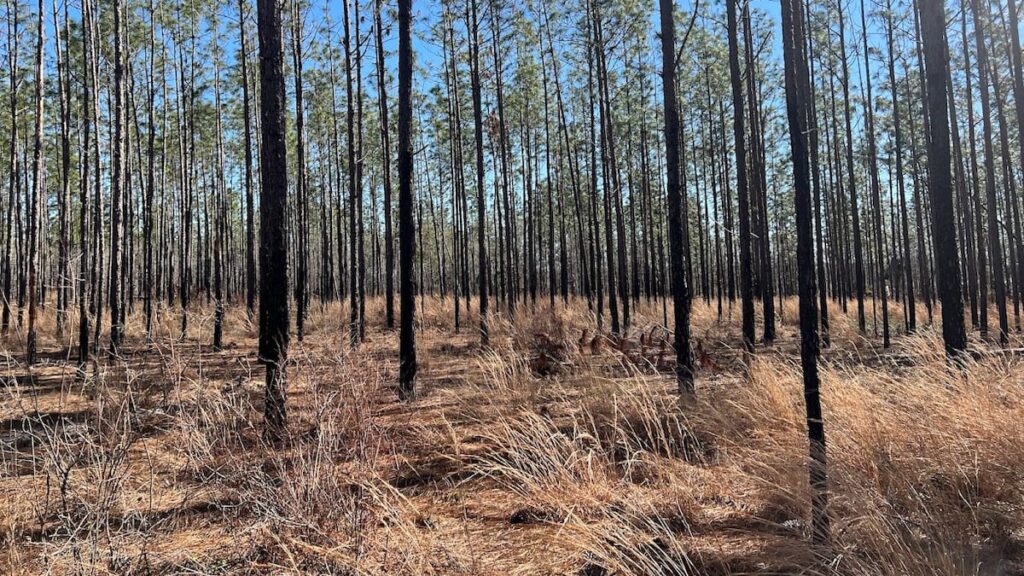
In a move that has alarmed wildlife advocacy groups, state water managers are considering a land swap that would give nearly 700 acres of North Florida state forest land to a neighboring peanut farming company.
The proposal comes more than a decade after a separate peanut operation sought the same swath of Madison County land within the Twin Rivers State Forest — dubbed the Ellaville Tract — in a similar trade offer.
But that deal never went through: Citing the risk to endangered species on the property, and a bustling gopher tortoise population, federal wildlife biologists urged state leaders at the time to keep the land for conservation.
“If the land being swapped is developed or unmanaged in the future, it will erode protection of several imperiled species,” the U.S. Fish and Wildlife Service wrote in a December 2012 email.
Today, the land’s owners, the Suwannee River Water Management District, say the Ellaville Tract was hit hard by Hurricane Idalia and, if it weren’t for a packaged land deal nearly four decades ago, it’s not the type of land the group would typically acquire.
In exchange for the state forest land, the district would receive roughly 550 acres of Lee Peanut Farms LLC’s farmland along the Withlacoochee River, a waterway that officials say gives the property “significantly higher” value than the high-and-dry state forest uplands being traded away.
The district’s land committee voted March 11 to formally put the swap up for consideration, and its governing board will vote on it at a future meeting.

Katherine Sayler, a biologist and Southeast representative with the nonprofit Defenders of Wildlife, hiked the Ellaville Tract of the Twin Rivers State Forest on March 7 and documented this gopher tortoise burrow on the property. State wildlife officials led a gopher tortoise population count on this land in April 2017 and found as many as 440 tortoises on the state forest land. This piece of land is now part of a land swap proposal that could be traded to a peanut farming operation. [ Courtesy of Katherine Sayler ]
Four days before the committee’s decision, Katherine Sayler hiked the state forest that could soon be traded.
Sayler, a biologist and Southeast representative with the nonprofit Defenders of Wildlife, said she and Florida Forest Service staff saw “really clear evidence” of a flourishing habitat: active gopher tortoise burrows a few dozen feet apart, deer tracks, woodpeckers and more.
Even in parts of the property where harvested slash pines were reduced to stumps, Sayler found burrows with signs that tannish-brown tortoises lived inside. Large longleaf pines, remnants of a habitat that once dominated America’s southeastern coastal plains, stretch across 300 acres of the Ellaville Tract.
“This is a very unique ecosystem with tall, beautiful trees,” Sayler said in an interview.
After her hike, Sayler took her observations to the land committee on March 11. As the officials gathered to discuss the land swap, she outlined what she saw on the state forest property: healthy wiregrass beds, longleaf pines and markings in front of burrows where the underside of tortoise shells rubbed against the sandy ground.
Subscribe to our free DayStarter newsletter
We’ll deliver the latest news and information you need to know every morning.
Want more of our free, weekly newsletters in your inbox? Let’s get started.
“The district has not demonstrated that this parcel no longer has conservation value,” she told them.

Tom St. Clair, a Hernando Audubon Society Committee chairperson, gives a tour of a Withlacoochee State Forest parcel adjacent to Cabot Citrus Farms on Sept. 10, 2024, in Brooksville. [ JEFFEREE WOO | Times (2024) ]
She cited the public outcry over a similar land swap proposal, revealed by the Tampa Bay Times in August, that would trade more than 300 acres of the Withlacoochee State Forest to a luxury golf course developer.
The DeSantis administration added that land swap to a Cabinet meeting agenda at the last minute in June. Discussion of the deal during that meeting lasted less than 30 seconds before state officials greenlit it. Like the Ellaville deal, as part of the swap, the state would have to determine the forest land is “no longer needed for conservation purposes.” Progress with the Withlacoochee deal appears to have stalled.
“It is very important that the district follows the letter of the law on these types of actions,” Sayler said. “As such, Defenders of Wildlife recommends that you deny this proposal to convert imperiled gopher tortoise habitat into a peanut field.”
A spokesperson for the district, Troy Roberts, said the land owned by Lee Peanut Farms has more than 400 acres within the floodplain and stretches for more than a mile alongside the Withlacoochee River — all important features for water managers.

This piece of the Twin Rivers State Forest, dubbed the Ellaville Tract, could be traded away to a neighboring peanut farming operation, according to a proposal from the Suwannee River Water Management District. [ Suwannee River Water Management District ]
The property also has a spring, called Stuart Spring, that discharges more than 650,000 gallons of water daily, Roberts said. The land has mature longleaf pine trees and healthy wiregrass. It also would connect to other lands owned by the district.
The Suwannee River water managers bought the land it wants to trade in 1988 using land management trust funds, and the parcel was part of a large transaction spanning several counties, Roberts said. Staff have been working with the Florida Forest Service to restore longleaf pine habitat within Twin Rivers State Forest since then.
In a letter dated March 10, a top official with the Florida Fish and Wildlife Conservation Commission outlined to the head of the Suwannee River water management board how the state forest land is important for Florida wildlife species.
“The Ellaville Tract is ecologically significant” because it’s habitat for species like swallow-tailed kites, kestrels, eastern indigo snakes, gopher frogs, fox squirrels and the Florida black bear, wrote Jennifer Goff, head of the state’s species conservation division.
“Also of note, previous (wildlife staff) observations on the Ellaville Tract indicate that the tract supports a large, viable population of gopher tortoises,” Goff wrote.
The state led a gopher tortoise population count in April 2017, when they found as many as 440 tortoises on the state forest land, according to Goff.

A gopher tortoise emerges from a bush to feed on vegetation in 2016 at the Moccasin Lake Environmental Education Center in Clearwater. [ DOUGLAS CLIFFORD | Times (2016) ]
Still, if the land swap were approved, Goff said the wildlife agency would “work closely with the new landowner to ensure the continued health of the tortoises in this population.” Tortoises and their burrows are protected under state law, and any construction on the state forest land would require permits from the wildlife agency to relocate them.
Goff also noted that the proposed exchange would affect hunting opportunities for deer, turkey and other small species.
Elizabeth Fleming, a senior Florida representative with Defenders of Wildlife, said advocacy groups see the value in the roughly 550 acres of land the state would be acquiring along the banks of the Withlacoochee River — but not at the expense of a state forest.
“The things in public ownership we assume are safe — like this forest — may not be safe, and we have to keep an eye on these things,” Fleming said. “In this case, they want to trade gopher tortoises for peanuts.”