
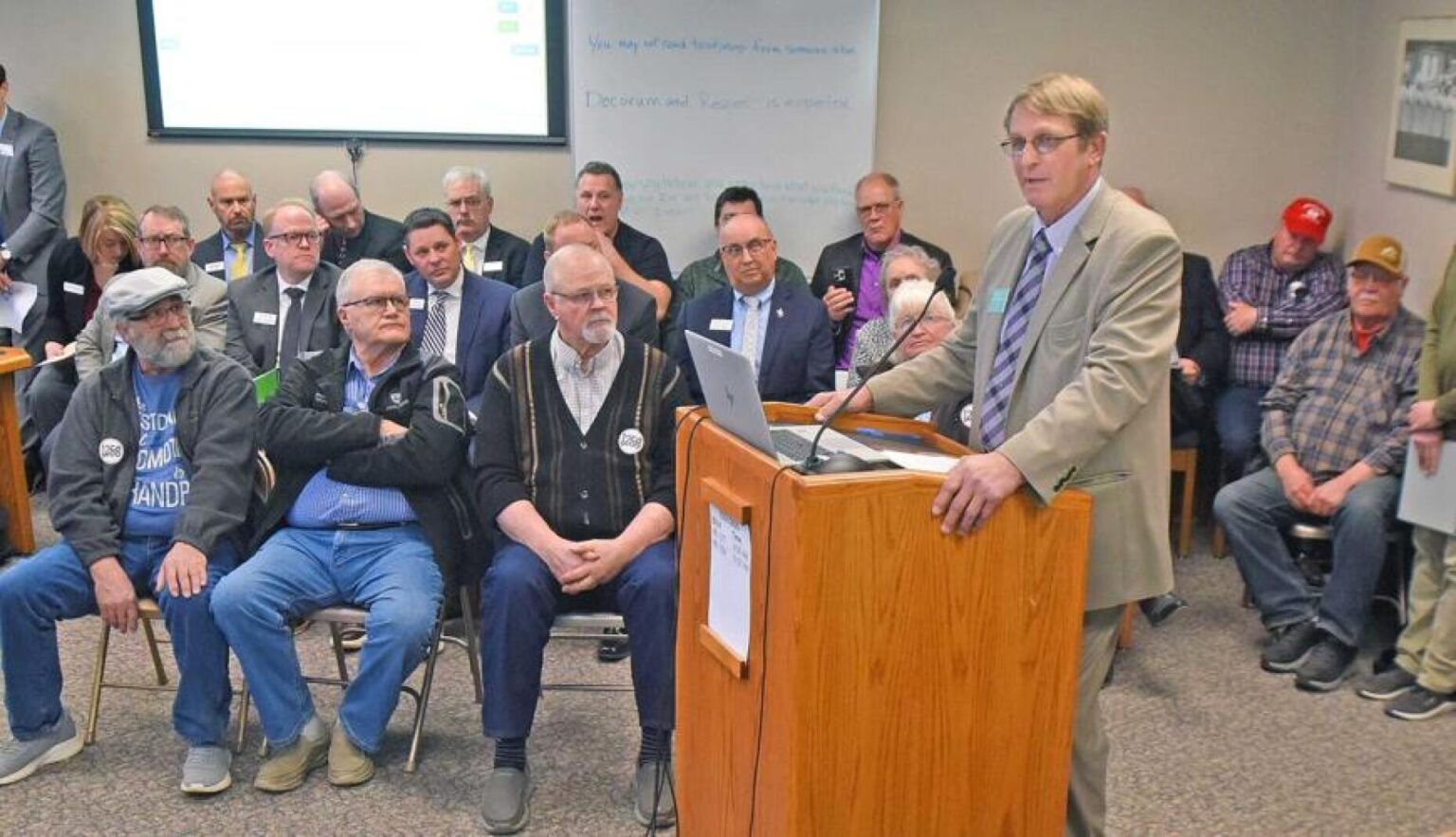
BISMARCK — A single project was the subject of practically all the testimony on Friday, March 21, for a bill that would give more authority to the North Dakota state government in electric transmission planning.
House Bill 1258 would give the state Public Service Commission the authority to override rules set by local governments that conflict with a state approval for an electric transmission project. It passed through the House of Representatives 86-7-1. There was no opposing testimony as the bill went through the House committee hearings, but the room for the Senate committee hearing was overflowed Friday.
The legislation mirrors the language that the state government has in place for pipeline siting projects — though the reach of that language is being contested in court right now. The PSC recently invoked it to override Burleigh and Emmons counties’ local rules aimed at limiting the location for Summit Carbon Solutions’ pipeline. The counties have since sued.
If passed, the bill would apply to all power line siting cases, but the Jamestown to Ellendale Express (JETx) — a joint $440 million, 85-mile transmission project between MDU and Otter Tail Power that would carry electricity between the two cities in southeastern North Dakota — was the main focus both for the proposed legislation’s supporters and its opponents.
The line is part of a broader push by the Midcontinent Independent System Operator (MISO), one of two regional grid operators in North Dakota, to meet its long-term transmission planning goal of improving the ability to move electricity in the region.
The certificate of public convenience and necessity for JETx was approved by a 2-1 vote in November. The utility companies will soon apply for a route corridor approval at the state agency.
The companies behind JETx say they have around 67% of the project footprint secured, but local opposition from some landowners could kill the project. This includes setback distances enacted by townships that are more than five times what the state requires — 500 feet. The companies could avoid that requirement by seeking a waiver or burying the line.
State Rep. Mike Brandenburg, R-Edgeley, one the bill’s sponsors, said the changes to the law are needed because some landowners refuse to negotiate with the companies. He said that without a consistent siting process for large power lines, the state’s plans for growth, which include using its coal and natural gas reserves to power artificial intelligence data centers and agriculture processing facilities, would likely fizzle.
“Not everybody can stay on the farm,” Brandenburg said.
Jason Weiers, a lead engineer for Otter Tail, said the line is also needed for better system reliability. He pointed to the December 2023 ice storm in southeastern North Dakota. He described the prospect of burying a high-voltage line such as JETx as unrealistic because of costs and land disruptions.
“Large customers in the Jamestown area, including Cavendish Farms, Green Bison, Dakota Spirit Ag and Applied Digital, were forced to operate at reduced levels in order to keep the lights on for the rest of the customers in the area,” he said.
But some opponents of JETx latched onto the dissenting opinion of PSC Commissioner Randy Christmann from the agency’s November approval to argue against the bill. Christmann questioned whether the project was necessary to alleviate present grid constraints or to prepare for large changes that are being planned for.
Others testifying against the bill said local zoning was not aimed at blocking the project but giving their neighbors more of a say.
“We don’t have the liberty to move like somebody in town. And you talk about zoning? A city is so well protected … We don’t get the option to move our farms,” said Darren Orr, who sits on one of the township boards that passed an ordinance in response to JETx.
But multiple lawmakers noted that more than just JETx is at stake.
“(We’re) setting policy unrelated to one specific project, we’re setting policy for electric transmission,” said state Sen. Justin Gerhardt, R-Mandan.

Rep. Justin Gerhardt, R-Mandan
Derrick Braaten, an attorney who frequently represents landowners at odds with energy companies, said local opposition to projects is not inevitable. He pointed to the North Plains Connector, a proposed 420-mile transmission project that would run from Montana to North Dakota.
“I didn’t even represent landowners on it because I passed them off to another firm. And I told that company, ‘Let me know when you go into your PSC siting proceedings because I’ll come and testify for you because I’ve never seen a company do it right, and that well.’ But it can be done,” he said.