Not sure how countries that maintain and support a royal family are “full democracies,” but whatever
KRed75 on
canada, japan, spain and uk a full democracy? Please. Who came up with this trash. The people of uk, spain and canada can’t even vote for their prime minister. The japanese people can’t even vote for their emperor. They are are constitutional monarchies. Germans can’t vote for their president.
A flawed democracy completely made up by some media publishers.
Orgidee on
How is South Africa a flawed democracy? It’s a very new constitution and while there are occasional allegations of voter fraud it is attended to and resolved and even as a member of a minority that despises the government I cannot see how it’s accurate especially when monarchies with hereditary peers are included in “full democracy”. Get real.
NoDadNoTears on
I too can make a colored graph/chart and put countries I like in blue and countries I don’t like in red. Would mean just as much as the one the Economist puts out
Improvisable on
Idk much about the politics but is Japan really a full democracy when the U.S. isn’t? I feel like I’ve heard so much about it being corrupt meanwhile the other countries in that section I’ve heard little to nothing about them being corrupt
Outragez_guy_ on
Often when countries try to be democratic a certain “full democracy” fucks their shit up.
conventionistG on
Okay, flawed dataset aside, this is a bit of an interesting take on a pie chart. But it’s still a pie chart.
Gonzy__ on
I find the idolization of “full” democracy to be hilarious (ie majority votes to make every decision? Idk). Think about how easy it is to get a majority vote on literally the most dumb things… I personally prefer to have something like the us constitution that allows change but imposes restrictions on the rat race of full democracy
Brushner on
A good reminder of how fleeting and fragile this experiment is
TheScullywagon on
This is so silly – “flawed democracy “ “full democracy “
What does this even mean
A full democracy could be everyone votes on every law
It looks nice but it it ain’t beautiful
Not-N-Extrovert on
India doesn’t feel like a full democracy anymore
mr_ji on
Interesting that half of those full democracies still have monarchs.
DepletedMitochondria on
A lot of US allies backsliding as the US does.
pierreman on
Is this put out by the GOP?
Proman2520 on
ITT: people angry at the democratic indicator, debating what a democracy is, and calling it opinion.
Most of these international democratic indicators are as empirical as social science can be, and they tend to align with one another as well. Sorry people are upset that their country has not achieved the bluest status, but if anything this chart is too generous to the flawed democracies — India probably should be downgraded.
eario on
From a historical perspective I find it funny, that the US and France end up in the “flawed democracies”, while Germany and Japan are “full democracies”.
The US and France became democracies on their own through popular revolutions. People rose up to fight for their rights and freedoms.
Germany and Japan became democracies, because they first turned fascist, then lost a war, and then had democracy imposed on them by foreign powers.
And those are now the full democracies.
tdfast on
People think South Korea is great but they have a dark history, that isn’t that old. Pretty wild to learn about. Getting better but I guess not there yet.
ImSomeRandomHuman on
Being more democratic is not inherently more good. The US Constitution is made in such a way Democracy exists without undoing itself and harm the Nation grievously.
Heavy_Stomach_7633 on
Including me. Hopefully that lasts.
-Proud Canadian 🇨🇦
SeveralBollocks_67 on
Don’t tell Reddit that when they threaten to leave America and realize the 5 or 6 “good” countries don’t want them either 🤣
ginpaachi_sensei on
Eu are the biggest hypocrites. They ban opposition parties and cancel elections then lecture others about democracy.
PMmeyourSchwifty on
The irony is that the poor in China are probably better looked after than any of the poor in the US.
nosmelc on
You do realize much of this is just someone’s opinion, right?
Legosheep on
Odd that the UK is considered a “full democracy” despite technically being a parliamentary monarchy.
Oddswimmer21 on
I don’t buy the UK as a full democracy.
Even if we set aside the limited and unused powers of the monarch, you have the unelected upper house and the first past the post system that allows for governments with large majorities from less than 50% of the popular vote.

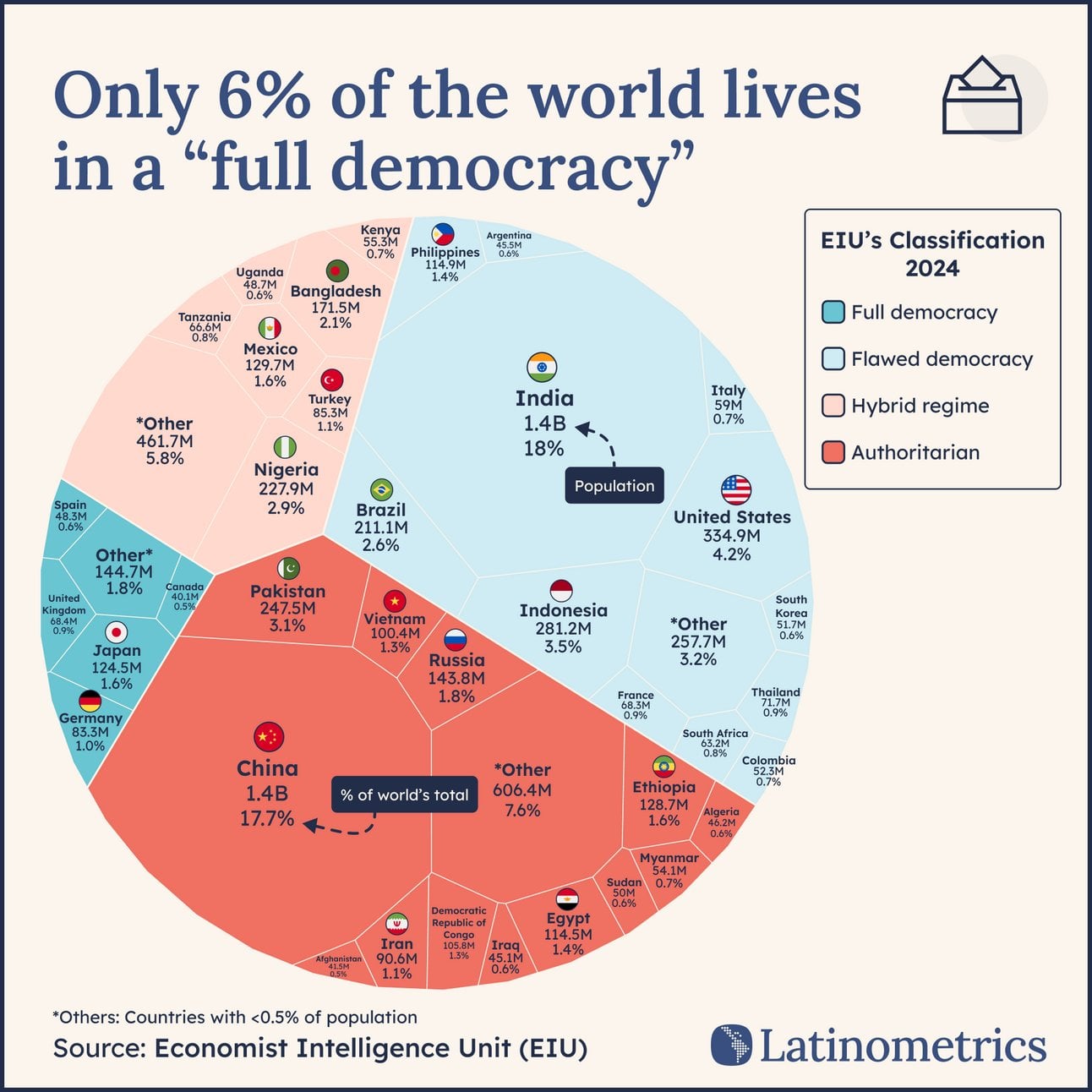
![[OC] Only 6% of the world lives in a "full democracy"](https://www.byteseu.com/wp-content/uploads/2025/03/irRFW4kgjI6PQD0kJJZcqIHJHDrT7HJh99-uyHC4Tn0-1024x1024.jpg "[OC] Only 6% of the world lives in a “full democracy”")
28 Comments
Source: [EIU’s Democracy Index 2024](https://www.eiu.com/n/campaigns/democracy-index-2024/)
Tools: Rawgraphs, Figma
And that share is rapidly shrinking
Hope in that full democracy “other” bucket
Not sure how countries that maintain and support a royal family are “full democracies,” but whatever
canada, japan, spain and uk a full democracy? Please. Who came up with this trash. The people of uk, spain and canada can’t even vote for their prime minister. The japanese people can’t even vote for their emperor. They are are constitutional monarchies. Germans can’t vote for their president.
A flawed democracy completely made up by some media publishers.
How is South Africa a flawed democracy? It’s a very new constitution and while there are occasional allegations of voter fraud it is attended to and resolved and even as a member of a minority that despises the government I cannot see how it’s accurate especially when monarchies with hereditary peers are included in “full democracy”. Get real.
I too can make a colored graph/chart and put countries I like in blue and countries I don’t like in red. Would mean just as much as the one the Economist puts out
Idk much about the politics but is Japan really a full democracy when the U.S. isn’t? I feel like I’ve heard so much about it being corrupt meanwhile the other countries in that section I’ve heard little to nothing about them being corrupt
Often when countries try to be democratic a certain “full democracy” fucks their shit up.
Okay, flawed dataset aside, this is a bit of an interesting take on a pie chart. But it’s still a pie chart.
I find the idolization of “full” democracy to be hilarious (ie majority votes to make every decision? Idk). Think about how easy it is to get a majority vote on literally the most dumb things… I personally prefer to have something like the us constitution that allows change but imposes restrictions on the rat race of full democracy
A good reminder of how fleeting and fragile this experiment is
This is so silly – “flawed democracy “ “full democracy “
What does this even mean
A full democracy could be everyone votes on every law
It looks nice but it it ain’t beautiful
India doesn’t feel like a full democracy anymore
Interesting that half of those full democracies still have monarchs.
A lot of US allies backsliding as the US does.
Is this put out by the GOP?
ITT: people angry at the democratic indicator, debating what a democracy is, and calling it opinion.
Most of these international democratic indicators are as empirical as social science can be, and they tend to align with one another as well. Sorry people are upset that their country has not achieved the bluest status, but if anything this chart is too generous to the flawed democracies — India probably should be downgraded.
From a historical perspective I find it funny, that the US and France end up in the “flawed democracies”, while Germany and Japan are “full democracies”.
The US and France became democracies on their own through popular revolutions. People rose up to fight for their rights and freedoms.
Germany and Japan became democracies, because they first turned fascist, then lost a war, and then had democracy imposed on them by foreign powers.
And those are now the full democracies.
People think South Korea is great but they have a dark history, that isn’t that old. Pretty wild to learn about. Getting better but I guess not there yet.
Being more democratic is not inherently more good. The US Constitution is made in such a way Democracy exists without undoing itself and harm the Nation grievously.
Including me. Hopefully that lasts.
-Proud Canadian 🇨🇦
Don’t tell Reddit that when they threaten to leave America and realize the 5 or 6 “good” countries don’t want them either 🤣
Eu are the biggest hypocrites. They ban opposition parties and cancel elections then lecture others about democracy.
The irony is that the poor in China are probably better looked after than any of the poor in the US.
You do realize much of this is just someone’s opinion, right?
Odd that the UK is considered a “full democracy” despite technically being a parliamentary monarchy.
I don’t buy the UK as a full democracy.
Even if we set aside the limited and unused powers of the monarch, you have the unelected upper house and the first past the post system that allows for governments with large majorities from less than 50% of the popular vote.