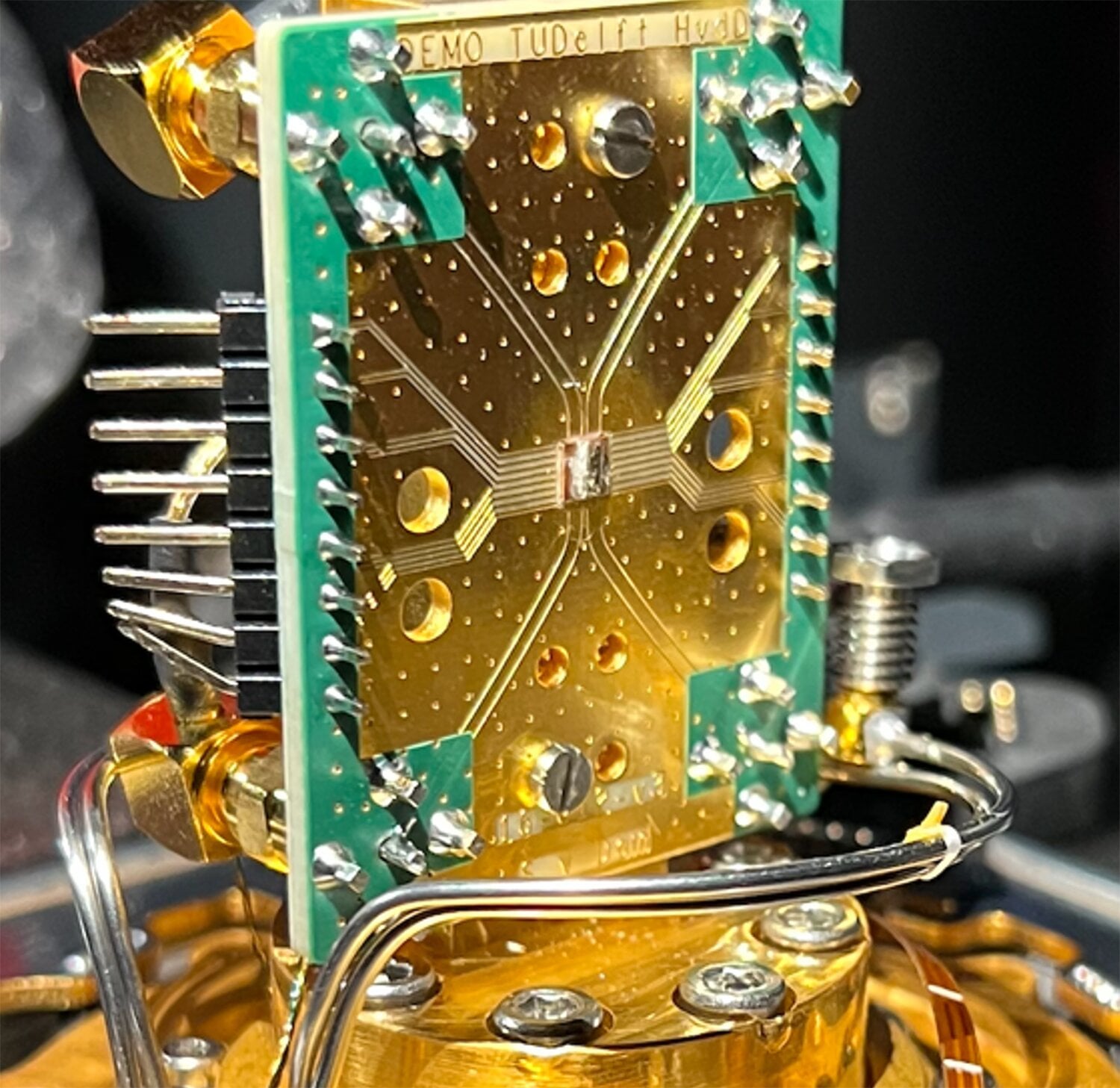
High-precision quantum gates with diamond spin qubits achieve error rate below 0.1%
https://phys.org/news/2025-03-high-precision-quantum-gates-diamond.amp

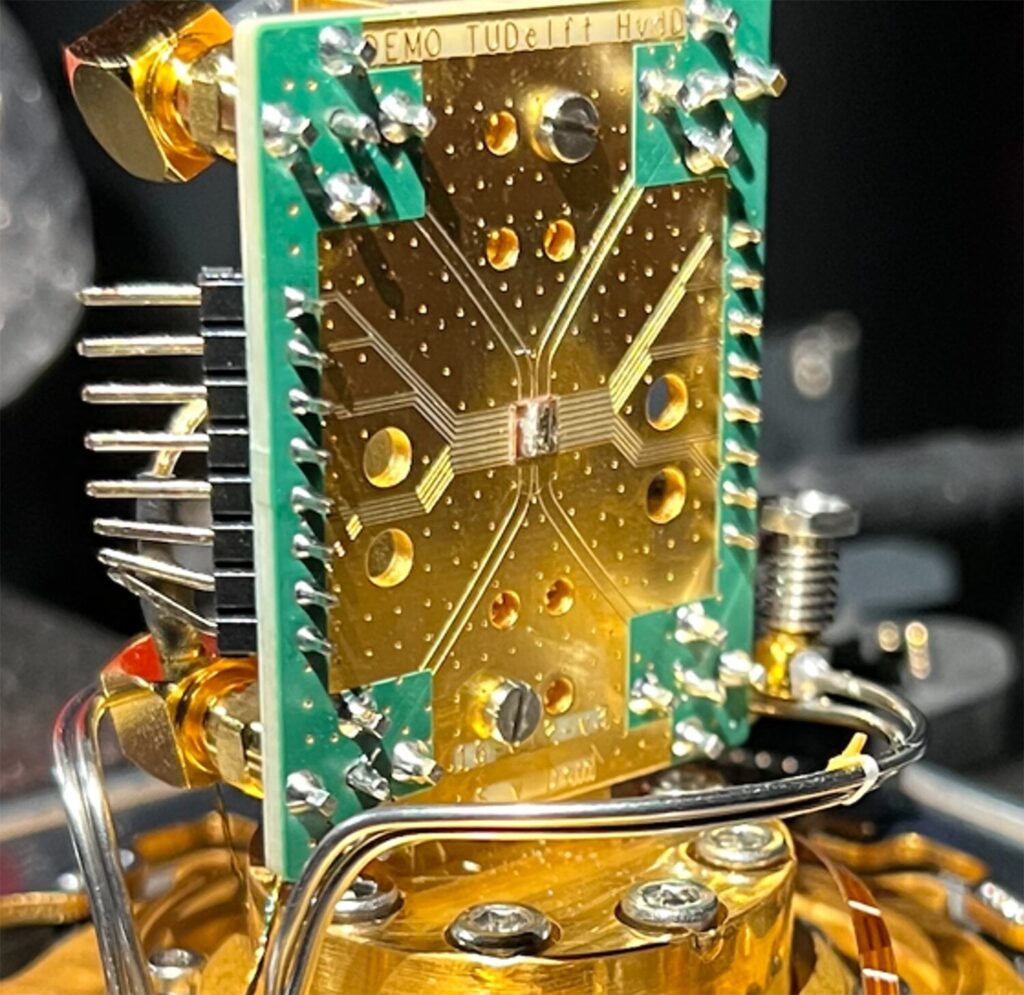
High-precision quantum gates with diamond spin qubits achieve error rate below 0.1%
https://phys.org/news/2025-03-high-precision-quantum-gates-diamond.amp
2 Comments
Submission Statement:
Researchers at QuTech, in collaboration with Fujitsu and Element Six, have demonstrated a complete set of quantum gates with error probabilities below 0.1%. While many challenges remain, being able to perform basic gate operations with errors occurring below this threshold, satisfies an important condition for future large-scale quantum computation. The research was published in Physical Review Applied on 21 March 2025.
Quantum computers are anticipated to be able to solve important problems that are beyond the capabilities of classical computers. Quantum computations are performed through a large sequence of basic operations, called quantum gates.
For a quantum computer to function, it is essential that all quantum gates are highly precise. The probability of an error during the gates must be below a threshold, typically of the order 0.1 to 1%. Only then, errors are rare enough for error correction methods to work successfully and ensure reliable computation with noisy components.
Spins in diamond are a type of qubit that shows promise for quantum computation. These qubits consist of electron and nuclear spins associated with atomic defects, for example, a nitrogen atom replacing a carbon atom in a diamond. They operate at relatively high temperatures, up to 10 Kelvin, and are well protected from noise. Also, their natural connection to photons—the elementary particles of light—enables distributed computation over quantum networks. However, realizing a complete set of quantum gates with low enough error rates has remained a challenge until now.
Researchers at QuTech, the interfaculty quantum technology research institute of Delft University of Technology, have now demonstrated a highly precise universal set of quantum gates using a diamond quantum chip. The researchers used a system of two qubits, one formed by the electron spin of the defect center, the other by its nuclear spin. Each type of gate in this two-qubit system operates at an error below 0.1%, and the best gates even reach errors as low as 0.001%.
“To realize such highly precise gates we had to systematically remove sources of errors. The first step was to use ultrapure diamonds that have a lower concentration of carbon-13 isotopes as these cause noise,” says Hans Bartling, lead author. The second key step was to design gates that carefully decouple the spin qubits from each other and from interactions with the remaining noise in the environment.
Cool, cool. Now let’s see how that error rate looks like for more than a handful of qubits.