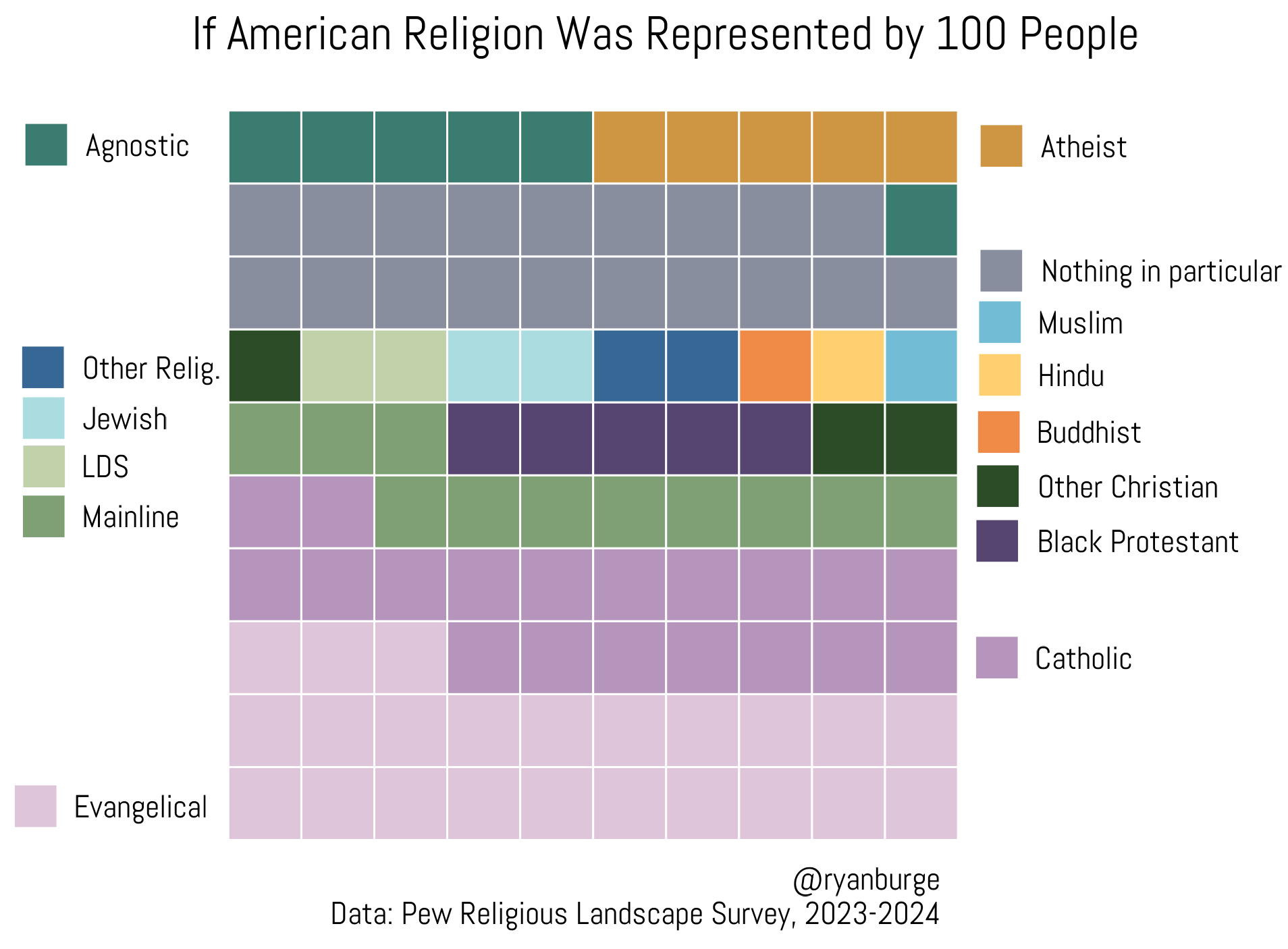
The data comes the recently released Pew Religious Landscape Survey. I used ggplot to make the data visualization.
Posted by huxleyan

![[OC] If American Religion was 100 people.](https://www.byteseu.com/wp-content/uploads/2025/03/pc2d8rslzure1-1536x1132.png "[OC] If American Religion was 100 people.")
The data comes the recently released Pew Religious Landscape Survey. I used ggplot to make the data visualization.
Posted by huxleyan
27 Comments
Makes u realise how many evangelicals there are in the us
Is nothing in particular just agnostic??
I hate these so much. Google “percentages” people!
Question and a comment:
1) comment- I am a little distracted by the legend being broken up across the plot. My gut would be to say stick with legend information on one side. But I like the creativity.
2) question- did you split the legend and have labels near the data manually after ggplot or was this a function within R?
So each box is 1% of the population. The title would make more sense if you used 100 icons of people to represent this.
What categories belong to the general category of “protestant”? Black protestant, LDS (I’m assuming that’s lutherans??), maybe “mainline”? “Other christian”?
And what is meant by “mainline”? I feel like I am pretty familiar with religion in general and I haven’t a clue what “mainline” is referring to.
EDIT: LDS is Latter-Day Saints, got it, thx
Why is it wrapping right to left? Also does Other Christian = Protestant? What on earth is Mainline? I get the feeling from the sizes, Protestant is rolled into Evangelical. My understanding is that about half of Protestants are Evangelical so its the only way the graph makes sense.
This is not beautiful or efficient at conveying percentages
“Black Protestantism” isn’t a separate religion, methinks. That’s a weird racial grouping in what is supposed to be a religious breakdown.
It’s like this was intentionally organized poorly, just to get a rise out of people. Rage bait.
There being that many evangelicals is a surprise to me. Explains a lot, actually.
shout out to everyone that moved from the bottom to the top!
Not beautiful, sorry.
No apparent effort was put into arranging the groups, titles, or colors in a way that makes the representation easier to understand. For example:
* The “agnostic” group is broken across two rows, and arranged with one block being non-contiguous with the other five. No reason to do that.
* “Other Christian” as a title is stuck between “Buddhist” and “Black Protestant” in labels, and between “Black Protestant” and “LDS” in the figure–why not actually put “Other Christian” directly after all the other Christian sects?
* Colors appear to be mostly random, and do not seem to reflect natural or logical categories. (Atheist, Hindu, and Buddhist are all shades of orange. Some Christians are green, some are purple–Catholics and Evangelicals are mildly different shades of lilac.)
And if I really wanted to be picky, I’d note that the title talks about the data being represented by “100 People”, but the figure is just squares–yes, we know how percentages work.
No way Muslim and Buddhist are sharing the same percentage.
Wow this sucks. The colors are hard to tell apart. There’s no symbols to help people match up the key. The key is all over the place. Wow like you couldn’t try harder to make this worse.
I’m colorblind and I don’t get much out of this lol
for so many divisions idk if a “100 person graphic” is the best to do it..
*based on what people admit to on a poll
in my lifetime experience as an atheist/agnostic, I find that maybe as much as 50% of religious folks are really more agnostics when pressed not in front of their religious family/friends.
Lots of folks in here asking about “Mainline”
Mainline Protestants are mostly made up of the “seven sisters of mainline Protestantism”, the United Methodist Church (UMC), Evangelical Lutheran Church in America (ELCA), Episcopal Church, Presbyterian Church USA (PCUSA), American Baptist Churches USA (ABC-USA), United Church of Christ (UCC), and Disciples of Christ.
These churches tend to be much more progressive, meaning women and LGBTQ+ folks are welcomed and ordained as pastors as well. Obviously varies from congregation to congregation, but they tend to be very community oriented, ecumenical (partnering with other denominations), and open to multi-faith events. They tend to not be the fire and brimstone type churches and are much less “evangelical” in the sense of they don’t typically have the fog machines and rock bands, and they tend to not be as heavily invested in trying to convert people, but rather focusing on serving the community.
As always, each individual congregation will vary and some will be more conservative than others, but their denominational bylaws tend to be very open
Edit: for a recent example, the Bishop that asked Trump to have empathy towards immigrants after his inauguration, Mariann Budde, is an Episcopalian, which is Mainline.
This data is not beautiful
I shouldn’t be, but I am a little surprised by how many people identify as evangelical vs “mainline.”
Interesting side note: you can dig deeper into each category (on the Pew web site).
One Example: 62% of respondents call themselves “Christian” – but of those, less than 50% claim to attend church services at least once per month. It seems that one could argue that the 50%(+) who do not regularly attend a church should more logically fall into the “Noting in Particular” category (Or Agnostic perhaps???).
I always thought ’Black Protestants’ was just an insult that my Irish Catholic grandparents used to refer to non-Catholic Christians
is black christian a religion?
I had no idea how many evangelicals there were until they started fucking the rest of us
This is hideous and way more work to read than it should be.
There are no prayers in any faith to forgive you u/huxleyan for this grave sin of ugly data.
Im sorry but this is not beautiful why do the groupings have to be in order of left to right by row? Its not a paragraph and splits a lot of groups uneccessarily