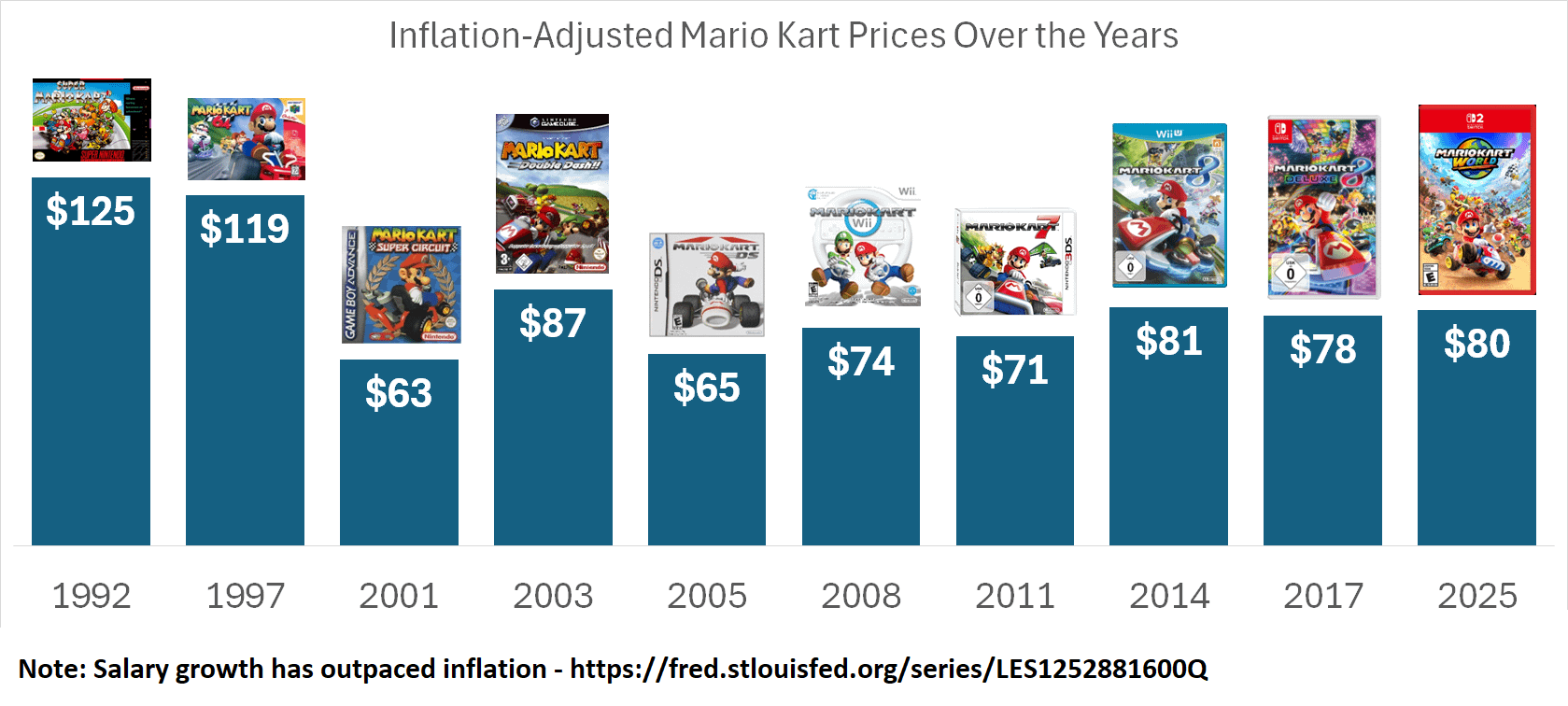
I can’t believe my parents spent the equivalent of $125 on me as a 5-year-old. This would have been in 1995, so maybe the price had dropped after being out for 3 years, but still, that’s a lot for immigrant parents to spend on a child.
balbiza-we-chikha on
Has salary growth really outpaced inflation? Maybe over this period but not in the past decade I feel like
vvvvfl on
only correction I’d apply is put this game at $90 since we are comparing between physical copies here.
Docile_Doggo on
This confirms my priors of the DS/Wii era of Nintendo being the absolute cheapest to get a bunch of great games. Probably has something to do with the “Blue Ocean” strategy they had during that gen, trying to appeal to casual gamers.
chiefmud on
Yeah there was a reason videogame rental was a popular option during the 90’s
ToxicVampire on
I understand now why I had to rent so many SNES games…
kangaroospider on
It’s amazing that video game prices held pretty much steady at $60 since 2005.
ChipmunkWalnuts3 on
Of course game prices had to go up. Everything else has why would game prices not keep up with inflation?
WillyTRibbs on
Yeah, I mean, it’s impossible for this to not come across like bootlicking, but I don’t know what people expect.
Growing up in the 1990s, games felt *outrageously* expensive, even when you consider that cartridge based systems cost a bit less because the cost was so heavily tied up in the games themselves. And that’s all when game development was a comparatively inexpensive process with smaller teams and shorter development timelines. The flipside of that was all the money was made on the sale of the game. The variety of special editions, microtransactions, subscriptions, etc. didn’t exist.
Present day, sure, you have larger install bases (more people with systems that can potentially buy your game), but development teams are *much* larger, individuals cost more, and making games takes far longer…meaning you’re paying those larger teams of more expensive people for a longer period of time.
So, it pretty much leaves with a few realistic choices when it comes to making money:
1. You can charge more for the game.
2. You can subsidize the cost of the game with add-on purchases, or in-game ads, or whatever.
3. You can make lower quality or less complex games by paying for fewer and/or less capable people for a shorter period of time.
4. You can do some mix of the above.
I don’t like the sticker shock either, but that’s really a byproduct of the broader economy than Nintendo individually being uniquely greedy. This chart shows that there is a sense of fairness in the pricing choice. Their console game pricing has stayed essentially the same since 2003 (slight variations away from $80 probably being mostly to setting prices at consumer-friendly round numbers).
smashed__ on
The real tragedy is that its been ELEVEN years since the last time a main series mario kart game was released.
theironrooster on
Damn. I gotta call my mom.
QCTID on
Finding out that my dad dropped 120 on a single game just made me appreciate him that much more, I barely buy games at full price for myself these days.
AlanTheMediocre on
This has been shown a lot. It would be interesting to see how much the total profit & profit margins have changed though. Sales volume would probably be higher than it was back then. Cost to produce the physical games is probably cheaper with inflation, digital copies are basically free to produce, and I expect game development costs would be far higher?
vsmack on
Inflation is smoke and mirrors. The game is 45% more expensive now in real dollars than it was then. If the median person isn’t earning 45% more in real dollars now than in 1992, a Mario Kart game takes more out of your paycheque now than it did then.
beatlz on
I will never hold a grudge against my parents again for not buying me more SNES games…
takii_royal on
*in the USA
The relative values make it obvious, I guess, but there are other countries that use the dollar or the $ sign for their currency.
connorgrs on
Wait so the new Mario Kart is essentially only $2 more and there’s this much outrage? 🤨
Fivebeans on
Is part of the reason that the new game feels *especially* expensive that we’re now used to picking up games for $10 in the Steam sale? Thinking back to when I was a kid before Steam, I definitely bought far fewer games than I do now, but I was definitely paying more for each one.
Heavyspire on
I said to a die hard Nintendo fan recently that at least you get the finished product at the $90 price point. PC games have figured out how to ship an unfinished game at full cost and then DLC you out of a wallet with Micro transactions. And maybe after a year you might have a full game but at a much higher cost.
veebs7 on
The 3 cheapest games are for handheld consoles, which were always cheaper by default
redditmailalex on
* **Super Mario Kart (Original):** 8.76 million copies
* **Mario Kart 8 Deluxe:** 67.35 million units
Going drop those here as people keep bringing up video game prices.
One of the reasons the price of video games has not had to increase over time is that video games have much larger audiences and volume of sales. The price of games has held steady at around $70 lets say for top tier games since the mid 90’s. And it has been able to because now they are selling (in this example) to 8x the audience.
A second is that you just drove a much larger number of people than in 1995 to buy your console and then more of your games. Its way more common now for people to buy a console for 2-3 specific titles, which would have been unheard of in 1995 because no one had loyalty to Smash Bros or Call of Duty or anything.
A third is that it doesn’t really “cost” much to distribute digital content anymore (now that we don’t have as many disks/cartridge’s). Internet says about $15 to make a cart back in 1995.
Basically, we are still selling video games… but its such a different world, other than remarking how much games cost back then relative to income, its basically apples to oranges at this point.
OllyDee on
Yeah but you could buy games second-hand for a significantly cheaper price back then. You can’t do that now.
Mikimao on
Yeah, 2 games a year is about the most I could ever hope for, and that would be a lucky year.
Game rentals on weekends though helped with the variety issue, but you would really vet a game before purchasing. A few other factors though, you could get games used, you could swap them with friends at school, you could borrow your friends games. There were ways to cheaply get access to a larger pool of games that don’t exist now.
Like I never owned the original Mario Kart, but I probably put more hours into it than games I actually owned. It became strategic to not purchase games you had access too.
ChewiesLipstickWilly on
As soon as they announce the price, the fandom goes into copium mode. The difference is cost of living and disposable income, there was way more prior to 2008
battleship61 on
Nintendo doesn’t reduce pricing either. Probably still $125 to get that OG
Bknownst on
This is nit picky, but evenly spaced bars give the impression that releases are evenly spaced through time when they aren’t. Two options to address this:
1. A line graph with annotated points
2. Stick with bars, but reserve a slot for every possible year (several would be empty)
Master-Back-2899 on
Inflations a stupid metric to use.
Use hours at minimum wage or cost compared to median salary.
I don’t care how many bananas I can trade for Mario cart, I care how much it costs relative to my salary.
Spoiler: Salaries have not kept pace with inflation
TheRealSlimSaady on
The statement “salary growth has outpaced inflation” is a bit misleading no? Like yeah, if you quit your job every year and go find a new one your salary would outpace inflation, but if you stay at the same position your salary falls behind inflation pretty quick (in the US).
Maybe I’m just working shitty jobs where I’m not getting a raise every year?
DotMatrixHead on
Needs minimum wage superimposed for some perspective.
zeje on
So, it’s confirmed. 1997 was the pinnacle of video gaming.
Simply_Epic on
Mario Kart 8 Deluxe is $107 in today’s dollars when you include the entire game.
futurespacecadet on
the red on the packaging for NS2 is too much
Obyson on
Wait Mario kart 8 came out in 2014 and its the last one? Dafuq
skobuffaloes on
Nice try Nintendo lol
“Note: Salary growth has outpaced inflation” mhmmm. Sure.
whitestar11 on
N64 was my favorite. It has gameplay mechanics that were changed in later games. I liked that the tracks are fun and challenging without a ton of distractions and hazards. I love all 16 tracks and I can’t say more than 4 in the other games.
Seeker_Of_Toiletries on
Thanks for collecting the inflation adjusted. People are jerking about it so hard when it’s functionally equivalent to previous prices.
Mrgray123 on
It’s really worth reminding people that the team which produced Super Mario 3 was around 30 people but even that number is a bit exaggerated as several kind of dipped in and out of the project as it was going on as needed. Mario Kart 8 had several hundred people working on it for a much longer period of time and I’m assuming that this current game is going to be similar in that respect.
The fact is that those of us growing up in the 1980s and 1990s simply had fewer games because they did cost a lot more. At my height of owning the SNES I think I had maybe a dozen games after having it for maybe 4-5 years, the same for the N64. At last count I think I had something like 40 games for the Switch because, in a lot of cases, they were bought on sale for $5 to $10. It’s not as if premium games are the only option here.
The worst part is that some people accuse you of being some kind of industry shilling sellout for pointing these things out. Big games cost a lot of money to make and if you produce a turkey it can have very serious negative financial consequences for developers. How do you try to avoid this as much as possible? Well you pour resources into development which you then have to try to earn back. The other way is to just bombard customers with micro-transactions which can be understandable but is intensely annoying to a lot of people.
fantasmoofrcc on
Compare this to what Neo Geo games cost, like 200 bucks+ in the 90s.
Exanguish on
Everyone has been telling me that salary growth HASN’T outgrown inflation though.
TostedAlmond on
I’m not sure why I am supposed to be completely taken back by a $20 increase in a game after paying $60 for literally the last 18 years or so. McDonalds costs like $50 for a family of 3, things have changed
LargeHumanDaeHoLee on
YES. Finally a good comparison! People up in arms over a video game crossing the $100 threshold are crazy. Video games BEEN costing that much, the dollar is just worth less now.
Eswercaj on
Thank you for putting this together. I’ve felt like I have been taking crazy pills seeing people upset about this. I’m not happy when prices go up either, but it’s just a part of the economic structures we decide to live in.
FMC_Speed on
Used games were very common back then, other than the 8 games that we got with our Megadrive, I don’t think we bought a single new game all were second hand
well_acktually on
Images like this are a bit frustrating as they don’t mention inflation in prices but they also don’t account that this was an emerging technology. TV’s used to cost thousands of dollars for “big screens” that were 42″. They now cost a couple hundred for 65″ that are of much higher and better quality.
As the technology advances, it becomes so much easier to not only produce, but labor becomes cheaper because there wasn’t a shit ton of game devs in the 90’s to pick and choose from. All the tech was new. We have engines, we reuse textures and assets, we reuse code. They will probably reuse Mario’s “whoooppeeeeeeee” like they always do.
I’m sorry but there is not a single fucking reason why video games shouldn’t cost less now. Especially for a racing game that will reuse 80% of the code from the last damn version.
jack3moto on
Now factor in the rise in cost of living compared to inflation to show how game prices haven’t necessarily changed as much but the discretionary income to buy those games has changed a lot.
Average hourly earnings for non-management private-sector workers in July were $22.65, up 3 cents from June and 2.7% above the average wage from a year earlier, according to data from the federal Bureau of Labor Statistics. That’s in line with average wage growth over the past five years: Year-over-year growth has mostly ranged between 2% and 3% since the beginning of 2013. But in the years just before the 2007-08 financial collapse, average hourly earnings often increased by around 4% year-over-year. And during the high-inflation years of the 1970s and early 1980s, average wages commonly jumped 7%, 8% or even 9% year-over-year.
After adjusting for inflation, however, today’s average hourly wage has just about the same purchasing power it did in 1978, following a long slide in the 1980s and early 1990s and bumpy, inconsistent growth since then. In fact, in real terms average hourly earnings peaked more than 45 years ago: The $4.03-an-hour rate recorded in January 1973 had the same purchasing power that $23.68 would today.
A similar measure – the “[usual weekly earnings](http://www.bls.gov/news.release/wkyeng.nr0.htm)” of employed, full-time wage and salary workers – tells much the same story, albeit over a shorter time period. In seasonally adjusted current dollars, median usual weekly earnings rose from $232 in the first quarter of 1979 (when the data series began) to $879 in the second quarter of this year, which might sound like a lot. But in real, inflation-adjusted terms, the median has barely budged over that period: That $232 in 1979 had the same purchasing power as $840 in today’s dollars.
Meanwhile, wage gains have gone largely to the highest earners. Since 2000, usual weekly wages have risen 3% (in real terms) among workers in the lowest tenth of the earnings distribution and 4.3% among the lowest quarter. But among people in the top tenth of the distribution, real wages have risen a cumulative 15.7%, to $2,112 a week – nearly five times the usual weekly earnings of the bottom tenth ($426).

![[OC] A Look at Mario Kart Game Prices Over the Years](https://www.byteseu.com/wp-content/uploads/2025/04/m5ttfw06wmse1-1536x692.png "[OC] A Look at Mario Kart Game Prices Over the Years")
48 Comments
Source: Wikipedia
Tool: Google Sheets
Inflation adjusted salaries: https://fred.stlouisfed.org/series/LES1252881600Q
I can’t believe my parents spent the equivalent of $125 on me as a 5-year-old. This would have been in 1995, so maybe the price had dropped after being out for 3 years, but still, that’s a lot for immigrant parents to spend on a child.
Has salary growth really outpaced inflation? Maybe over this period but not in the past decade I feel like
only correction I’d apply is put this game at $90 since we are comparing between physical copies here.
This confirms my priors of the DS/Wii era of Nintendo being the absolute cheapest to get a bunch of great games. Probably has something to do with the “Blue Ocean” strategy they had during that gen, trying to appeal to casual gamers.
Yeah there was a reason videogame rental was a popular option during the 90’s
I understand now why I had to rent so many SNES games…
It’s amazing that video game prices held pretty much steady at $60 since 2005.
Of course game prices had to go up. Everything else has why would game prices not keep up with inflation?
Yeah, I mean, it’s impossible for this to not come across like bootlicking, but I don’t know what people expect.
Growing up in the 1990s, games felt *outrageously* expensive, even when you consider that cartridge based systems cost a bit less because the cost was so heavily tied up in the games themselves. And that’s all when game development was a comparatively inexpensive process with smaller teams and shorter development timelines. The flipside of that was all the money was made on the sale of the game. The variety of special editions, microtransactions, subscriptions, etc. didn’t exist.
Present day, sure, you have larger install bases (more people with systems that can potentially buy your game), but development teams are *much* larger, individuals cost more, and making games takes far longer…meaning you’re paying those larger teams of more expensive people for a longer period of time.
So, it pretty much leaves with a few realistic choices when it comes to making money:
1. You can charge more for the game.
2. You can subsidize the cost of the game with add-on purchases, or in-game ads, or whatever.
3. You can make lower quality or less complex games by paying for fewer and/or less capable people for a shorter period of time.
4. You can do some mix of the above.
I don’t like the sticker shock either, but that’s really a byproduct of the broader economy than Nintendo individually being uniquely greedy. This chart shows that there is a sense of fairness in the pricing choice. Their console game pricing has stayed essentially the same since 2003 (slight variations away from $80 probably being mostly to setting prices at consumer-friendly round numbers).
The real tragedy is that its been ELEVEN years since the last time a main series mario kart game was released.
Damn. I gotta call my mom.
Finding out that my dad dropped 120 on a single game just made me appreciate him that much more, I barely buy games at full price for myself these days.
This has been shown a lot. It would be interesting to see how much the total profit & profit margins have changed though. Sales volume would probably be higher than it was back then. Cost to produce the physical games is probably cheaper with inflation, digital copies are basically free to produce, and I expect game development costs would be far higher?
Inflation is smoke and mirrors. The game is 45% more expensive now in real dollars than it was then. If the median person isn’t earning 45% more in real dollars now than in 1992, a Mario Kart game takes more out of your paycheque now than it did then.
I will never hold a grudge against my parents again for not buying me more SNES games…
*in the USA
The relative values make it obvious, I guess, but there are other countries that use the dollar or the $ sign for their currency.
Wait so the new Mario Kart is essentially only $2 more and there’s this much outrage? 🤨
Is part of the reason that the new game feels *especially* expensive that we’re now used to picking up games for $10 in the Steam sale? Thinking back to when I was a kid before Steam, I definitely bought far fewer games than I do now, but I was definitely paying more for each one.
I said to a die hard Nintendo fan recently that at least you get the finished product at the $90 price point. PC games have figured out how to ship an unfinished game at full cost and then DLC you out of a wallet with Micro transactions. And maybe after a year you might have a full game but at a much higher cost.
The 3 cheapest games are for handheld consoles, which were always cheaper by default
* **Super Mario Kart (Original):** 8.76 million copies
* **Mario Kart 8 Deluxe:** 67.35 million units
Going drop those here as people keep bringing up video game prices.
One of the reasons the price of video games has not had to increase over time is that video games have much larger audiences and volume of sales. The price of games has held steady at around $70 lets say for top tier games since the mid 90’s. And it has been able to because now they are selling (in this example) to 8x the audience.
A second is that you just drove a much larger number of people than in 1995 to buy your console and then more of your games. Its way more common now for people to buy a console for 2-3 specific titles, which would have been unheard of in 1995 because no one had loyalty to Smash Bros or Call of Duty or anything.
A third is that it doesn’t really “cost” much to distribute digital content anymore (now that we don’t have as many disks/cartridge’s). Internet says about $15 to make a cart back in 1995.
Basically, we are still selling video games… but its such a different world, other than remarking how much games cost back then relative to income, its basically apples to oranges at this point.
Yeah but you could buy games second-hand for a significantly cheaper price back then. You can’t do that now.
Yeah, 2 games a year is about the most I could ever hope for, and that would be a lucky year.
Game rentals on weekends though helped with the variety issue, but you would really vet a game before purchasing. A few other factors though, you could get games used, you could swap them with friends at school, you could borrow your friends games. There were ways to cheaply get access to a larger pool of games that don’t exist now.
Like I never owned the original Mario Kart, but I probably put more hours into it than games I actually owned. It became strategic to not purchase games you had access too.
As soon as they announce the price, the fandom goes into copium mode. The difference is cost of living and disposable income, there was way more prior to 2008
Nintendo doesn’t reduce pricing either. Probably still $125 to get that OG
This is nit picky, but evenly spaced bars give the impression that releases are evenly spaced through time when they aren’t. Two options to address this:
1. A line graph with annotated points
2. Stick with bars, but reserve a slot for every possible year (several would be empty)
Inflations a stupid metric to use.
Use hours at minimum wage or cost compared to median salary.
I don’t care how many bananas I can trade for Mario cart, I care how much it costs relative to my salary.
Spoiler: Salaries have not kept pace with inflation
The statement “salary growth has outpaced inflation” is a bit misleading no? Like yeah, if you quit your job every year and go find a new one your salary would outpace inflation, but if you stay at the same position your salary falls behind inflation pretty quick (in the US).
Maybe I’m just working shitty jobs where I’m not getting a raise every year?
Needs minimum wage superimposed for some perspective.
So, it’s confirmed. 1997 was the pinnacle of video gaming.
Mario Kart 8 Deluxe is $107 in today’s dollars when you include the entire game.
the red on the packaging for NS2 is too much
Wait Mario kart 8 came out in 2014 and its the last one? Dafuq
Nice try Nintendo lol
“Note: Salary growth has outpaced inflation” mhmmm. Sure.
N64 was my favorite. It has gameplay mechanics that were changed in later games. I liked that the tracks are fun and challenging without a ton of distractions and hazards. I love all 16 tracks and I can’t say more than 4 in the other games.
Thanks for collecting the inflation adjusted. People are jerking about it so hard when it’s functionally equivalent to previous prices.
It’s really worth reminding people that the team which produced Super Mario 3 was around 30 people but even that number is a bit exaggerated as several kind of dipped in and out of the project as it was going on as needed. Mario Kart 8 had several hundred people working on it for a much longer period of time and I’m assuming that this current game is going to be similar in that respect.
The fact is that those of us growing up in the 1980s and 1990s simply had fewer games because they did cost a lot more. At my height of owning the SNES I think I had maybe a dozen games after having it for maybe 4-5 years, the same for the N64. At last count I think I had something like 40 games for the Switch because, in a lot of cases, they were bought on sale for $5 to $10. It’s not as if premium games are the only option here.
The worst part is that some people accuse you of being some kind of industry shilling sellout for pointing these things out. Big games cost a lot of money to make and if you produce a turkey it can have very serious negative financial consequences for developers. How do you try to avoid this as much as possible? Well you pour resources into development which you then have to try to earn back. The other way is to just bombard customers with micro-transactions which can be understandable but is intensely annoying to a lot of people.
Compare this to what Neo Geo games cost, like 200 bucks+ in the 90s.
Everyone has been telling me that salary growth HASN’T outgrown inflation though.
I’m not sure why I am supposed to be completely taken back by a $20 increase in a game after paying $60 for literally the last 18 years or so. McDonalds costs like $50 for a family of 3, things have changed
YES. Finally a good comparison! People up in arms over a video game crossing the $100 threshold are crazy. Video games BEEN costing that much, the dollar is just worth less now.
Thank you for putting this together. I’ve felt like I have been taking crazy pills seeing people upset about this. I’m not happy when prices go up either, but it’s just a part of the economic structures we decide to live in.
Used games were very common back then, other than the 8 games that we got with our Megadrive, I don’t think we bought a single new game all were second hand
Images like this are a bit frustrating as they don’t mention inflation in prices but they also don’t account that this was an emerging technology. TV’s used to cost thousands of dollars for “big screens” that were 42″. They now cost a couple hundred for 65″ that are of much higher and better quality.
As the technology advances, it becomes so much easier to not only produce, but labor becomes cheaper because there wasn’t a shit ton of game devs in the 90’s to pick and choose from. All the tech was new. We have engines, we reuse textures and assets, we reuse code. They will probably reuse Mario’s “whoooppeeeeeeee” like they always do.
I’m sorry but there is not a single fucking reason why video games shouldn’t cost less now. Especially for a racing game that will reuse 80% of the code from the last damn version.
Now factor in the rise in cost of living compared to inflation to show how game prices haven’t necessarily changed as much but the discretionary income to buy those games has changed a lot.
[For most Americans, real wages have barely budged for decades | Pew Research Center](https://www.pewresearch.org/short-reads/2018/08/07/for-most-us-workers-real-wages-have-barely-budged-for-decades/)
The disconnect between the job market and workers’ paychecks has fueled much of the recent activism in states and cities around [raising minimum wages](https://money.cnn.com/2018/04/27/news/economy/minimum-wage-increase/index.html), and it also has become a factor in at least [some of this year’s congressional campaigns](https://www.bloomberg.com/news/articles/2018-07-27/booming-economy-hasn-t-given-house-gop-candidates-election-edge).
Average hourly earnings for non-management private-sector workers in July were $22.65, up 3 cents from June and 2.7% above the average wage from a year earlier, according to data from the federal Bureau of Labor Statistics. That’s in line with average wage growth over the past five years: Year-over-year growth has mostly ranged between 2% and 3% since the beginning of 2013. But in the years just before the 2007-08 financial collapse, average hourly earnings often increased by around 4% year-over-year. And during the high-inflation years of the 1970s and early 1980s, average wages commonly jumped 7%, 8% or even 9% year-over-year.
After adjusting for inflation, however, today’s average hourly wage has just about the same purchasing power it did in 1978, following a long slide in the 1980s and early 1990s and bumpy, inconsistent growth since then. In fact, in real terms average hourly earnings peaked more than 45 years ago: The $4.03-an-hour rate recorded in January 1973 had the same purchasing power that $23.68 would today.
A similar measure – the “[usual weekly earnings](http://www.bls.gov/news.release/wkyeng.nr0.htm)” of employed, full-time wage and salary workers – tells much the same story, albeit over a shorter time period. In seasonally adjusted current dollars, median usual weekly earnings rose from $232 in the first quarter of 1979 (when the data series began) to $879 in the second quarter of this year, which might sound like a lot. But in real, inflation-adjusted terms, the median has barely budged over that period: That $232 in 1979 had the same purchasing power as $840 in today’s dollars.
Meanwhile, wage gains have gone largely to the highest earners. Since 2000, usual weekly wages have risen 3% (in real terms) among workers in the lowest tenth of the earnings distribution and 4.3% among the lowest quarter. But among people in the top tenth of the distribution, real wages have risen a cumulative 15.7%, to $2,112 a week – nearly five times the usual weekly earnings of the bottom tenth ($426).
Sluggish and uneven wage growth has been cited as a key factor behind [widening income inequality](https://academic.oup.com/cje/article-abstract/37/4/921/1712745) in the United States. A recent [Pew Research Center report](https://www.pewresearch.org/social-trends/2018/07/12/income-inequality-in-the-u-s-is-rising-most-rapidly-among-asians/), based on an analysis of household income data from the Census Bureau, found that in 2016 Americans in the top tenth of the income distribution earned 8.7 times as much as Americans in the bottom tenth ($109,578 versus $12,523). In 1970, when the analysis period began, the top tenth earned 6.9 times as much as the bottom tenth ($63,512 versus $9,212).
Is this supposed to make me feel empathy for poor, broke Nintendo?