Trying to explain to gamers why the low prices they already pay are not any higher than they used to be is a fool’s errand.
DevinBelow on
This point is valid. The context it’s missing is that you used to be able to walk down the block and rent a game for the weekend for $2. Most people didn’t own a bunch of $100 games back in the SNES days. I had 5 or 6 I think, and that was the most out of anyone in my friend group. I would usually get one game per year. Now, I have nephews who get a new game every month, sometimes even more. I did have Super Mario Kart though.
DontTakeToasterBaths on
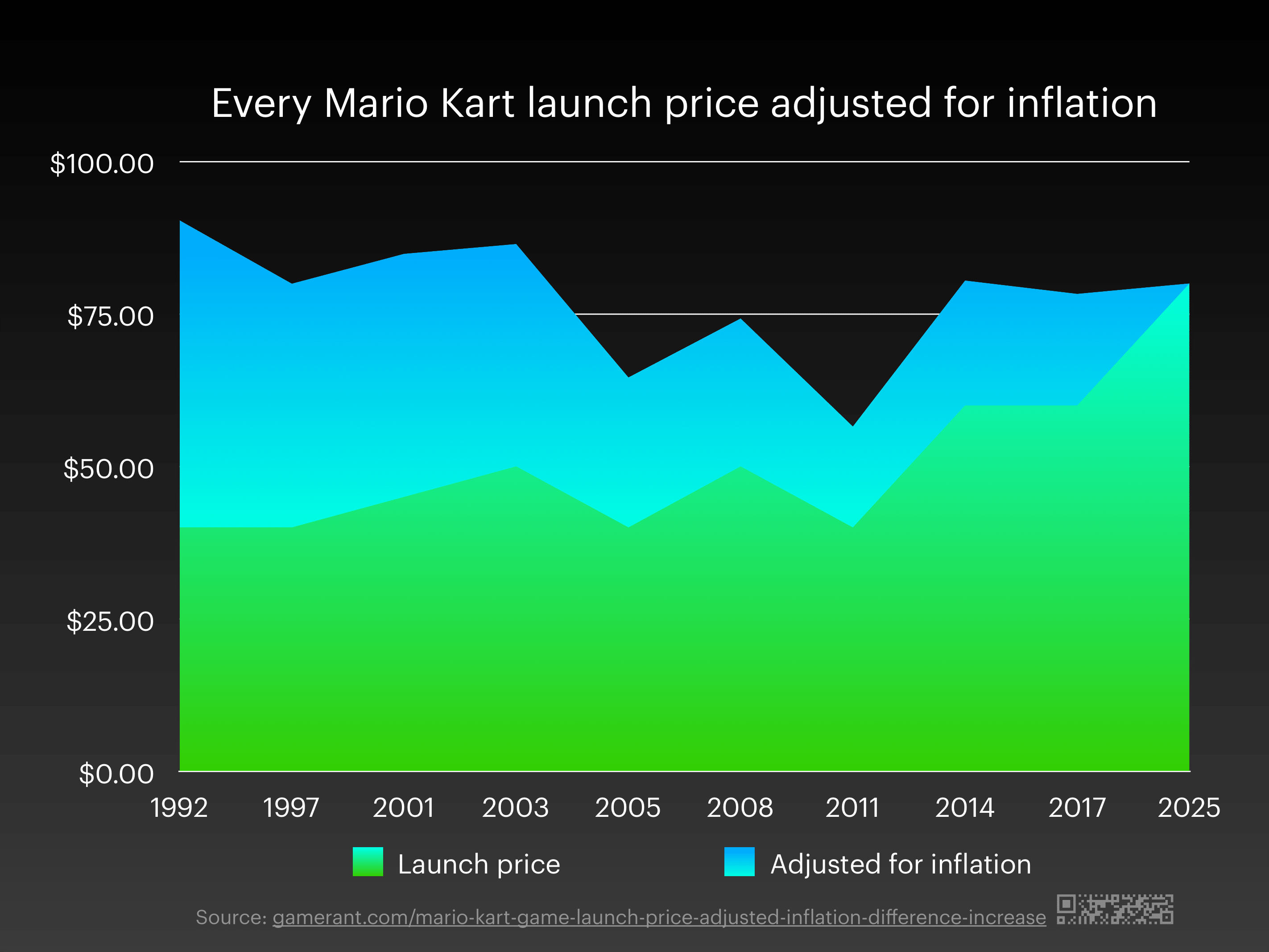
The color scheme you chose is horrendous IMO.
Boonpflug on
is this including the new tariffs?
Kitakitakita on
there’s inflation, then there’s unchecked, unregulated greedflation. We’re dealing with the latter these days
Palettenbrett on
But the wages didnt increase as much as inflation.
bigguccisosaxx on
Inflation as a whole is not a good metric. There is inflation for groceries, materials, etc. but there was no inflation for games.
podolot on
This is an ad to prep people for 80$ digital games.
silverbolt2000 on
Fuck me. How many more ways can you visualise the price of Mario games?
*“The problem with Reddit is not the number of bots, but the number of people whose behaviour is indistinguishable from bots.”*
joestaff on
Can we get a graph that depicts the console game market value adjusted for value? Or perhaps the net profit?
NW_Forester on
I am pretty sure original Mario Kart on SNES was not a sub-$50 game on release.
RyviusRan on
Just looking at price doesn’t tell much.
Game companies back then were much smaller with lower budgets, a smaller user base, and the physical cartridge was quite pricey.
Many factors made it so you had to sell at a much higher price to turn a profit.
In the 1980s, word processing software sold for hundreds of dollars.
Now in days a small indie group can turn out a quality game for 20 dollars that would be similar to Mario Kart.
The higher prices are not because developing is expensive.
Tobi97l on
Now do the average salary adjusted for inflation.
NeedAVeganDinner on
Booooo don’t use logic booooooooo
_Faucheuse_ on
It’s asinine to even bring it up, but maybe a few bucks off digital copies.
ButterbeerAndPizza on
You can’t compare the cost of consumer electronics to inflation, however. As technology advances, the cost to produce something decreases over its lifecycle. Look at the price of TVs, for example. A tv that used to cost thousands now costs hundreds.
Seileach on
I’m happy for you Nintendo fans, please keep being yourselves.
Glinckey on
Yeah but back then you could just give your game to someone else

![[OC] Every Mario Kart game launch price adjusted for inflation (USD)](https://www.byteseu.com/wp-content/uploads/2025/04/4f4ec67v4wse1-1536x1152.png "[OC] Every Mario Kart game launch price adjusted for inflation (USD)")
19 Comments
Source: On image
Tools: Keynote
Trying to explain to gamers why the low prices they already pay are not any higher than they used to be is a fool’s errand.
This point is valid. The context it’s missing is that you used to be able to walk down the block and rent a game for the weekend for $2. Most people didn’t own a bunch of $100 games back in the SNES days. I had 5 or 6 I think, and that was the most out of anyone in my friend group. I would usually get one game per year. Now, I have nephews who get a new game every month, sometimes even more. I did have Super Mario Kart though.
The color scheme you chose is horrendous IMO.
is this including the new tariffs?
there’s inflation, then there’s unchecked, unregulated greedflation. We’re dealing with the latter these days
But the wages didnt increase as much as inflation.
Inflation as a whole is not a good metric. There is inflation for groceries, materials, etc. but there was no inflation for games.
This is an ad to prep people for 80$ digital games.
Fuck me. How many more ways can you visualise the price of Mario games?
*“The problem with Reddit is not the number of bots, but the number of people whose behaviour is indistinguishable from bots.”*
Can we get a graph that depicts the console game market value adjusted for value? Or perhaps the net profit?
I am pretty sure original Mario Kart on SNES was not a sub-$50 game on release.
Just looking at price doesn’t tell much.
Game companies back then were much smaller with lower budgets, a smaller user base, and the physical cartridge was quite pricey.
Many factors made it so you had to sell at a much higher price to turn a profit.
In the 1980s, word processing software sold for hundreds of dollars.
Now in days a small indie group can turn out a quality game for 20 dollars that would be similar to Mario Kart.
The higher prices are not because developing is expensive.
Now do the average salary adjusted for inflation.
Booooo don’t use logic booooooooo
It’s asinine to even bring it up, but maybe a few bucks off digital copies.
You can’t compare the cost of consumer electronics to inflation, however. As technology advances, the cost to produce something decreases over its lifecycle. Look at the price of TVs, for example. A tv that used to cost thousands now costs hundreds.
I’m happy for you Nintendo fans, please keep being yourselves.
Yeah but back then you could just give your game to someone else
Now? Not anymore