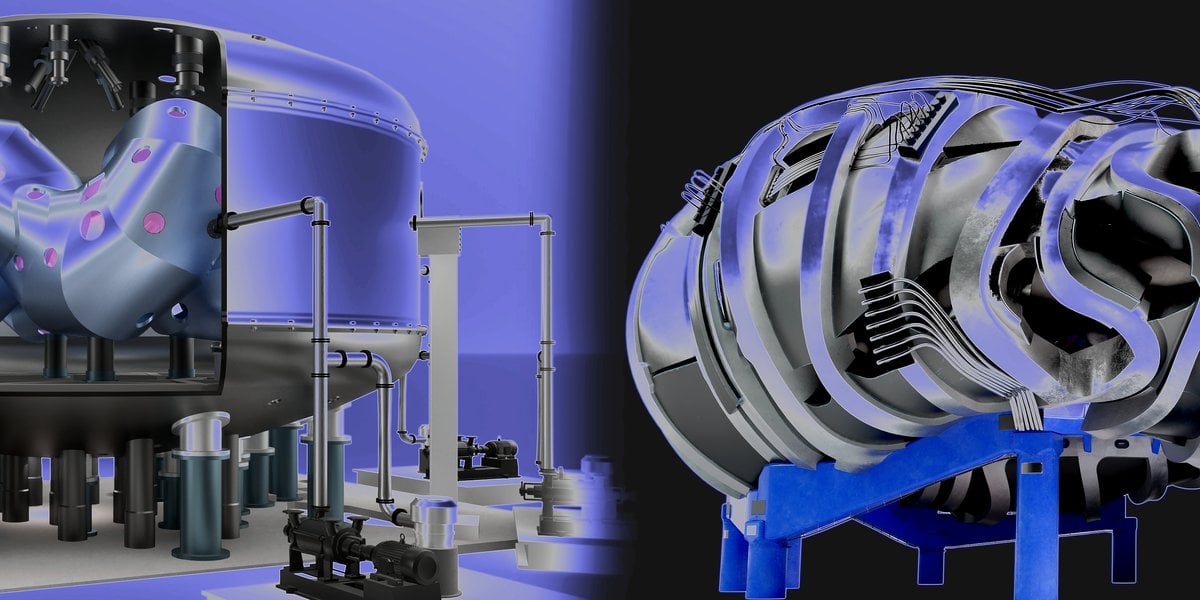
Get Ready for the Stellarator Showdown! – Two fusion firms unveil blueprints for commercial reactors in the 2030s
https://spectrum.ieee.org/stellarator

Get Ready for the Stellarator Showdown! – Two fusion firms unveil blueprints for commercial reactors in the 2030s
https://spectrum.ieee.org/stellarator
2 Comments
From the article
For decades, [nuclear fusion](https://spectrum.ieee.org/tag/fusion)—the reaction that powers the sun—has been the ultimate energy dream. If harnessed on Earth, it could provide endless, carbon-free power. But the challenge is huge. [Fusion](https://spectrum.ieee.org/tag/fusion) requires temperatures hotter than the sun’s core and a mastery of plasma—the superheated gas in which atoms that have been stripped of their [electrons](https://spectrum.ieee.org/tag/electrons) collide, their nuclei fusing. Containing that [plasma](https://spectrum.ieee.org/tag/plasma) long enough to generate usable energy has remained elusive.
Now, two companies—Germany’s [Proxima Fusion](https://www.proximafusion.com/) and Tennessee-based [Type One Energy](https://typeoneenergy.com/)—have taken a major step forward, publishing peer-reviewed blueprints for their competing [stellarator](https://spectrum.ieee.org/tag/stellarator) designs. Two weeks ago, Type One released six technical papers in a special issue of the [*Journal of Plasma Physics*](https://www.cambridge.org/core/journals/journal-of-plasma-physics/collections/physics-basis-of-the-infinity-two-fusion-power-plant). Proxima detailed its fully integrated stellarator [power plant](https://spectrum.ieee.org/tag/power-plant) concept, called Stellaris, in the journal [*Fusion Engineering and Design*](https://www.sciencedirect.com/science/article/pii/S0920379625000705?via%3Dihub). Both firms say the papers demonstrate that their machines can deliver commercial [fusion energy](https://spectrum.ieee.org/tag/fusion-energy).
At the heart of both approaches is the [stellarator](https://spectrum.ieee.org/tag/stellarator), a mesmerizingly complex machine that uses twisted [magnetic fields](https://spectrum.ieee.org/tag/magnetic-fields) to hold the plasma steady. This configuration, first dreamed up in the 1950s, promises a crucial advantage: Unlike its more popular cousin, the [tokamak](https://spectrum.ieee.org/tag/tokamak), a stellarator can operate continuously, without the need for a strong internal plasma current. Instead, stellarators use external magnetic coils. This design reduces the risk of sudden disruptions to the plasma field that can send high-energy particles crashing into reactor walls.
[deleted]