
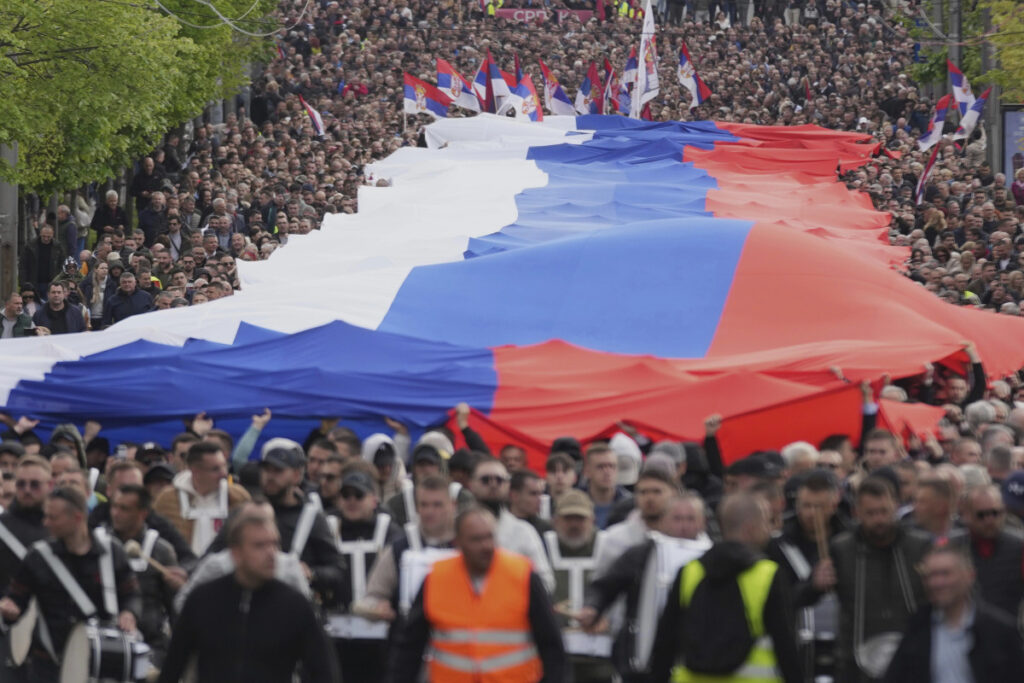
The involvement of Kosovo Serbs in the internal protests in Serbia and in support of President Aleksandar Vučić has become a front in the political battle between the government and the opposition in this country. Their participation has been used to strengthen the narrative of what the government in Serbia has called “national unity” against the protesters against Vučić’s rule. And analyst Arbnor Sadiku has said that the Serbian president is misusing Serbs for his own political purposes.
On the eve of the counter-protest to be held on Saturday in Belgrade in support of Serbian President Aleksandar Vučić, senior Serbian government officials have highlighted the participation of Serbs from Kosovo, presenting it as a sign of national unity and strong support for state policy towards Kosovo.
There has been no shortage of accusations against the opposition and critical media in Serbia, which, according to them, are treating Kosovo Serbs in a manner similar to the approach of Kosovo Prime Minister Albin Kurti.
Petar Petkovic, director of the Office for Kosovo in the Serbian Government, has accused the media of negatively portraying the participation of Serbs from Kosovo in the protest, as they have reported that they were not traveling on foot, as they said, but in buses. According to him, the media is “following them with drones, just like Kurti.”
“This just shows how much they are burdened with Serbs from Kosovo and Metohija who are marching to support President Vučić and their country Serbia, and are even spying on them with drones. In that way, they are very similar to Kurti. Don’t worry, Serbia will win,” Petković wrote on the “X” platform.
The statement was made at a time when political tensions have increased in Serbia, where protests and counter-protests have become the main means of political and social mobilization.
Analyst Arbnor Sadiku has said that the involvement of Kosovo Serbs in these developments is being misused by the government in Serbia to consolidate domestic support.
“The first thing is that historically, since the time of Milosevic, Kosovo Serbs have been used or misused by the government, once in Kosovo and now in Serbia. Even such statements, where in the past Serbs were told that ‘if an Albanian cow enters your agricultural lands, then attach its name, don’t say that it is just a cow, but also the Albanian surname’ and of course even today they misuse these protests to achieve the goal of maintaining power”, said Sadiku.
He stressed that Serbs may even be forced to go to Belgrade, due to Serbia’s conditionality regarding the provision of aid.
“It is known that Vučić is already in a major crisis in terms of legitimacy and what is called credibility in politics. In addition, he tries to lie to the Serbs of Kosovo, since they do not live the reality of Serbia and at the same time depend on the social assistance that Serbia provides for them, through parallel institutions, whether pensions or other economic assistance for Serbs. They are in a certain way dependent on Vučić’s malicious policy,” he emphasized.
And the opposition in Serbia has qualified the accusations raised by Vučić as an attempt to divert attention from internal problems, by instrumentalizing the Kosovo issue for political purposes.
A group of Serbs from Kosovo, who set out from Rudnica last weekend, plan to walk another 250 kilometers, in order to join the three-day rally to be held in Belgrade.
This is not the first time that Serbs from Kosovo have marched towards Belgrade, traveling hundreds of kilometers to show support for President Vučić. They did the same in 2023 and 2019.
On the other hand, Serbian students have secured the support of hundreds of thousands of people, after continuous protests seeking accountability for the 16 victims of the November 1 collapse of the newly renovated railway station shelter in Novi Sad. Their determination has also encouraged citizens who are dissatisfied with politicians and who have lost faith in state institutions.
In the March 15 protest, after sporadic incidents between protesters and police, students who had been organizing peaceful protests for more than four months called for an end to the protest, saying they could no longer guarantee everyone’s safety.
Vučić has rejected proposals for a transitional government that would prepare the country for early elections. Amid the tensions, Vučić’s supporters have set up a camp in central Belgrade, outside his state offices. They include former members of paramilitary units involved in the 2003 assassination of former Serbian Prime Minister Zoran Đinđić. The group has also included football hooligans known for inciting violence.
Vučić has repeatedly accused regional intelligence services, including Kosovo and Western ones, of being behind the almost daily student protests aimed at removing him from power. But he has offered no evidence for these claims.