
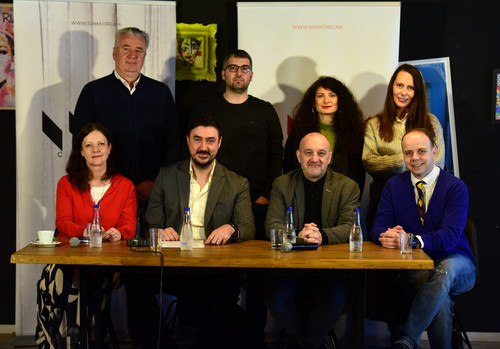
A delegation from the International Federation of Journalists (IFJ) took part in a mission to Skopje from 2 to 4 April to ensure that amendments to the country’s media law will include better working conditions and a safer working environment for journalists and media workers. In this context, the Independent Trade Union of Journalists and Media Workers (SSNM) issued the Skopje Declaration, which calls for national media legislation to be aligned with the European Media Freedom Act (EMFA) and the IFJ’s Global Charter of Ethics. The IFJ and the Association of Journalists of Macedonia (AJM) endorsed this declaration.
Journalists and media workers in North Macedonia are working in precarious conditions, with low salaries, and frequent breaches of their professional and labour rights. They are also facing threats and attacks that hinder their journalistic activities. Since October 2024, North Macedonia has been immersed in the process of revising its national media law. It is expected that amendments to this legislation will be debated in a first reading in a plenary session on or around 8 April.
In this context, the SSNM and the AJM are demanding that the government hold a comprehensive and open debate to ensure that national media legislation aligns with EU standards, especially the EMFA and the IFJ’s Global Charter of Ethics. If adopted, current amendments to the media law will harmonise the status between digital and traditional media. This is a recognition that journalists’ representatives in the country have long been fighting for.
However, “partial changes to the media law are not enough”, states the President of SSNM , Pavle Belovski. “We call on the government to hold a comprehensive and open debate with journalists’ representatives aimed at strengthening media pluralism, improving working conditions for media professionals and enabling a safer working environment for journalists.” Belovski points out that, in their current form, many local and community media will fail to register as media outlets because they do not meet certain requirements. “This needs to be addressed,” he concludes.
As part of the three-day mission organised by the journalists’ union, representatives of the IFJ and the SSNM met high-ranking government officials to press the case for key amendments such as improving working conditions for journalists and media workers, protecting media freedom and advancing towards a more favourable environment for professional journalism.
The delegation also visited the newsrooms of two leading investigative media organisations in the country, Investigative Reporting Lab (IRL) and 360 Degrees, to discuss media viability amid US funding cuts, protection and safety of journalists, and the proliferation of SLAPPs (strategic lawsuits against public participation) that are being used to silence journalistic investigations.
The mission ended with the launch of the Skopje Declaration on 4 April, as part of an EU-funded project on labour rights and independent journalism and the Union to Union (UTU)’s project ‘Building power for democratic rights, media freedom and decent work’. This declaration, developed by the SSNM and endorsed by the IFJ and the AJM, recalls that only well-paid media professionals working in a safe environment can produce journalism in the public interest, and asks the Macedonian government to commit to it.
At the launch of the Skopje Declaration, IFJ General Secretary Anthony Bellanger said: “While it is difficult to please everyone with amendments […], it is essential that the main interlocutors, journalists’ representatives, are listened to and that their demands are taken into account. We should never forget that journalists work in the public interest […] and that a democracy must ensure the ethical and economic independence of its journalists”.