
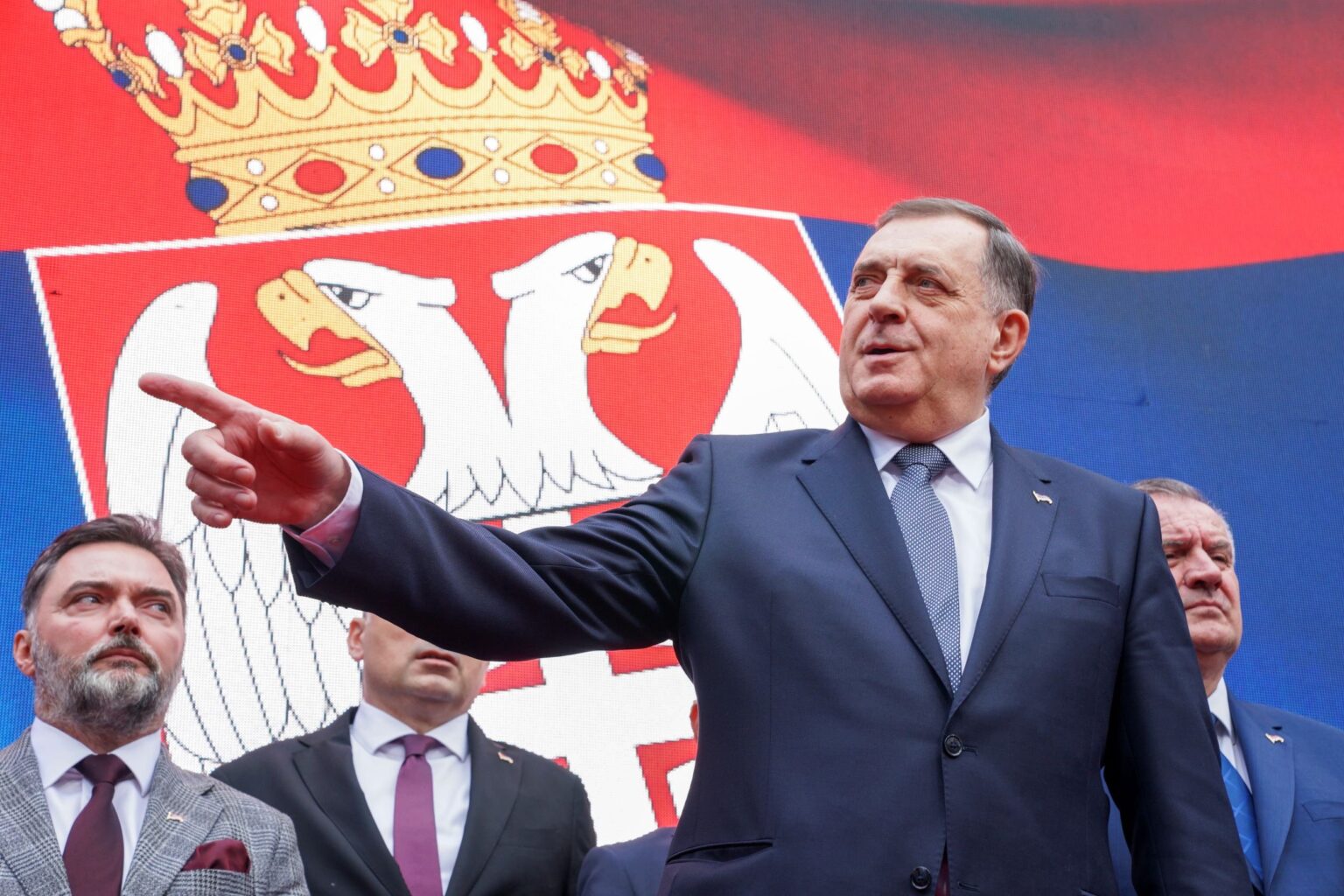
SARAJEVO, Bosnia-Herzegovina — Bosnia’s Constitutional Court on Friday suspended legislation by the deeply divided nation’s Serb statelet rejecting the authority of the federal police and judiciary on Serb territory.
The court said it was “temporarily suspending” the laws announced by Serb leader Milorad Dodik, “until the announcement of a definitive decision.”
The legislation in question was adopted by the Serb deputies in the Republika Srpska and was due to come into force on Friday. Both the European Union and the U.S. embassy in Sarajevo condemned the law.
Bosnia’s Foreign Minister Elmedin Konakovic described the law as a “textbook coup d’etat” in comments on Wednesday.
Dodik on Friday called on ethnic Serbs to quit the federal police force and courts and join the government of the deeply divided country’s Republika Srpska.
The call follows a series of moves that risk pushing Bosnia into greater uncertainty, a week after Dodik was convicted for defying an international envoy charged with overseeing the Balkan country’s peace accords.
“We have ensured them a job, while preserving their legal status, ranks, and positions. They will receive the same salary, or even a higher salary than they had,” said Dodik, the president Republika Srpska.
Dodik later added there were no plans for violent escalation but insisted that the Republika Srpska had “the ability to defend itself, and we will do that.”
Earlier this week, Dodik signed a raft of bills into law that banned the federal police and judiciary from his statelet.
Dodik pushed the legislation through the Republika Srpska parliament last week, after he was sentenced to a year in prison and banned from office for six years for refusing to comply with decisions made by Christian Schmidt, the international high representative charged with overseeing Bosnia’s peace accords.
The legislation has escalated tensions in Bosnia and is proving to be a key test for its fragile, post-war institutions.
Dodik also said this week that he planned to ignore a summons from Bosnia’s chief prosecutor who is investigating Dodik for allegedly undermining the constitution.
Tension
The situation on the ground remained tense.
At The Srebrenica Memorial Centre — where most of the 8,000 victims killed by ethnic Serb forces in July 1995 are buried — the facility said it had closed its doors “until further notice,” citing uncertainty triggered by the ongoing political crisis.
“This decision has been made due to the inability to ensure adequate security guarantees for our employees, collaborators, guests, and visitors,” the center, which is located in the Republika Srpska, said in a statement posted online.
During an interview with a local broadcaster, Darko Culum, who oversees Bosnia’s federal police force, dispelled rumours that their offices had been targeted by operations from Republika Srpskasecurity personnel in east Sarajevo and Banja Luka.
“The security situation in Bosnia and Herzegovina is stable and calm,” he told N1 television.
The Bosnian Muslim member of the country’s joint presidency, Denis Becirovic, also hit back at Dodik’s latest move and implored state employees to remain in their positions.
“Bosnia and Herzegovina will prevail. It is difficult indeed, but we will win. We cannot give up,” he added.
Separatist agenda
Since the end of Bosnia’s inter-ethnic war in the 1990s, the country has consisted of two autonomous halves: the Serb-dominated Republika Srpska and a Muslim-Croat statelet.
The two are linked by weak central institutions, while each has its own government and parliament.
The high representative holds vast powers in Bosnia, including the ability to effectively fire political leaders and strip them of power.
Dodik’s conviction last week was linked to his role pushing through two laws in 2023 previously annulled by high representative Schmidt.
The legislation refused to recognize decisions made by the high representative and Bosnia’s constitutional court in Republika Srpska.
This followed months of tensions, as Dodik engaged in a bitter feud with Schmidt.
For years, Dodik has pursued a relentless separatist agenda that has put him on a collision course with Bosnia’s institutions.
The Republika Srpska president has repeatedly threatened to pull the Serb statelet out of Bosnia’s central institutions, including its army, judiciary and tax system, which has led to sanctions from the United States.
—
By Agence France-Presse
Sign up for new weekly newsletter Closing Arguments to get the latest about ongoing trials, major litigation and hot cases and rulings in courthouses around the U.S. and the world.