
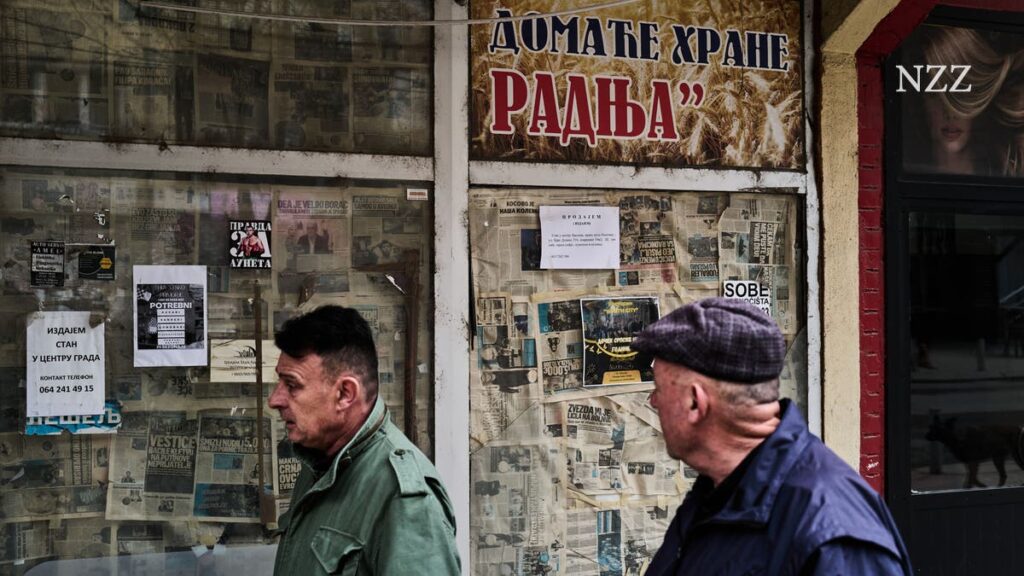
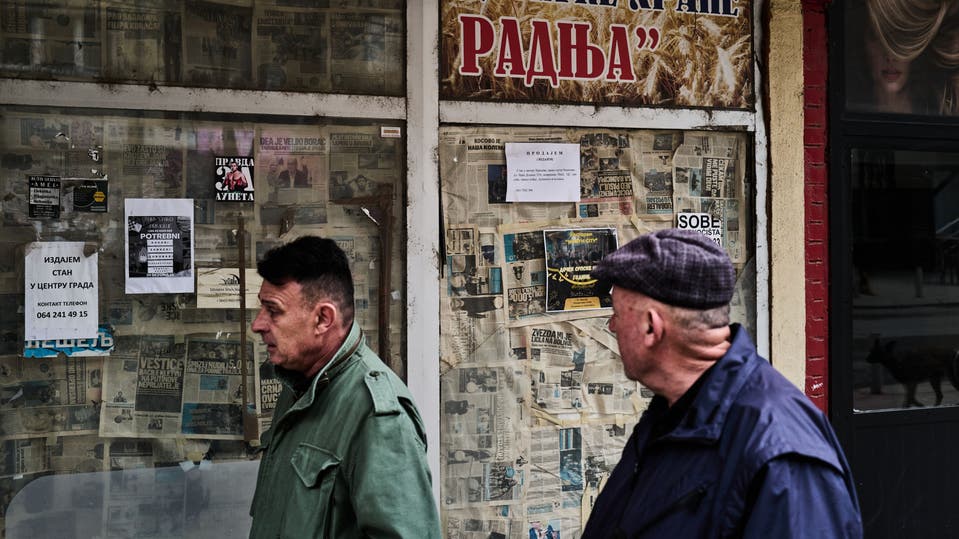
In the long-running standoff between Serbia and Kosovo, ethnic Serbs in Kosovo find themselves increasingly isolated. As political pressure mounts from both sides, tens of thousands are left asking the same question: Should we stay or go? A report on a marginalized community caught in the middle.
High above the northern Kosovo town of Mitrovica stands a brutalist monument from the Yugoslav era: two massive concrete pillars bearing a stylized mine cart. It honors the miners, both Albanian and Serb, who fought and died together resisting the Nazis during World War II. Once a symbol of Yugoslav unity, the site now looms over a region where that brotherhood has long since fractured.
Below, the town remains physically and politically divided. The smaller, Serb-dominated North Mitrovica and the larger, Albanian South Mitrovica are split by the Ibar river. Roughly 1.5 million Albanians and between 50,000 and 100,000 Serbs live in Kosovo. About half of the Serb population resides in the north, where they are the majority. The rest are scattered across the south in isolated towns and villages, many of them feeling like outsiders in their own country. Many still look to Serbia as their homeland – or hope, at minimum, for political autonomy. But that vision remains far out of reach.
Mitrovica: A city no longer entirely divided
Once the pride of the local Serb community, the promenade leading uphill from the Ibar Bridge to the center of North Mitrovica now feels subdued. The cafés, bars, and bookshops are still there, but the street is quiet. Serbian flags hang in tatters from the lampposts. Down near the bridge, Kosovar confectioneries and fast-food chains have taken the place of Serbian shops.
Many Serbs avoid these new establishments, seeing them as symbols of a slow, creeping takeover by Kosovo Albanians. They have largely withdrawn to the upper part of the promenade. At the nearby traffic circle, some cars now carry Kosovar license plates – mandated by Pristina since 2022 – but many still display codes from Serbian cities, a quiet act of defiance.
Inside a nearby café, prices are listed in euros, Kosovo’s official currency. Yet the waitress only carries Serbian dinars in her wallet, despite a government ban that took effect in early 2024. Customers who try to pay in euros are met with suspicion, but money is money. From license plates to pocket change, everyday life in North Mitrovica is marked by small but potent acts of protest – against Pristina, and against the man leading it: Prime Minister Albin Kurti.

Mitrovica remains divided: Serbs in the north, Albanians in the south, separated by the Ibar river.
On a wall in North Mitrovica, a pro-Serbian mural reads: «… because there is no turning back from here.»
Since taking office in 2021, Kurti, a left-wing nationalist, has made it his mission to assert Kosovo’s sovereignty in the Serb-dominated north. Step by step, he has rolled back Belgrade’s influence: banning Serbian license plates, shutting down Serbian-run post offices and insurance agencies. His actions have sparked protests not only from Kosovo’s Serbs but also from the European Union and the United States. Kurti has pressed on regardless.
At the same time, pressure from Belgrade continues. The Serbian government, still the largest employer in northern Kosovo, has instructed Serbs to boycott local elections and withdraw from Kosovo’s public institutions. The Serb minority has clearly become a political pawn, caught between Pristina and Belgrade.
Anastasija Djordjevic, 21, has lived through the escalating tensions of the past four years. She studies mathematics at the University of North Mitrovica, the only university in Kosovo still part of the Serbian education system, where classes are taught in Serbian.
«We Serbs don’t really care who owns a business,» Djordjevic says. «We still cross the river to shop or eat a meal with Albanians.» She says there are no problems living alongside Albanians, Roma or Bosniaks who have long lived in the north. Nonetheless, «That bridge is a border for us. I If someone from the south comes here and opens a shop, it feels like something’s being taken from us.»
In Kosovo, coexistence is often viewed as a zero-sum game, whatever one side gains, the other believes it has lost.
Anastasija Djordjevic, a mathematics student, lives in North Mitrovica. Like many young Serbs in northern Kosovo, she sees little reason for optimism about the future.
The bridge over the Ibar River links the Serb and Albanian sides of Mitrovica. But these days, it is open only to pedestrians.
Kosovo police have stepped up patrols in the divided city in an effort to prevent flare-ups. But tensions remain high. On Feb. 17, Kosovo’s Independence Day, a group of 12 Kosovo Albanians drove through town waving Albanian flags. They filmed themselves shouting threats at Serbs. «We’ve got a bullet for every Chetnik.» one man said in the video, using a wartime slur for Serbs.
For many Serbs in northern Kosovo, such provocations are deeply unsettling. They are stark reminders that they are seen as outsiders in their own towns. The images recall painful chapters from the past, including the war and the 2004 riots, when thousands of Serbs and Roma were driven from their homes by an Albanian mob.
Those who don’t cooperate are out
The man now charged with maintaining order here is Veton Elshani. A broad-shouldered Kosovo Albanian in his late 40s with a crew cut, Lt. Col. Elshani is officially the deputy police commander for the northern region. But in practice, he’s the top cop. His Serbian predecessor resigned in late 2022, along with all other Serb officers, in protest over Pristina’s decision to replace Serbian license plates with Kosovo-issued ones.
Pristina responded swiftly, filling the vacancies with ethnic Albanians. However, one third of the police force is now made up of Kosovo Serbs again, says Elshani. In his North Mitrovica office, a Kosovo flag trimmed with gold stands beside a television playing Kosovo-Albanian reality TV. On the desk sit two assault rifles. One is his, Elshani says. The other – a modified Kalashnikov – was seized after a deadly standoff in Banjska last fall.
Confiscated weapons and equipment, on display like trophies, in the police commander’s office.
Veton Elshani commands the police in northern Kosovo.
In September 2023, a group of 30 heavily armed Serbs ambushed a police patrol near the village of Banjska, killing a Kosovo officer. The attackers fled only after a Kosovo special police unit intervened, leaving three gunmen dead. Many in the region now view the incident as a turning point.
Elshani says things have improved since then. He welcomes the deployment of Kosovo’s militarized special police force in the north. But for the student Anastasija Djordjevic, the aftermath has only made things more tense. She describes the sight of heavily armed, Kosovo-Albanian police patrolling Serb neighborhoods as intimidating for the Serbs in particular.
Meanwhile, pressure has been mounting in the bureaucracy as well. Unlike Serbs living in the south, who often carry duplicate sets of documents – one issued by Kosovo, the other by Serbia – many in the north have relied exclusively on Serbian papers. «They now have three months to obtain Kosovan documents,» says Elshani. «After that deadline, I treat them as foreign nationals. They can apply for a residence permit – or they’ll be deported.»
For many Serbs in the north, it’s a harsh awakening. For more than two decades, they lived in a legal gray zone, hoping that one day the region would return to Serbian control. Now, Kosovo citizenship is being imposed, and Albanian businesses and institutions are expanding into their city. With the closure of Serbian-run offices, many have lost not only jobs, but also a sense of hope. Belgrade accuses Kurti of deliberately trying to drive Serbs out of the country, calling it «ethnic cleansing by political means.»
North Mitrovica’s main street stands nearly empty as two officers patrol.
In 2022, about 600 Kosovo Serb officers resigned from the joint police force in protest. Today, Serbs once again make up roughly a third of the civil servants in the region.
Djordjevic, the mathematics student from North Mitrovica, believes the Serb leadership also made mistakes. The mass resignation of Serb officers in 2022 and the boycott of local elections in 2023 – moves that allowed Kosovo Albanians to take over municipal leadership in the north – may have seemed like «good ideas back then,» Djordjevic says. «But they gave us a disastrous life.» She believes Kosovo Serbs need to return to the country’s institutions as quickly as possible if they want to have a voice in Kosovo. Without engagement, she says, survival is unlikely.
Goraždevac: A rare example of coexistence
Not all Serbs and Albanians in Kosovo live as separately as they do in Mitrovica. About 75 kilometers to the southwest, in the village of Goraždevac, some 700 Serbs live in the overwhelmingly Albanian municipality of Peja – far from the Serbian government’s influence. The mood there is also somber, but the reasons are different.
The road to Goraždevac winds through the Drenica region, once a stronghold of the Albanian separatist Kosovo Liberation Army (KLA) during the war in the late 1990s. Memorials and war graves appear regularly along the roadside. Flags of the KLA fly next to Albanian ones. The flag of Kosovo is conspicuously absent.
In central and western Kosovo, the Albanian flag often flies in place of Kosovo’s official flag. For many Kosovo Albanians, it remains the more meaningful national symbol.
Flowers placed on the grave of a fallen fighter from the so-called Kosovo Liberation Army (KLA).
Monuments honoring the KLA and flags bearing Albania’s black eagle are a common sight in Peja, the capital of the surrounding municipality. The city was heavily damaged during the war and was the site of ethnic cleansing carried out by Serbian forces. An estimated 80% of the homes were damaged or destroyed. After the war ended, Kosovo Albanians expelled the remaining Serbs from Peja and nearby villages – though Goraždevac was a notable exception. According to local accounts, NATO troops stationed in the area prevented the village from being overrun.
But the scars of war remain palpable. At the entrance to Goraždevac stands a memorial bearing the faces of two boys – one 13, the other 19 – killed in 2003. They were swimming in a nearby river when gunmen, believed to be Kosovo Albanians, opened fire on the group. Both were killed, and four others wounded.
Still, despite the trauma of the past, daily coexistence between Albanians and Serbs in the Peja municipality is largely functional. Much of that is thanks to Gazmend Muhaxheri.
A mayor defends his minority
Gazmend Muhaxheri, a member of the opposition Democratic League of Kosovo (LDK), has served as mayor of Peja since 2013. Two years ago, he drew heavy criticism for comparing Prime Minister Kurti’s approach to northern Kosovo with Serbia’s policies in the 1990s – when Belgrade stripped Kosovo of its autonomy and placed the province under direct Serbian rule.
Muhaxheri has since been severely attacked for this comparison. Detractors accused him of equating Kurti with Slobodan Milosevic, the Serbian leader later convicted of war crimes. «No,» Muhaxheri says, pushing back on the charge. «I was comparing the measures. They’re not equally bad, but both are inhumane.»
Gazmend Muhaxheri has been Peja’s mayor for 12 years.
In the village of Goraždevac, a yellow mailbox still hangs on the wall of the now-shuttered Serbian post office.
A year ago, on orders from Pristina, Kosovo police closed both the Serbian-run municipal office and the post office. The closures had serious consequences. Because Serbia does not recognize Kosovo’s postal or banking systems, many elderly residents now must travel more than 150 kilometers into Serbia just to collect their pensions.
An elderly man in Goraždevac says that he will not be able to keep making the trip for much longer. He will soon be too frail to make the journey, he says, and it eats up a sizable share of his already modest pension.
Mayor Gazmend Muhaxheri calls the shutdown of Serbian offices a propaganda move by the central government. In contrast, he has tried to keep lines of communication open with the local Serb community. He shares updates on the municipal budget and invites them to weigh in on local development plans. The Serbs give him credit for this and praise him for it. They are happy to see newly asphalted roads and improved street lighting. Some Serbs, quietly, even say they have begun voting for Muhaxheri’s Democratic League of Kosovo instead of ethnic Serb parties.
Still, when asked how he bridges the divide between Albanians and Serbs in Peja, the mayor has no clear answer. «Relations are good,» he says. «Not perfect, but good.»
But it is not just officials who hold a community together. Sometimes, it is the people themselves. Miroslavka Simonovic is one of them.
«People are good, politics divides them»
Simonovic, 60, has lived in the village of Goraždevac with her husband for 42 years. Like many Serbs in rural Kosovo, she relies on what she can grow and raise herself, such as vegetables from the garden, a few chickens, a couple of pigs. Before the war, her husband worked as a waiter at a hotel in nearby Peja. His pension from Serbia is not enough to live on, so Simonovic makes and sells traditional foods to get by: jars of ajvar, a roasted pepper spread; sauerkraut; and homemade rakija, a strong fruit brandy.
Miroslavka Simonovic holds a jar of her homemade pickled peppers. Selling local products helps her make ends meet.
Simonovic on her farm in Goraždevac.
She buys her ingredients from local Albanian farmers. All of her customers are Albanian, too, and they come straight to her door. «I’ve become good friends with many of them,» she says. «When the dinar was banned, some of them called to ask how they could help. I was so touched, I cried.»
Simonovic believes that the people in Kosovo, both Albanians and Serbs alike, are good. It’s the politicians who split them apart. She has nothing positive to say about them, she says, «so don’t talk to me about them!» She then gestures toward her home.
The roof sags, threatening to give way in the next heavy rain. She says she has repeatedly called the Serb List, the dominant Serb political party in Kosovo, asking for help with repairs. «Politicians just look out for themselves and their families,» she says. «Everyone else is left with nothing.»
For both Serbs and Albanians, the economic outlook in Kosovo is bleak. Private enterprise is scarce, and government jobs are often handed out through political connections. Many people have left. Simonovic’s children now live in Serbia and Montenegro.
The bus to Peja passes through Goraždevac, carrying both Serbs and Albanians who sit side by side on their way into town.
In the village pub, those without work gather in the mornings over beer, while Yugoslav-era films and television shows play in the background.
In Goraždevac, life offers a modest but powerful answer: Albanians and Serbs can live side by side. The question is whether their political leaders want that to happen. An EU-brokered agreement between Belgrade and Pristina has technically been in place since 2013. Under the deal, Serbia would accept Pristina’s authority over Kosovo, not formally, but in practice. In return, Kosovo’s Serb minority was promised a degree of self-governance through a unified association of Serb-majority municipalities.
But neither Kosovo’s Kurti nor Serbian President Aleksandar Vucic appears willing to implement the agreement. Kurti has continued to shut down Serbian-run institutions in northern Kosovo. Vucic, for his part, maintains that Kosovo remains – and will always be – a part of Serbia. A compromise seems nowhere in sight.
The village school, still operated by Serbia, displays portraits of two boys killed in 2003.
Latest articles
Global reporting. Swiss-quality journalism.
In today’s increasingly polarized media market, the Switzerland-based NZZ offers a critical and fact-based outside view. We are not in the breaking-news business. We offer thoughtful, well-researched stories and analyses that go behind the headlines to explain relevant events in the U.S., in Europe and worldwide. To produce this work, the NZZ maintains an industry-leading network of expert reporters around the globe who work closely with our main newsroom in Zurich.
Sign up for our free newsletter or follow us on Twitter, Facebook or WhatsApp.