
3-minute read
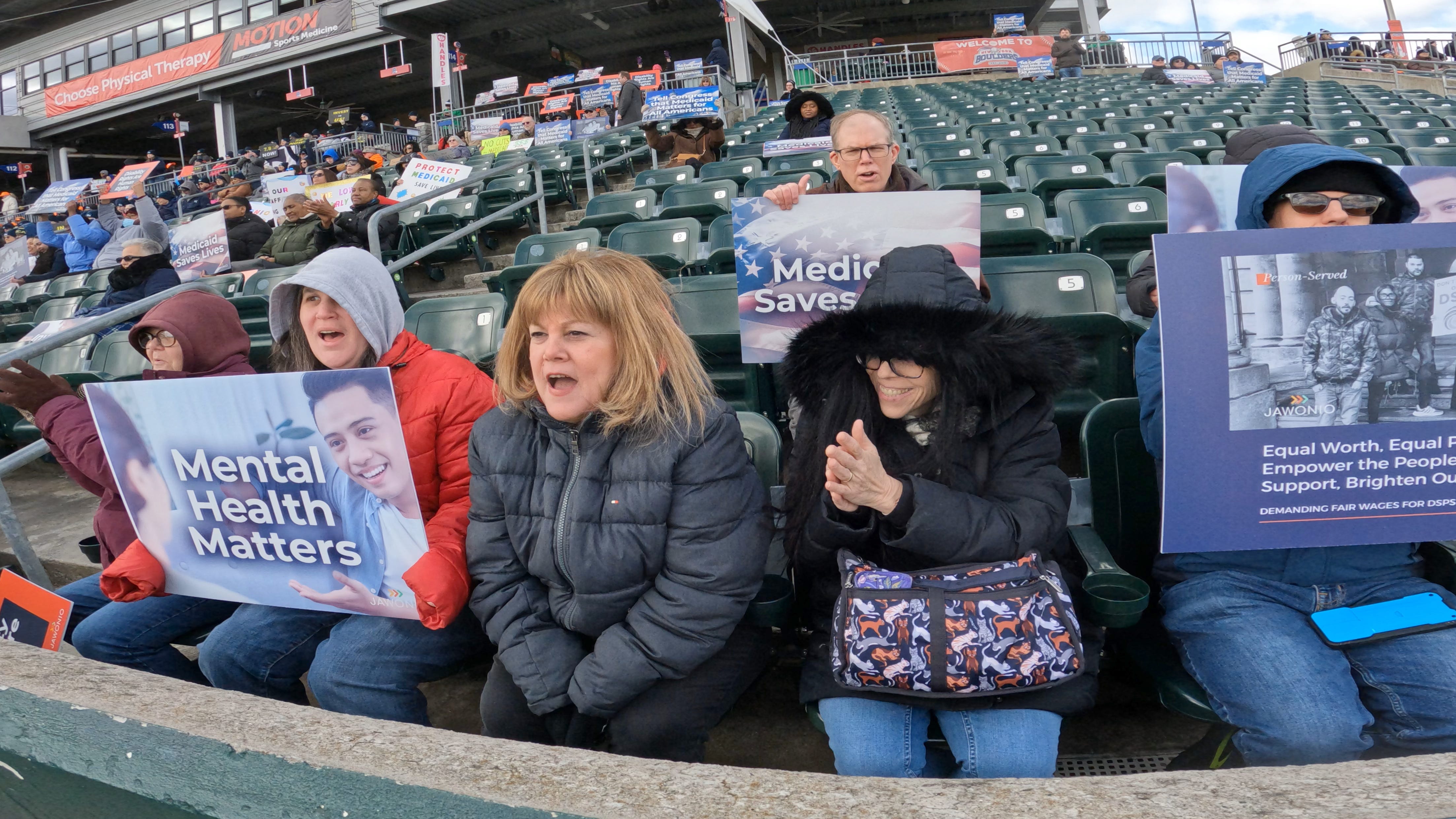

Rally against threats to Medicaid funding at Clover Stadium in Pomona NY
Rally in the Valley against threats Medicaid funding at Clover Stadium in Pomona March 7, 2025.
- Proposed cuts to Medicaid could slash up to $880 billion over 10 years, impacting millions of recipients.
- Medicaid is the most cost-effective way to provide healthcare to low-income families, disabled individuals and the elderly.
- Cuts would force states to reduce eligibility, benefits or provider reimbursements, jeopardizing healthcare access and jobs.
- Cost-saving proposals focused on reducing waste, fraud and abuse are absent from current Congressional discussions.
Medicaid provides healthcare to families with modest incomes, young adults who have aged off their parents’ insurance, people with disabilities and frail elderly individuals in long-term care. It covers your neighbors, your kids, your parents and grandparents. And it is now on the chopping block.
The program is administered by the states and jointly funded with the federal government. It is not cheap, costing more than $600 billion a year. That is why it is in Congress’ crosshairs. The House of Representatives’ budget plan would slash up to $880 billion from Medicaid over the next 10 years, about 11.8% of all federal funding to the states.
Despite the expense, which makes up less than 10% of all federal spending, Medicaid is the cheapest, most efficient way to provide health coverage to those who don’t have employer-based insurance. That explains why Texas, which chose not to expand its Medicaid program under the Affordable Care Act, has an uninsured rate of nearly 19%. By comparison, New York’s uninsured rate is under 5%.
More than 6.9 million New Yorkers use Medicaid. Moreover, the need and utilization does not respect political boundaries. Almost 900,000 individuals in the Hudson Valley are covered by Medicaid, the Essential Plan for those with modest incomes and the Children’s Health Insurance Program. They live in both red districts and blue ones, in cities, suburbs and rural areas. As much as 72% of long-term care expenses in this region are paid for by Medicaid. Not only would major cuts to Medicaid harm the health of New Yorkers, but they would also ravage healthcare providers and undermine the state’s economy.
If Congress follows through on the proposed cuts, the Kaiser Family Foundation estimates it would be a 22% decrease in Medicaid spending per New York resident. That leaves a few options, all bad: reduce eligibility, cut benefits or cut provider reimbursements. Under any one of these, healthcare providers would be placed in jeopardy (more uninsured patients destabilize any institution’s finances) and could be forced to reduce headcount. According to a Commonwealth Fund assessment, nearly 40,000 New York jobs could be at risk — staff at hospitals, doctors’ offices, pharmacies, nursing homes, etc. Such job losses will lead to reduced spending on consumer goods and services, housing and transportation. Local governments will collect less in sales and property taxes. Reduced staff also means less access to care for all New Yorkers regardless of insurance. Those kicked off the system will still seek care, but now in emergency rooms and often when earlier intervention could have helped. What Congress is proposing is the opposite of an economic stimulus and will lead to poorer health outcomes.
Some proposals currently being considered by Congress would save money by reducing eligibility through work requirements. But according to the Congressional Budget Office, while work requirements are certainly effective in cutting coverage, they do not increase employment. Other proposals would simply cut or cap federal support, particularly for those who qualify for Medicaid through ACA expansion. That is especially cruel to veterans, young adults, the homeless and other populations that were hard to reach before the ACA. Capped funding would be less than what New York receives now, and would lead to cuts during recessions or emergencies, when more people need coverage.
What is noticeably missing are any proposals specifically targeted to minimize waste, fraud or abuse – proposals such as rigorous provider screening, enhanced data mining powered by predictive analytics, and more robust enforcement of Medicaid managed care plans. These omissions suggest that Congress’ goal is less about efficiency and more about undoing the ACA’s Medicaid expansion to pay for tax cuts designed disproportionally to benefit the wealthy. Congress is explicitly backing into a number.
Meanwhile, there are real consequences for both public health and the state’s economy. Less federal support means less coverage, less access to care, and a decline in economic activity. Some may believe these sacrifices are worth it. But once the damage is done, it is not easily reversed. Congress should protect enrollees, healthcare providers and the economy by rejecting cuts to Medicaid.
Wendy Darwell is president and CEO of the Suburban Hospital Alliance of New York State. Michael N. Romita is president and CEO of the Westchester County Association.