
On Good Friday evening, as Orthodox Christians across Greece walked solemnly behind the Epitaphios, my phone lit up with a series of photos from a friend in Athens. They were stunning images. I even wrote a short piece and shared the series of images.
But there was one photograph that I was fixated on. Every time I’d swipe on my phone and pass this image, I quickly back swiped to look at it again. And again.
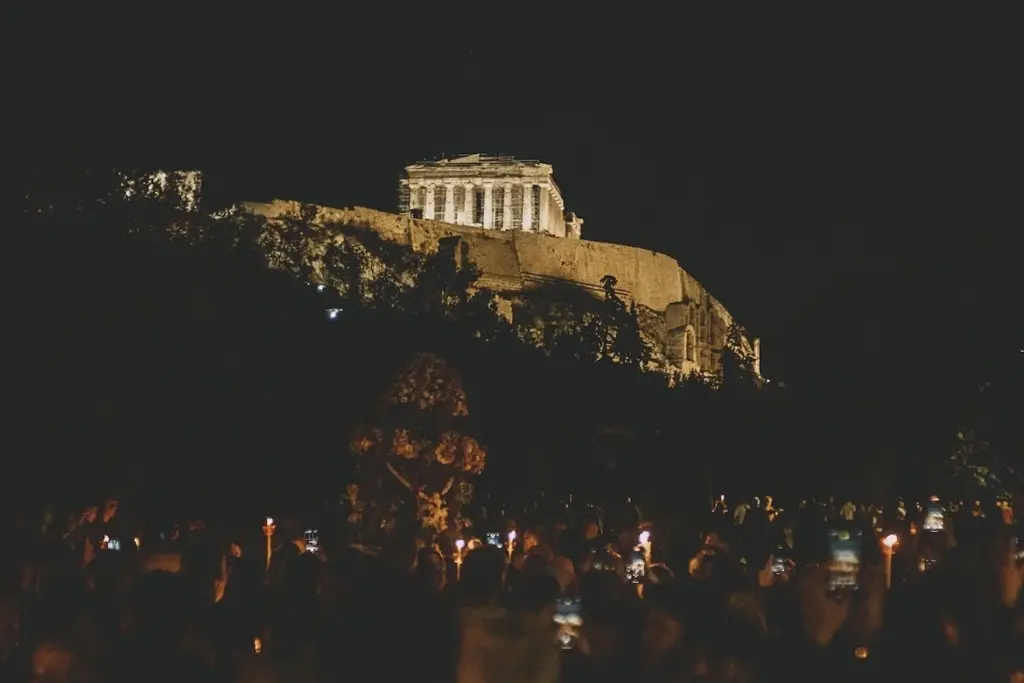
The image was striking in its quiet power: the candlelit procession winding through the streets of central Athens, heads bowed in reverence, with the Parthenon looming in the background, bathed in golden light.
A pagan temple towering over a Christian ritual. The goddess Athena, in ruins but not forgotten, watching over Christ in the tomb.
That one photo captured the essence of Greece in a way few words ever could—layered, complex, and full of sacred contradictions.
Without having any official statistics, I think I can say with confidence that if you ask a hundred Greeks on the street what structure they believe best represents the nation or is the national symbol—upwards of 85 or 90 would say “the Parthenon.”
Not the Hagia Sophia in Istanbul. Not the Monastery of Hosios Loukas. Not even the parliament building in Syntagma.
The Parthenon. A temple built for a goddess in a religion no longer practiced. A monument from a civilization that predates Christianity by centuries.
How is it that the Parthenon, once a temple to a pantheon of gods, is now the most iconic symbol of a modern nation whose soul is bound tightly to Orthodox Christianity?
The answer, I believe, lies in our ability as a people to embrace contradiction without discomfort. To carry forward the legacy of ancient Athens alongside the faith of Byzantium. To look to the Parthenon not as a religious symbol, but as a cultural one. A monument to democracy, reason, and artistic achievement—a mirror of our highest human aspirations.
Meanwhile, the Epitaphios, draped in flowers and tears, represents our deepest spiritual longings: mourning, sacrifice, and the hope of resurrection.
And somehow, they coexist.
In that single photo, ancient stones and sacred hymns met beneath the same Athenian sky. No tension. No contradiction. Just Greece being Greece. Greeks being Greeks.
Perhaps this is what makes Greek identity so enduring—not a single story, but a tapestry woven from many threads: ancient and modern, pagan and Christian, philosophical and mystical, broken and eternal.
This Good Friday, as the Epitaphios passed beneath the shadow of the Parthenon, I was reminded of something profound: our history does not divide us—it deepens us.
The Parthenon is not a relic of who we used to be, and the Epitaphios is not merely a symbol of who we are now. Together, they tell the full story.
And it is a story still being written.
Photograph by: Dimitris Polymenopoulos