
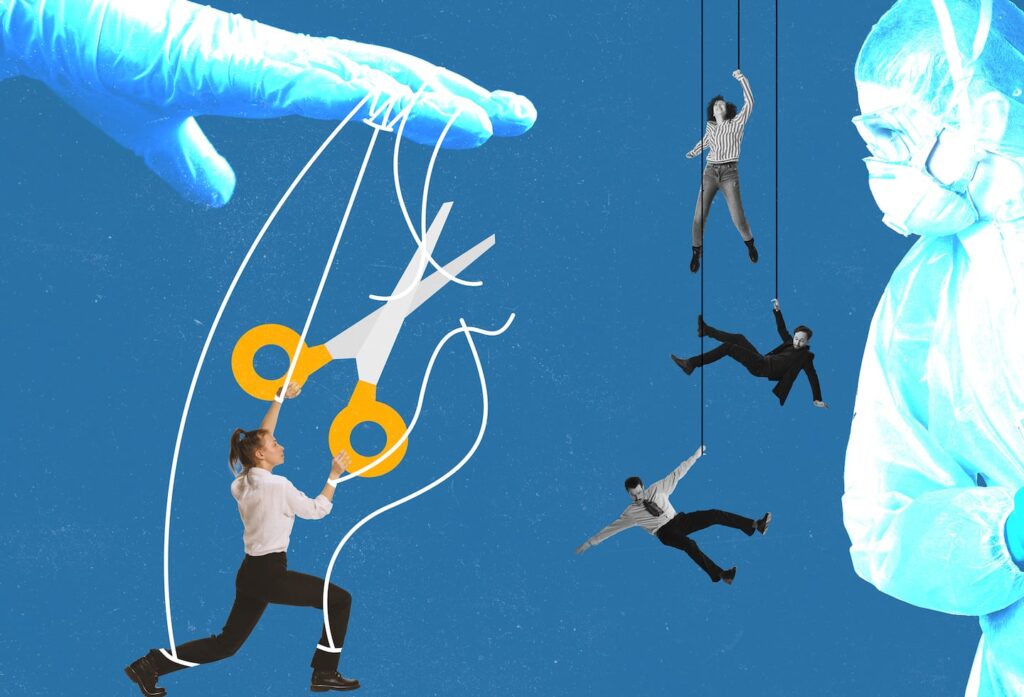
Yet the field’s illiberalism did not suddenly emerge during the COVID pandemic. A reckoning was long overdue: The pandemic merely revealed weaknesses in public health’s approach to human beings living with disease. I experienced this firsthand.
What it’s like to get tuberculosis
Most of us won’t interact directly with our public health department during our lifetime. Unless, that is, we contract what is considered a “reportable disease,” which happens to a small fraction of the population each year (COVID was only reportable for a short time).
In 2020, I was one of those people — but I didn’t have the novel coronavirus. I had somehow contracted the oldest-known and still deadliest infectious disease: tuberculosis.
I went to the doctor after a couple of months of coughing, which progressed to intermittent fevers, night sweats, and extreme fatigue. The nurse practitioner first thought the coughing was my childhood asthma rearing its head. Then she thought maybe it was a mild case of pneumonia. A week of antibiotics cleared up the fever and night sweats, for a while at least. But the cough never went away.
Finally, as the pandemic lockdown descended around us in late March, I went to get an X-ray. In some ways, I’m in the pandemic’s debt — I would have never bothered to get a cough checked out if COVID’s respiratory nature hadn’t put my husband on high alert. “What if it’s COVID?” he said, worried.
I got the call two days into what would become our months-long stay-at-home adventure. My X-ray showed granulomas in my lungs — little nests of calcified tissue protecting the billions of teeming Mycobacterium tuberculosis that had begun to eat away at my lungs.
Here’s what happens when the health care system suspects a reportable disease: First, your medical provider hands your case over to the local public health department. The health department becomes responsible for coordinating all aspects of your diagnosis and treatment, as well as carrying out contact tracing — tracking down and notifying anyone you might have infected.
In my case, which happened in New York State, they also put me under state-ordered quarantine. I was not allowed to leave my house. This and contact tracing are tools that are now familiar to most Americans, as many public health departments tried to implement them, with little success, to control COVID’s spread.
The State of New York became responsible for my care from that point on. The day after the X-ray news, I got a call from the tuberculosis control nurse at my local health department — I’ll call her Joan. She would become my caseworker through the duration of my treatment, although I eventually came to think of her as my warden.
Under New York state law, a person diagnosed with tuberculosis is mandated to complete a full course of antibiotics — often under the daily supervision of a trained health care professional. That means a state public health official has to watch you take your pills every day. In my case, that was six months of antibiotics: eight pills daily for the first two months and then three pills every day for the rest of the time. If a patient refuses to comply, the health department can order them to remain under quarantine for an indefinite period or in extreme cases have them committed to a state-run facility.
I was initially grateful for Joan. For the first few days the pills made me debilitatingly nauseous. After my first night of vomiting, Joan got me a prescription for an antiemetic and dropped it off at my house.
In order to contain the public health threat tuberculosis poses, the government takes care of coordinating all aspects of treatment — down to billing insurance. If you don’t have insurance, the state often pays for testing and treatment directly. I had unwittingly walked into an American’s vision of a Scandinavian health care utopia.
I didn’t have to call the doctor, make an appointment, go in for an exam, get the prescription, fight with the pharmacy over whether my insurance was up-to-date — instead, the medication just showed up at my door. And it was all free.
As the days passed, I slowly felt better. My state-ordered quarantine was lifted (not that it mattered, since we were on COVID lockdown) as I became noninfectious, and I started to go outside for long walks in the woods behind my house. My visits with Joan had turned into video calls as lockdown continued. (In nonpandemic times, the state would have required Joan to meet with me in person to supervise my daily dose of antibiotics.)
As I got the hang of my treatment, the daily video calls with Joan started to feel unnecessary. I asked her if I could move to checking in weekly or monthly — I was already required to meet monthly with an infectious disease doctor and have monthly blood work to make sure the antibiotics weren’t frying my liver (a fairly serious potential side effect of long-term high-dose antibiotic use).
But Joan’s answer was an unequivocal no.
Some form of daily observed therapy is the recommended standard of care for tuberculosis in every state, and Joan sent me a PowerPoint presentation explaining why having daily supervision from a nurse was necessary to make sure patients don’t slack on their treatment.
I pushed harder. I would take the drugs, as prescribed, no skipping doses. I had already seen what tuberculosis can do to people. I worked in a network of health clinics in Delhi, India, right after college, and the images of people unable to get out of bed, their emaciated bodies racked with fevers and coughs, have stayed with me. I was well aware of the risks and complications that came with not finishing treatment or skipping doses: drug-resistant tuberculosis — a scary diagnosis with no guaranteed cure.
And I had the state’s public health law on my side. Only patients who were “unable or unwilling” to complete treatment should be required to undergo daily observed therapy.
Joan was unpersuaded. “The TB control office told us to take you to court if you don’t comply,” she told me during a video call.
Well, that seemed a little heavy-handed.
To some extent, I understood Joan’s perspective. Her job was to make sure I didn’t infect anyone else with tuberculosis. Full stop. If I skipped doses, I put not only myself but potentially others at risk.
But a question weighed on me, fueling the anger I felt at being treated like a child: How big a risk was that really? Did that risk justify keeping me under Joan’s thumb and even taking me to court if I resisted? Wasn’t there a better use of Joan’s time than chasing after me?
Paternalism and public health
There are deep contradictions between public health and an individual’s rights to consent, privacy, and dignity. Most Americans didn’t have to grapple with these trade-offs until COVID forced the issue. But COVID was far from the first time the public health system has been tested — and has failed — to weigh the trade-offs it asks of people who contract infectious diseases.
Often, the trade-offs are framed as insignificant — small steps we are told we should be happy to take to protect our neighbors. Wearing a mask is easy — those who refuse are selfish. Staying at home isn’t such a big ask — how important is it really to go out to a restaurant or a friend’s party? In my case: It shouldn’t be a big deal to have someone watch me take pills every day. What’s the harm?
There is logic to this. But it ignores much bigger realities. Why should we be compelled to take steps that haven’t been shown to work? Daily observed therapy can be more or less coercive than what I experienced and has come under fire as being unnecessarily restrictive, resource-intensive, and ineffective. A 2015 Cochrane review found no evidence that daily observed therapy improved treatment outcomes for tuberculosis at all.
So why was I, a fully capable adult, under state supervision and threatened with legal action when I had done nothing wrong? Getting sick is not a crime. Yet public health officials sometimes treat illness as though it is.
This is not a new phenomenon. Some of the earliest American public health pioneers were deeply moralistic about the nature of illness. In the mid-19th century, health-minded urban reformers were taking aim at the lack of sanitation in European and American cities as a contributor to poor health. Here in Massachusetts, a statistician named Lemuel Shattuck produced a Report of the Massachusetts Sanitary Commission in which he wrote that drunkenness, sloth, and the “immoral lifestyle” of the poor contributed to disease.
As cities — including Boston — grew, Shattuck and his peers became concerned that the poor could infect the wealthy, necessitating the state to intervene. He recommended the state establish health boards to enforce sanitary regulations and to study specific diseases that disproportionately afflicted the poor, like alcoholism and tuberculosis (which killed 300 per 100,000 Massachusetts residents in 1850 — today, tuberculosis kills 0.2 per 100,000 nationwide). But the key point is that he did not trust the masses. He wanted state regulations in place not only to protect the common good but to police the least virtuous and keep them from infecting the rest.
This sort of attitude has been pervasive throughout public health history. Gay men were stigmatized and imprisoned all over the world during the early years of the AIDS crisis: Cuba quarantined people living with HIV, many of whom were gay, in medical facilities from 1986 until 1994. In the United States, public health campaigners targeted gay men and told them to simply stop having sex. Alcoholism and substance use disorders are still treated as crimes in most parts of the world. Compulsory drug treatment remains common, especially in Asian countries — and is growing in popularity in the United States and Canada. Tuberculosis is deeply stigmatized as a disease of the poor in countries where it is endemic, like India — and though it is less common today, mandatory detention and quarantine for the duration of treatment still happens.
Public health’s excesses are the downside of something positive: There is little doubt that public health workers are motivated by a desire to protect people’s health and lives. But too often, public health has failed to trust those people or respect their rights to question, debate, or even refuse.
Some of that is due to an excessively narrow measure of success, as political scientists Frances Lee and Stephen Macedo write in the latest broadside against public health’s response to COVID.
In July 2023, the former National Institutes of Health director Francis Collins acknowledged that the public health community had approached the pandemic too narrowly. “As a guy living inside the Beltway, feeling the sense of crisis, trying to decide what to do in some situation room in the White House…. We weren’t really considering the consequences in communities that were not New York City or some other big city. If you’re a public health person and you’re trying to make a decision, you have this very narrow view of what the right decision is, and that is something that will save a life,” he said. “It doesn’t matter what else happens. You attach infinite value to stopping the disease and saving a life.”
As the long-time global health reporter Donald J. McNeil writes in his recent book “Wisdom of Plagues,” “I think it’s imperative to save lives. To the exclusion of every other goal.”
In some ways, a field that closely resembles public health is the military — where we expect collateral damage in order to achieve victory. But that mind-set is a problem. It has eroded trust between public health and the people it purports to serve. Very few people outside the field are willing to suffer collateral damage to their lives and livelihoods for tenuous reasons.
Taking public health back
As the COVID pandemic unfolded, I saw my small example, my dynamic with Joan and New York state’s health department, playing out on a larger scale all around me. Americans across the country tried to make sense of what public health officials were telling them, often with increasing confusion and resentment.
Much of the populist backlash against public health can be attributed to disinformation campaigns and conspiracy theories — but not all of it. Some in the public health field have acknowledged, and are bravely grappling with, the fact that public anger over the pandemic response is justified. No one wants or deserves to be treated as though they are the unwashed masses, to hark back to Shattuck’s attitude.
So why has it taken me five years to write this essay? Because I have always been uninterested in piling on an already beleaguered sector — especially now, as the federal government attacks and undermines public health institutions. I believe that many, if not most, public health workers and leaders across America act in good faith. I have been wary of fanning the flames of antipathy toward the field — and encouraging politically motivated attacks on individual public health officials.
But I write this now because we will experience another pandemic, and we are in danger of failing worse than we did last time. It is critical we understand all contributing factors to that failure and attempt to root out the paternalism that proved to be a part of public health’s fall from grace.
Now the challenge is not to simply regain public trust. It is to retake the field from the forces like Robert F. Kennedy Jr. and his allies who threaten to destroy it from within. To do so, public health leaders will have to demonstrate their fidelity not only to saving lives but to the dignity and messy complexity of those lives.
Christine Mehta can be reached at christine.mehta@globe.com.