
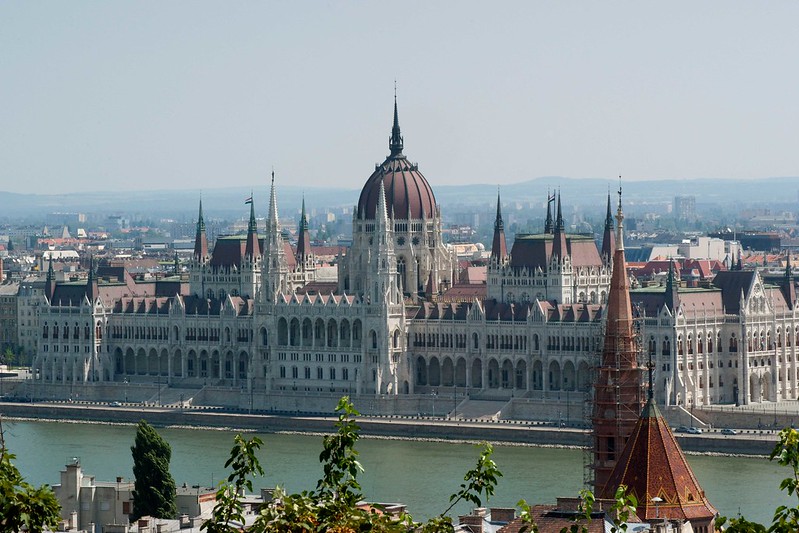
Hungary approaches its most pivotal elections since 1990 amid growing concerns over electoral integrity and the country’s democratic future. From GMF.
The term “watershed elections” is becoming devalued as electoral contests across the West increasingly serve as plebiscites on illiberal populism versus liberal democracy. But it is no exaggeration to say that, in the spring of 2026, Hungary will face its most consequential elections since the first free ones in its post-communist history in 1990.
Since 2014, every parliamentary poll has offered a slight chance to correct Hungary’s increasingly anti-democratic direction, yet ultimately pushed it further along the autocratization path paved by Prime Minister Viktor Orban and his Fidesz party. The next elections will determine the country’s democratic or authoritarian trajectory – and its geopolitical alignment will also be at stake.
Since 2014, Hungary under Orban’s regime has become increasingly detached from the strategic direction of the other EU member states. This has coincided with a realignment toward the main challengers of the EU and the European security order, a trend that became undeniable following Russia’s full-scale invasion of Ukraine in 2022.
Today, Orban’s authoritarian ambitions and his geopolitical realignment away from the EU have been emboldened by recent moves from the second Trump administration. These developments have cast doubt on the United States’ commitment to supporting democracies and maintaining the European security order, weakened Ukraine’s position, and encouraged further disruptions by the Kremlin.
Neither Free, Nor Fair
Against this backdrop, the stakes in Hungary’s next elections will be higher than they have been since 1990, not only for the country’s citizens but also for Europeans at large. Following the elections, the EU will face either a Hungary further radicalized in its role as a disruptor or one embarking on re-democratization and reintegration into the mainstream.
Hungary’s citizens have the right to decide their country’s direction and make this pivotal choice through free and fair elections, as EU membership stipulates. However, the political and electoral reality is far from that ideal. Hungary last held free and fair elections in 2010.
Since then, voters have been denied a fair electoral process due to the regime’s overwhelming media dominance and Fidesz’s comprehensive abuse of state resources, creating a fundamentally uneven playing field for political competition. This has been well documented in the election-monitoring reports of the Organization for Security and Cooperation in Europe’s Office for Democratic Institutions and Human Rights (OSCE-ODIHR) in 2014, 2018, and 2022.
In 2026, not only the fairness but also the freedom of the elections is likely to come under significant threat.
Hungarian politics is currently defined by a mix of promise and danger. For the first time since 2010, a domestic political force – the Respect and Freedom (Tisza) party – poses an existential challenge to Fidesz’s rule. Leading in most independent polls and campaigning on a platform of accountability and anti-corruption, Tisza is gaining momentum. Meanwhile, there is a growing perception among Fidesz stakeholders that the regime’s usual campaign tactics may not be sufficient to secure victory this time.
Encouraged by developments in Washington, Orban may be tempted to escalate his tactics. In 2026, beyond cracking down on independent media and civil society, he could manufacture widespread election-day irregularities to tilt the outcome in his favor.
Robust Election Observation Needed
Hungary has experienced significant election-day irregularities before, particularly in 2018. These included the organized transportation of voters, fraudulent voter registration in border regions, voter intimidation – especially of public-sector employees and social-security beneficiaries – and vote buying in rural areas and minority communities.
Election watchdogs such as Unhack Democracy found a clear correlation between the proportion of invalid votes and the presence or absence of opposition ballot counters at polling stations. They calculated that, while election-day irregularities were not decisive in securing Fidesz’s governing majority, they may have been crucial in obtaining its two-thirds constitutional supermajority.
In 2022, the deployment of nearly 20,000 independent civic ballot counters and a full OSCE-ODIHR election observation mission helped safeguard the integrity of the ballot on election day. However, the recently adopted and controversial Sovereignty Protection Law may hinder the deployment of a similarly strong domestic effort in 2026. Opposition from the United States and indecision among EU member states could also jeopardize the possibility of a full OSCE-ODIHR mission.
Therefore, election-day irregularities could determine the outcome of next year’s contest, potentially leading to a rigged result in an EU country – similar to Georgia in 2024 – that would likely be swiftly recognized by the Trump administration.
EU Leadership Crucial
To prevent this disastrous development for Hungary’s prospects of re-democratization – and for the democratic integrity of the EU – member states must ensure robust election observation in the country.
Above all, this must mean a full OSCE-ODIHR mission. While deploying one in an EU country is politically sensitive as it signals significant irregularities, the parliamentary elections in Bulgaria in 2021 and Hungary in 2022, as well as this year’s presidential election in Romania, provide precedents.
In 2022, the United States championed sending a full mission to Hungary within the OSCE. This time, however, EU member states must take the lead and push for the mission’s approval, even in the face of potential U.S. opposition.
OSCE-ODIHR is expected to decide on the nature of its election observation mission to Hungary around September, following a needs-assessment mission. Until then, EU member states have the opportunity to push for a full mission and to signal their willingness to support it financially and with human resources. In addition, robust observation should include a sizable European Parliament mission as well as missions from individual member states.
This monitoring would serve two purposes: deterrence and documentation. The 2022 elections demonstrated that a large-scale effort can deter incumbents from deploying election-day irregularities and that electoral integrity can improve despite years of democratic backsliding. Solid documentation of any irregularities will also be crucial for the legitimacy of the next government, regardless of whether Fidesz or Tisza emerges victorious.
Finally, the Sovereignty Protection Law should be suspended to enable the recruitment and training of a large independent domestic ballot-counting force. This could and should be achieved almost immediately through an interim ruling by the Court of Justice of the European Union, at the request of the European Commission in its ongoing infringement procedure against the law.
It is of utmost importance that EU member states prepare now to address the risk of election-day irregularities in Hungary next year. A robust international observation effort and the suspension of the Sovereignty Protection Law are crucial steps to protect the country’s democratic future and the integrity of the EU.
Daniel Hegedus is regional director for Central Europe at the German Marshall Fund, where this article was originally published. Reprinted by permission.