

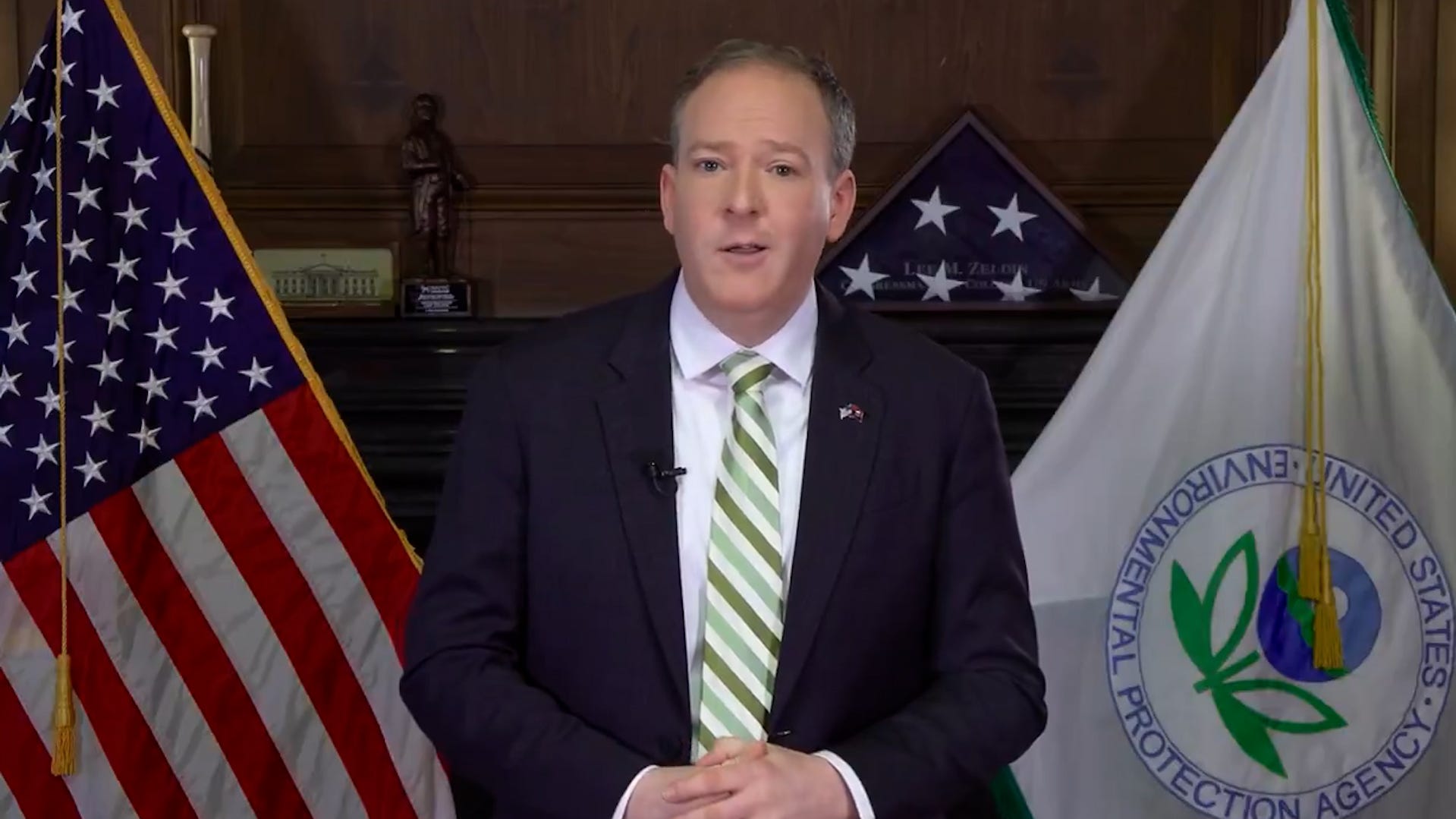

What do Lee Zeldin’s EPA rollbacks mean for Americans?
Lee Zeldin announced the Environmental Protection agency would roll back regulations aimed fighting climate change and pollution.
- The Trump administration’s rollback of environmental regulations is projected to cause significant public health issues and economic costs.
- Proposed cuts to the EPA and NOAA, including the closure of a key Great Lakes research lab, threaten environmental protection efforts.
- Trump’s actions endanger binational agreements crucial for Great Lakes management and invasive species control.
On April 22, Americans across our divided political landscape will celebrate the 55th Earth Day, reaffirming our commitment to wise environmental stewardship. We will do so not in a vacuum, but amid a ferocious assault on our nation’s public lands and environmental laws by the Trump-Musk administration. In part because this story has gotten overwhelmed by the larger authoritarian tsunami of these first 90 days, it seems an appropriate time to survey the wreckage.
Crowned by a rollback of 31 environmental laws and regulations — what Lee Zeldin, U.S. Environmental Protection Agency administrator, announced March 12 as “the most consequential day of deregulation in U.S. history” — this administration’s sweeping actions will not only gut environmental protection and endanger the health of Americans, they also will increase health care costs, undermine the fast-growing renewable energy sector of our economy, and sabotage the long-overdue investment in addressing the existential crisis of climate change. Independent, scientific analysis by the Environmental Protection Network indicates that the administration’s gutting of standards for allowable levels of pollution will lead to nearly 200,000 premature deaths by 2050, cause at least 10,000 more daily asthma attacks, and cost the public $6 for every dollar saved by deregulated industries.
Notwithstanding relentless Trump-GOP resistance, the Inflation Reduction Act (IRA) signed by President Biden has already created more than 400,000 jobs in the clean energy industry and is lowering energy costs for working families and businesses. But now President Trump is doing all he can to cancel congressionally authorized projects already in the pipeline. In February, Pennsylvania Governor Josh Shapiro sued the administration to unfreeze $2.1 billion for programs aimed at remediating abandoned coal mines, advancing the commonwealth’s transition from fossil fuels, and protecting our air and water. Further, the GOP budget would reverse much of the IRA’s progress, one study estimating it could increase household electricity costs by more than $110 in 2026, threaten $500 billion in planned investments, and result in 1 million fewer jobs.
Equally alarming, in my view, is Zeldin’s plan to fire up to 1,155 EPA scientists — 75% of those at the Office of Research and Development. The reported likely closure of the EPA’s lab in Duluth — a world-renowned leader in environmental toxicology freshwater research — is especially alarming. Closure or severe cuts at the lab would have devastating impacts on protecting the health of the entire Great Lakes basin.
This president may not know or care, but the Great Lakes hold 90% of this nation’s freshwater and the drinking water of 40 million people across eight states and two Canadian provinces. We who live here know that protection of Lake Erie and its watershed is essential to not only tourism and recreation but the broader economic vitality of northwest Pennsylvania. Until the Trump era, protection and restoration of the Great Lakes had been a bipartisan endeavor. Back in 2017, Mr. Trump proposed cutting by 97% the Great Lakes Restoration Initiative (GLRI) — an effort that fortunately was defeated by politicians of both parties. Since 2010, nearly 3,500 GLRI-supported projects have aided cleanup and remediation of toxic sites and other environmental pollutants, helped control coastal erosion, researched and helped control deadly algal blooms, restored habitat, and helped to preserve native species.
According to the Great Lakes Commission, every dollar invested by the GLRI generates $3.35 in local economic activity. Although the GLRI’s fate is unclear in Trump 2.0, the broad assault on the EPA, in concert with chainsaw-wielding Elon Musk and his so-called Department of Government Efficiency (DOGE), does not bode well, in my view. If GLRI manages to survive, it is unclear who will be left at EPA to staff it. The damage will be further compounded by devastating cuts at the National Oceanic and Atmospheric Administration’s (NOAA) Great Lakes Research Laboratory in Ann Arbor, Michigan.
Further demonstrating his contempt for a positive relationship forged over more than two centuries, Mr. Trump in February expressed to Canadian Prime Minister Justin Trudeau his desire to eviscerate the U.S.-Canada agreements and conventions governing management of the Great Lakes. Together, the Boundary Waters Treaty and International Joint Commission (1909) and the Great Lakes Water Quality Agreement (GLWQA, 1972) have guided the binational stewardship of the Great Lakes, which is a global model for managing freshwater resources. Controlling invasive species, monitoring ice cover, and reducing algal blooms require binational cooperation. Given this president’s threats against Canadian sovereignty, coupled with the cuts at EPA and NOAA, it appears all of it now is at risk.
Also threatened by the Trump-Musk chainsaw is the successful program aimed at controlling the blood-sucking, fish-destroying sea lamprey — the most notorious invasive species threatening the health of the Great Lakes fishery. Following blowback to the reckless firing of EPA workers and cutbacks in seasonal employees critical to the program back in February, the Trump administration restored some of the positions. But the six-week delay and ultimately reduced staffing levels have imperiled this year’s effort to control the creature. Musk and Trump claim to be advancing efficiency. To protect a fishery valued annually in the hundreds of millions of dollars, the sea lamprey program costs roughly $20 million — $10 million less than what President Trump’s golfing excursions had cost taxpayers as of late March.
DOGE has targeted other effective invasive species programs, including those pertaining to the spotted lanternfly, which poses a looming threat to the grape-growing, wine-producing regions of the Finger Lakes and the Great Lakes Basin. Critical federal funding has also been suspended to Trout Unlimited, an organization that works closely with agencies such as the U.S. Fish and Wildlife Service to protect freshwater resources in every state. Federal TU funding supports scientific analysis of invasive species, stream flow, coal mine remediation, and restoring watershed health — research that in some cases is many years in process. As with cuts at Social Security and other agencies, no thought has been given to the impacts on not only ecological health, but the essential role that river and stream health plays in local tourism and recreation economies across the Great Lakes Basin, including northwest Pennsylvania.
There is no end to the anti-environmental devilry. Despite communities of color being far more likely to live with high levels of pollution, the Trump administration has terminated the office aimed at addressing issues of environmental injustice. On March 25, Zeldin’s EPA and Musk canceled more than $1.7 billion already granted to communities across the country to remove lead from drinking water, reduce pollution, improve home energy efficiency, and grow neighborhood tree canopy.
Donald Trump will likely mark Earth Day by uttering the sort of grotesque disinformation or babble about cancer-causing wind turbines or weak shower flow to which Americans are now tragically inured. But as with the tariff trade war chaos and every other domestic policy action I believe he is taking to reverse more than a century of American progress, his anti-environmental agenda will be resisted by Americans with urgency. Our children’s future depends on it.
Chris J. Magoc is the author of “A Progressive History of American Democracy Since 1945” and a retired history professor. He serves on the leadership team of French Creek Indivisible.