
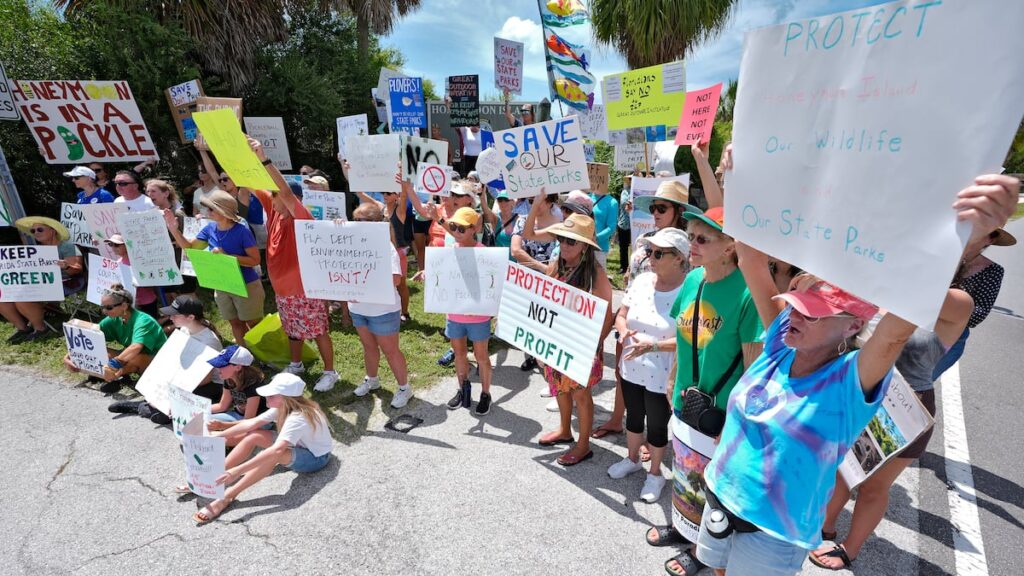
In a rare move, a panel in the Florida Senate rejected an amendment filed by a prominent Republican lawmaker to weaken a bill to prohibit golf courses, hotels and other amenities from being built in state parks. The vote Tuesday inched the Legislature toward a potential showdown with Gov. Ron DeSantis.
As they voted against the amendment, lawmakers on the Senate fiscal policy committee said the public sent a clear message last summer when they protested en masse against plans by the DeSantis administration to build golf courses, 350-room hotels and more on nine parks.
“I can think of few issues that united and galvanized folks so quickly across all spectrums than the prospects of golf courses being put on state parks,” said Sen. Jennifer Bradley, R-Fleming Island.
Several lawmakers said they received hundreds of emails and calls from concerned Floridians after the amendment was filed Monday.
In his final appeal for his doomed amendment, Sen. Joe Gruters, R-Sarasota, asked his colleagues to trust state government to only bring forth ideas that wouldn’t “substantially harm” the environment, an undefined threshold that his amendment would have created.
Under the amendment, if officials determined proposed amenities like golf courses or pickleball courts wouldn’t harm the environment, they would still be allowed. The same agency that brought forward last year’s parks development plans, the Florida Department of Environmental Protection, would be tasked with deciding which developments cause that “substantial damage,” according to the discussion among lawmakers.
“Do we trust state government to make the right decisions?” Gruters asked. His fellow lawmakers — as well as some members of the audience — groaned: “No!”
The bill, sponsored by Sen. Gayle Harrell, R-Stuart, passed without the amendment and now heads to the Senate floor.

Michelle Birnbaum, of Dunedin, speaks to the media at the entrance to Honeymoon Island State Park on Aug 27, where people gathered to protest against the “Great Outdoors Initiative” proposal to add golf courses, hotels, pickleball courts and other developments to nine Florida state parks. [ DOUGLAS R. CLIFFORD | Times ]
Negotiations may come down to the wire. Tuesday, which was Earth Day, marked less than two weeks before the scheduled end of the legislative session on May 2, at which point all bills that haven’t passed will die.
As the clock ticks, behind-the-scenes wrangling over the bill includes not only Republican lawmakers but also DeSantis.
His administration drew up the widely condemned plans last year.
His office has concerns with how the bill is worded, according to Harrell. This bill was proposed by Republicans to prevent plans like those from ever emerging again.
“There’s been concern from the governor’s office on it, and I’ve had conversations with them,” Harrell said in an interview. “I want to work with them to make sure we get a bill across the finish line. … We want to make sure it is signed and becomes law.”
Subscribe to our free DayStarter newsletter
We’ll deliver the latest news and information you need to know every morning.
Want more of our free, weekly newsletters in your inbox? Let’s get started.
After the Tampa Bay Times first reported the DeSantis administration’s plans to develop parks, Gruters publicly opposed the ideas.
But in an interview before the committee meeting Tuesday, he told a Times/Herald reporter that he wants to make sure “we don’t limit ourselves forever” on possible development opportunities in parks.
“If the park system goes and buys land and wants to create something that’s unique, that’s not allowed,” Gruters said. “We’re enshrining this forever.”
When asked if he’s been working with the governor’s office on the bill, he replied, “I don’t know. A lot of people, a lot of people want to help.”
An attendee of the “State Park Love Fest” holds up a sign at Honeymoon Island State Park on April 5. Across the state, Floridians convened at more than a dozen state parks to urge lawmakers to pass a version of the “State Park Preservation Act” that eliminates any loopholes that could be used by developers in the future, according to the advocacy groups that organized the event. [ Max Chesnes | Times ]
During the committee meeting, Gruters repeated the false claim made by DeSantis that the plans released by Florida’s environmental agency weren’t “the final product” because a concerned employee leaked the proposal. But the agency itself publicly posted the ideas on its website and shared them on social media.
The governor’s office did not respond to emails asking for details on DeSantis’ stance. His staff has not responded to repeated questions sent by email and text about whether he plans to sign the bill.
Last week, the House passed a strengthened version of the bill that banned hotels, golf courses and similar facilities after removing subjective language that environmentalists worried could be exploited as loopholes.
The Senate must now negotiate with the House to determine the final version. The two halves of the Legislature must agree on identical language before a bill can be sent to the governor for his signature. Because the House has already passed its version, the Senate must either take up the other chamber’s bill or the House must pass it again with the Senate’s changes.
If the full Senate votes to join the House in creating a stronger bill, DeSantis will be forced to decide whether he will sign a measure that explicitly counters an idea from his own administration, which his top staffers helped craft.
But despite the political backdrop — particularly as legislative leaders feud with DeSantis on an unrelated controversy surrounding a charity led by his wife — sponsors of the bill have instead framed this bill as an opportunity to listen to the public, rather than a rebuke of the governor.
“I want something to protect our parks and make sure we’re preserving them for the next generation — my grandkids,” Harrell said.
Times/Herald Tallahassee bureau staff writer Romy Ellenbogen contributed to this report.