
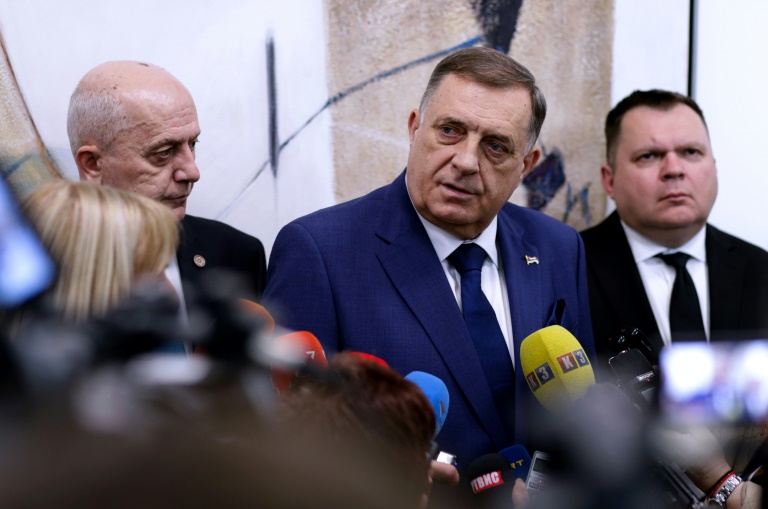
Bosnian Serb leader Milorad Dodik returned to the Serb-controlled part of the capital on Thursday, hours after federal police failed to arrest him there on secession charges.
Dodik, president of the Bosnian Serb statelet, is wanted by Bosnia’s central judiciary after a series of secessionist moves but continues to defy an arrest warrant issued in mid-March.
Since the end of its ethnic war in the 1990s, Bosnia remains split into two highly autonomous halves — the Serbs’ Republika Srpska (RS) and a Muslim-Croat Federation — linked by a weak central government.
On Wednesday, federal police officers tried to enter an official building in East Sarajevo, a Serb-controlled area of the Bosnian capital, to arrest Dodik but were blocked by Bosnian Serb interior ministry forces.
“Our colleagues from the RS ministry simply weren’t cooperative or, rather, they believed that it shouldn’t be carried out, that it could perhaps lead to some conflict,” said Jelena Miovcic, spokeswoman for the federal police force (SIPA).
“We simply assessed that proceeding might cause bigger problems… In the end, we didn’t go in armed,” she added.
“It was meant to be handled in a civilised way, to explain things clearly — that we are legally obliged to enforce the court order from Bosnia and Herzegovina,” she told AFP.
– Institutional weakness –
Aleksandar Popov, an analyst monitoring the Balkans, told AFP that this was the “expected outcome” and reflects the limited powers of Bosnian and international institutions.
An international “high representative” and a European military force, EUFOR, are tasked with overseeing implementation of a 1995 peace accord following Bosnia’s inter-ethnic war.
The failed arrest attempt “shows that Bosnia is not capable of enforcing its own laws or executing the orders of its courts and prosecutors,” said Popov, president of the Centre for Regionalism, a non-government group.
“On the other hand, it is clear that neither the high representative — as the civilian authority — nor EUFOR — as the military force — is able to enforce the decision that was issued,” he said.
“This is the reality,” added Popov, whose organization monitors the implementation of the Dayton Peace Agreement that ended the war.
Speaking at an improvised press conference on Wednesday night, Dodik accused the federal police of “violating RS laws”, referring to legislation by the RS parliament banning the federal police and judiciary from the statelet.
He reappeared in East Sarajevo on Thursday, attending the inauguration of a university building amid a heavier than usual police presence.
“Dodik is openly mocking everyone, defying the system,” said Popov, citing a prevailing fear of conflict in Bosnia’s current volatile state.
“Even the implementation of a single decision by a state institution can escalate into conflict, with consequences that are impossible to predict,” he added.
Dodik, 66, has repeatedly refused to follow rulings from the international high representative, Christian Schmidt.
Schmidt on Thursday announced the immediate suspension of all government aid to Dodik’s party.
A Bosnian federal court convicted Dodik in February, sentencing him to one year in prison and banning him from holding public office for six years.
Dodik rejected the ruling and, in response, barred the federal police and judiciary from operating in Republika Srpska.
cbo-ljv-oz/rlp