
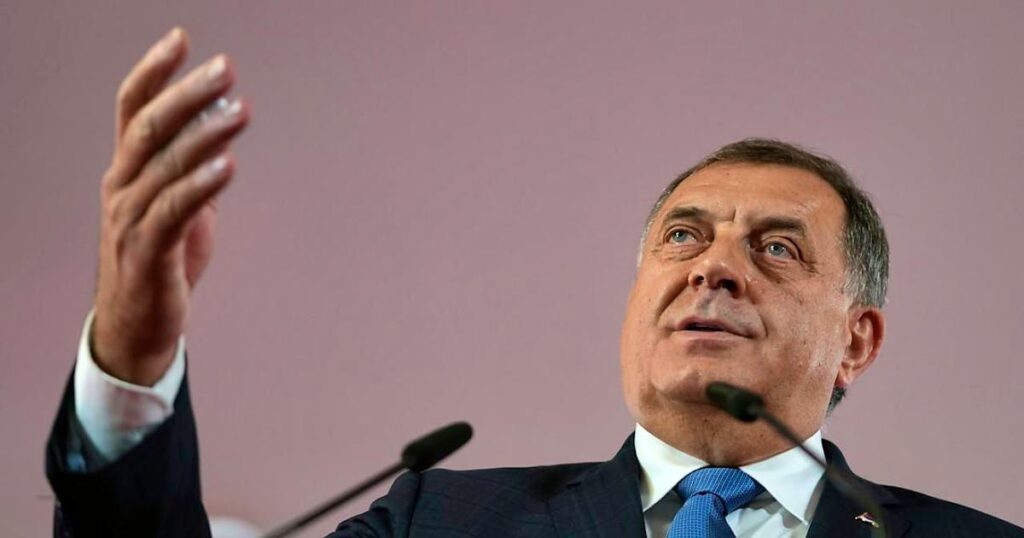
ARCHIVE – Bosnian Serb leader Milorad Dodik speaks during a press conference after his victory in the parliamentary elections in the Bosnian city of Banja Luka, 240 km northwest of Sarajevo. Photo: Darko Vojinovic/AP/dpa
Keystone
Political tensions are rising in Bosnia-Herzegovina following the failed arrest of Bosnian Serb separatist leader Milorad Dodik.
According to a report by the Bosnian portal “klix.ba”, an attempt by the central state police Sipa to arrest Dodik in an administrative building in East Sarajevo, which belongs to the Serb part of the country, Republika Srpska (RS), failed late on Wednesday evening. RS police officers loyal to Dodik prevented this. They also blocked access to the building where Dodik was still staying on Thursday, according to Bosnian media reports.
Dodik is president of the RS. The state prosecutor’s office issued arrest warrants for him, RS Prime Minister Radovan Viskovic and RS Parliament President Nenad Stevandic in March. The prosecutors accuse the trio of attacks on the constitutional order of Bosnia-Herzegovina. Most recently, the RS parliament passed laws to remove the authority of the central state courts, prosecutors and federal police officers in the territory of the RS.
Dodik, who regularly consults with Kremlin leader Vladimir Putin, has been pushing for the secession of the RS from the Bosnian state for years. Bosnia-Herzegovina, a former Yugoslav republic, was re-established as a state following the bloody war from 1992 to 1995 under the Dayton Peace Agreement. Since then, the two parts of the country, the Republika Srpska (RS) and the Bosnian-Croat Federation (FBiH), have enjoyed extensive autonomy.