
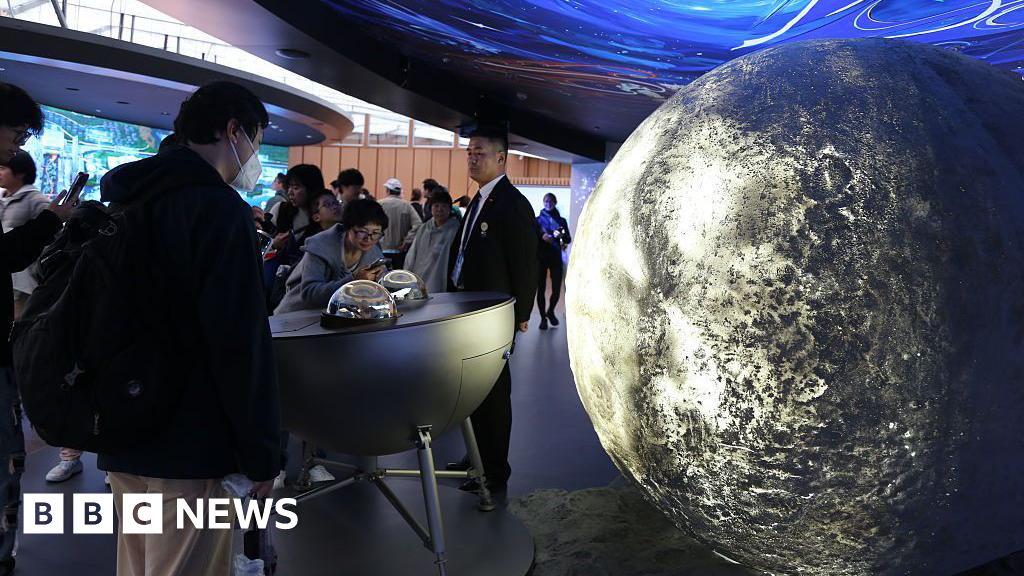
China will let scientists from six countries, including the US, examine the rocks it collected from the Moon – a scientific collaboration that comes as the two countries remain locked in a bitter trade war.
Two Nasa-funded US institutions have been granted access to the lunar samples collected by the Chang'e-5 mission in 2020, the China National Space Administration (CNSA) said on Thursday.
CNSA chief Shan Zhongde said that the samples were "a shared treasure for all humanity," local media reported.
Under the 2011 law, Nasa is banned from collaboration with China or any Chinese-owned companies unless it is specifically authorised by Congress.
But John Logsdon, the former director of the Space Policy Institute at George Washington University, told BBC Newshour that the latest exchange of Moon rocks have "very little to do with politics".
While there are controls on space technology, the examination of lunar samples had "nothing of military significance", he said.
"It's international cooperation in science which is the norm."
In 2023, the CNSA put out a call for applications to study its Chang'e-5 moon samples.
What's special about the Chang'e-5 Moon samples is that they "seem to be a billion years younger" than those collected from Apollo missions, Dr Logsdon said. "So it suggests that volcanic activity went on in the moon more recently than people had thought".
Space officials from the US and China had reportedly tried to negotiate an exchange of moon samples last year – but it appears the deal did not materialise.
Besides Brown University and Stony Brook University in the US, the other winning bids came from institutions in France, Germany, Japan, Pakistan, the UK.
Shan, from the CNSA, said the agency will "maintain an increasingly active and open stance" in international space exchange and cooperation, including along the space information corridor under the Belt and Road Initiative
"I believe China's circle of friends in space will continue to grow," he said.
https://www.bbc.com/news/articles/cp8v691qmg5o
6 Comments
Good, as it should be. Let scientists continue to collaborate with out this political crap. There is a lot of good research coming out of China, both in collaborations with Europe and independently. Neither China nor USA should diminish their efforts by exlucing each other because such research is a global effort, not an individual country’s effort.
I am so glad that scientists can still respect each other. It gives me hope. In many crazy times in history, it was only scientists, usually doing experiments (like charting a transit of Venus) that would be able to work with people of “enemy” countries.
One small thing almost lost to history is the Apollo Soyuz mission, where an Apollo Command Module, docked with a Soyuz from USSR, during the Cold War, 50 years ago.
[https://en.wikipedia.org/wiki/Apollo%E2%80%93Soyuz](https://en.wikipedia.org/wiki/Apollo%E2%80%93Soyuz)
With the current war against science by the US government, it‘s more likely the US scientists loose their funding than having the Chinese withold the research material.
The evolution of science shouldn’t stop for the primitive thinking of simple men.
With any luck the US can avoid someone stealing them, taking them home and having sex on them this time. Sigh.
I always thought the end of the Martian with the Chinese giving the US access to their secret rocket was hella unrealistic. Actually nice to see something that moves us towards that kind of collaboration instead of away from it (even if it is just a few rocks for now)