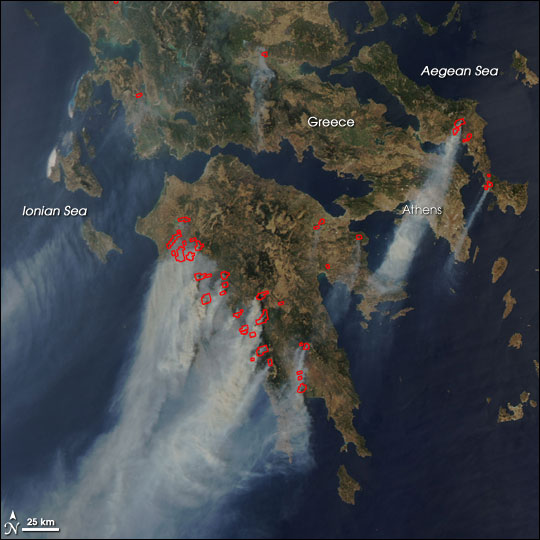
Greece’s Ministry of Climate Crisis and Civil Protection has announced extensive measures to confront this year’s wildfire season, which is expected to be severe amid escalating threats cause by climate change.
More than 18,000 firefighters—15,500 permanent and 2,500 seasonal personnel—will be deployed across the country, marking a 20% increase from 2023 and the largest force in Greece’s history.
They will be supported by approximately 4,000 trained volunteer firefighters and 5,700 civil protection volunteers from 295 organizations. Specialized forest operation units now number 1,600 individuals across 20 teams, with new units established in Chania, Ilia, Evia, and Zakynthos.
Greece’s firefighting capabilities will consist of 80–85 firefighting aircraft, 49 of which are leased, 3,700 fire engines, and 85 aerial surveillance drones equipped with thermal cameras—double last year’s fleet.
European Union cooperation will also play a critical role. Under the EU Civil Protection Mechanism, 294 firefighters from the Czech Republic, France, Romania, Moldova, and Bulgaria will be prepositioned in Greece to assist in firefighting efforts.
Greece’s Climate Crisis and Civil Protection Minister Giannis Kefalogiannis warned that “bad scenarios lie ahead,” emphasizing that “we should not be deceived by the fact that climate conditions appear slightly milder compared to previous years.”
Kefalogiannis cited the 1,350 fires recorded in March as an example and noted that prompt intervention of the Hellenic Fire Service and volunteer organizations prevented these incidents from escalating.
Cover Photo Credit: NASA Earth Observatory