

Spain’s nuclear power plants were kept in a “safe condition” by back-up diesel generators after the power cut caused them to switch off, officials said.
The power stations are designed to shut down when confronted with an unexpected power failure, the Spanish Nuclear Safety Council (CSN) said in a statement.
Four reactors at three nuclear plants were in operation when the power cut struck and immediately went offline.
Reactors at two other nuclear plants were already stopped before the blackout and generators were also maintaining basic functions safely, the CSN said.
Electricity has returned to parts of northern, southern and western Spain, the national grid operator has said.
Red Eléctrica said in a statement: “Tension has now been restored in substations in several areas of the north, south and west of the peninsula, beginning to give supply to consumers in these areas.”
Experts have warned that it could take time to completely restore power to all affected areas, and that it is likely to come back on in phases.
Sources in the southern region of Andalusia have confirmed the reports but told Europe Press that the “the percentage of the territory that has regained electricity supply is unknown”.
By Stuart Fraser, Tennis Correspondent
The Madrid Open tennis championships were among the events plunged into darkness and disrupted by the power cuts on Monday.
The power dropped just as the American star Coco Gauff was conducting a post-match interview after beating Belinda Bencic on the Arantxa Sanchez-Vicario Stadium.
Fans were left to use phone torches to navigate the pitch-black underground staircases of the Caja Magica, the tournament venue, while participants ate lunch by candlelight in the players’ restaurant.
Britain’s Jacob Fearnley was among several players to have their matches suspended.
Read in full: Power cut chaos stops play at Madrid Open
Isabel Díaz Ayuso, the conservative leader of the Madrid regional government, called on Spain’s Socialist-led national administration to activate emergency plans “to allow the army to keep order, if necessary”.
“We are all the same, we are all receiving information in bits and pieces,” she said.

Entrance to Lisbon’s Humberto Delgado airport
TIAGO PETINGA/EPA
EasyJet is suffering “some disruption” to its flying programme as a result of the power failure. It is a similar picture with other airlines including British Airways and Ryanair.
“Power outages in Portugal and Spain are impacting access to some airports and affecting some airports operations including Lisbon, Madrid and Barcelona,” easyJet said in a statement.
“Like all airlines, we are experiencing some disruption to our flying programme meaning that some return flights from Lisbon and Madrid have been unable to operate.
“Our flying programme at Porto and Faro airports is operating as planned.”
Passengers in Spain or Portugal who are unable to travel can change their flight free of charge to depart within 72 hours, or claim a flight voucher.
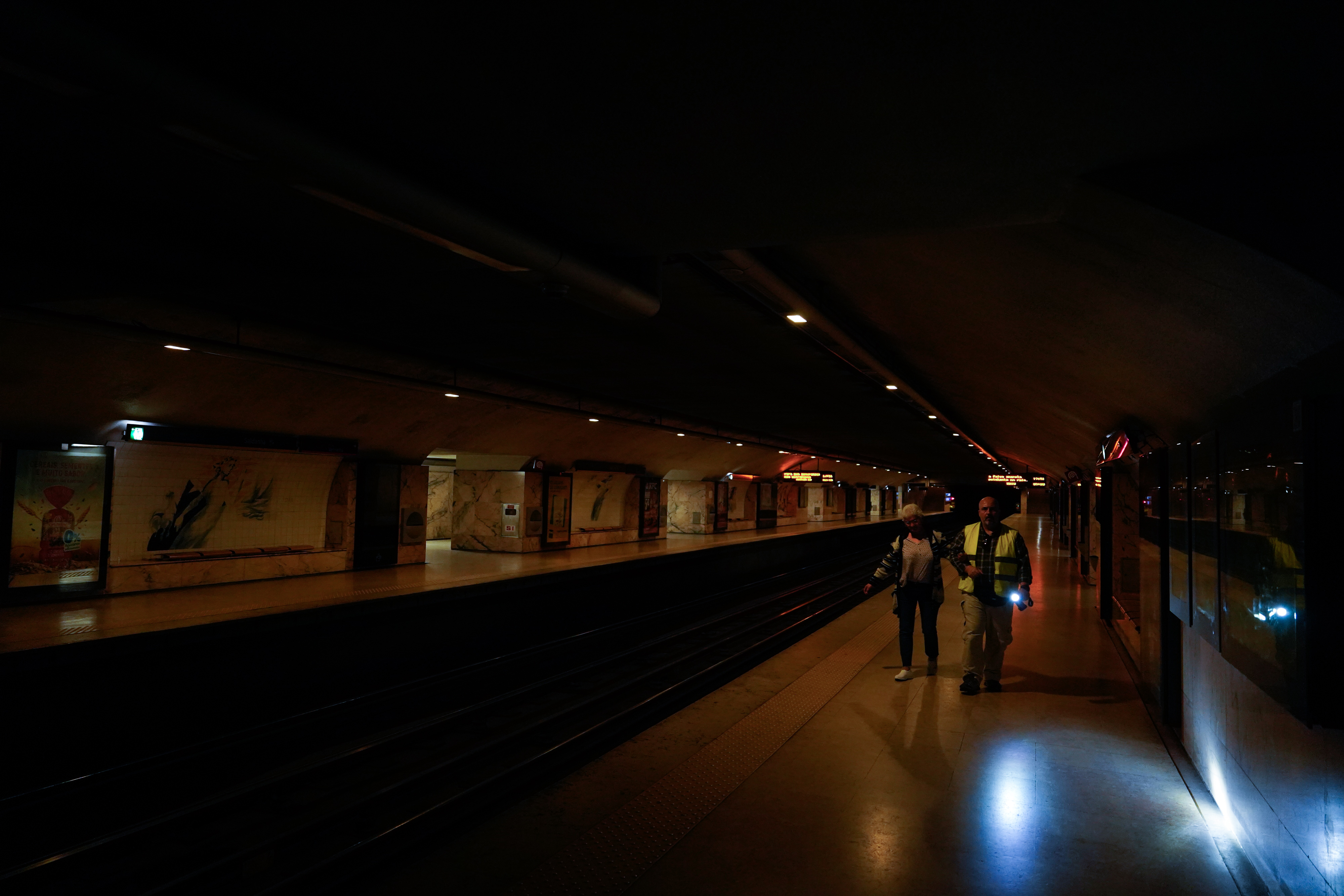
A metro station in Madrid
ADRI SALIDO/GETTY IMAGES
Antonio Costa, president of the European Council, said that “at this point, there are no indications of any cyberattack” that might have caused the blackouts.
“Grid operators in both countries are working on finding the cause, and on restoring the electricity supply,” Costa wrote on X, after being in touch with leaders in Spain and Portugal.

Luis Montenegro, Portuguese prime minister
HORACIO VILLALOBOS#CORBIS/CORBIS/GETTY IMAGES
Luis Montenegro, the Portuguese prime minister, told reporters that he expected electrical power to be restored “in the coming hours” after widespread outages hit most of the Iberian peninsula.
He added that there was “no indication” that a cyberattack was the cause of the blackout.

A high-speed AVE train stops working near Cordoba, Spain
JAVIER SORIANO/AFP/GETTY IMAGES
The Portuguese grid operator said a rare atmospheric phenomenon in Spain caused the power outages across the Iberian peninsula.
Redes Energéticas Nacionais (REN) said extreme temperature variations had caused “anomalous oscillations” in the very high voltage lines in the Spanish grid, known as “induced atmospheric vibration”.
The operator also warned that fully restoring the country’s power grid could take up to a week.
“At this time it is still impossible to predict when the situation will be normalised,” REN said in a statement, adding it had “all resources deployed” to resolve the blackout.
The Foreign Office has updated its Spanish travel advice pages and is warning Britons of travel disruption across the region.
The advice reads: “We are aware of reports of power outages across Andorra, mainland Spain and mainland Portugal and are monitoring the situation.
“There may be travel disruption, check with your tour operator or airline for more information before travelling. Follow the advice of the local authorities and monitor local updates.”
Spain is the UK’s most popular holiday destination with about 17 million visits each year.
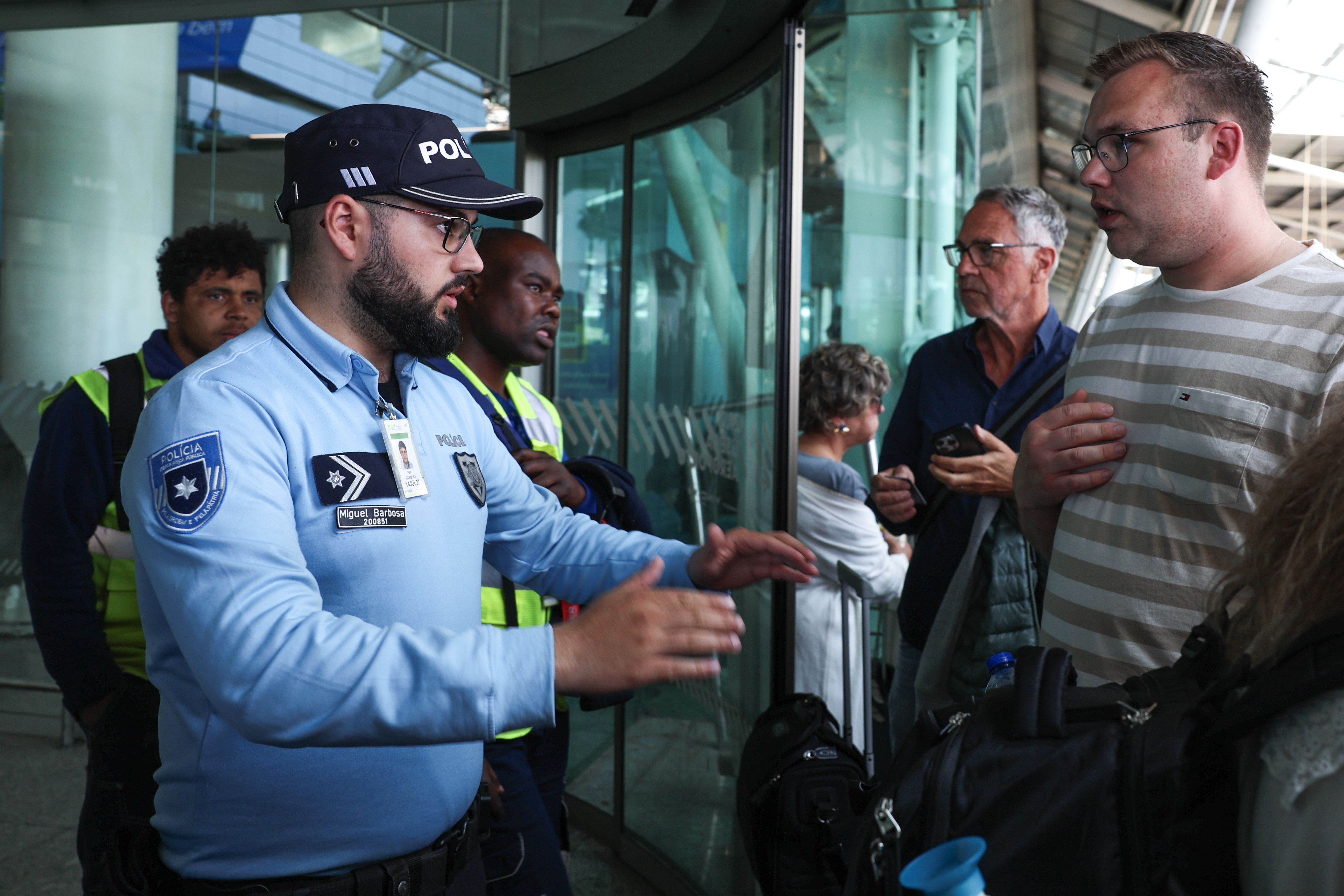
Lisbon’s Humberto Delgado airport is closed at the arrivals zone
TIAGO PETINGA/EPA
Tap Air Portugal has told passengers not to travel to the country’s airports until further notice.
In a statement on its Facebook page, the airline said: “Due to the power cut in several European countries, the operation of airports is temporarily very limited. TAP requests that you do not go to the airport until further information.”

Queues for the ATM in Lisbon
PATRICIA DE MELO MOREIRA/AFP
It is being reported that the blackout was caused by a “very strong oscillation in the electrical network”.
Eduardo Prieto, director of Red Eléctrica, the Spanish electricity grid operator, said the “oscillation” led to “the collapse of the Iberian electricity network at 12.38pm”.
Prieto refused to speculate on what caused the power surge and declined to say if a cyberattack was responsible.
The system operator is working to restore power across the network, but warned this could take between six and ten hours in some parts of the country. Widespread regional travel disruption is expected to last until Tuesday.
Portugal’s cybersecurity watchdog has said that “no evidence has been identified to date that points to a cyberattack” as the cause of the blackout that is affecting the Iberian peninsula.
In a statement, the National Cybersecurity Centre said: “After contacting the relevant entities, it was found that this is a failure that affected some European countries. We are in contact with our counterparts in these countries and with the relevant national entities.
“No evidence has been identified to date that points to a cyberattack. We draw attention to the circulation of misinformation that occurs in these situations, so we advise consulting or confirming information with reliable sources.”
Rescue workers have been attempting to evacuate passengers who became stuck on trains after the power failed.
One high speed train between Seville had been heading towards Barcelona when it was halted in the countryside outside Zaragoza. Passengers reported being stationary for two and half hours with no electricity, wifi or air conditioning.
Firefighters who boarded the train said the priority was to open all the doors to ventilate the train, while avoiding a panicked rush by passengers to escape, as they tried to arrange an organised evacuation.
“We opened the doors to help ventilate the train for the young and old,” Ruben Sole, 36, a firefighter, said. “I’ve never seen this [the power cut] before on a train like this — it happens in cities but not on the train.”

A closed metro station in Madrid, among the worst hit cities
SUSANA VERA/REUTERS
Experts said hospitals and other vital infrastructure should have back-up systems to avoid catastrophe. However the knock-on effects from the power cuts could get worse the longer they continue.
Dr Rowena Hill, professor of resilience, emergencies and disaster science at Nottingham Trent University, said: “If the electricity is out across the board, there are further implications the longer things go on. Not being able to get cash, not being able to process transactions, not being able to get fuel, the electricity might also ink to water or sewerage pumps and so that has a consequence for the younger and older populations quite quickly.
“But immediate thoughts are for those who have care support in the community that is electricity dependent. The acute health points are likely to have backup generators.”
Part of France was also affected “for a few minutes in the Basque Country”, French television reported.
Homes “were deprived of power” but “all power has since been restored“ , according to RTE, France’s transmission system operator, which is mobilising to “provide assistance”to its Spanish neighbour.
Portugal’s minister for national defence, Nuno Melo, has appealed for people to remain calm and said that the causes of the power failure are not yet known.
There have been some reports of panic buying at Spanish and Portuguese supermarkets due to the cuts, which appear to have left some homes without running water, if they are usually supplied by electric pumps.
Ben Lambert, a British expatriate based near Lisbon, said that there were “huge queues” at his local supermarket as people rushed to buy pasta, tins of food and long life milk.
“The water had sold out within an hour,” he said. “Many local supermarkets are shut — but I was able to find one that has a generator.”
Vasco Carou, 36, a builder who lives outside Lisbon, had also gone out to pick up supplies.
He said: “I think the panic is starting to set in because people remember the times when they had to stockpile in the pandemic. The fear here is real. Everyone is afraid.”

Gridlock in Madrid on Monday
OSCAR DEL POZO/AFP/GETTY IMAGES
Madrid’s mayor has called on all residents to stay at home and avoid travel.
“I ask all residents of Madrid to keep their movements to an absolute minimum and, if at all possible, to remain where they are. We want to keep all roads clear,” Jose Luis Martinez-Almeida said.
He also urged residents to only call emergency services if it is “truly urgent” and said they should go to police and fire stations in person if calls go unanswered.
In the wake of the power cuts heavy congestion has been reported in major cities, while crowds of people have gathered at airports and train stations, after routes were cancelled.
There have been reports of people being stuck inside lifts or stranded on trains after power supplies failed.
Landing restrictions introduced at big airports in Spain and Portugal will affect hundreds of flights to and from the UK.
FlightRadar24, the tracking website, reported that Lisbon will have no arrivals until 5.30pm local time (4.30pm UK). There will be a reduced landing rate afterwards.
There are also reduced landings at Barcelona and Madrid airports.
Cirium, the aviation analysts, reported that there are 399 scheduled departures from UK airports to Spain — equating to over 75,000 seats — for Monday. There are 105 departures from UK airports to Portugal, equating to just under 20,000 seats.
Aena, which operates dozens of airports in Spain, advised travellers to “check with your airline, as there may be issues with access and ground transportation”.
Spain’s government said it was investigating the cause, but urged residents to remain at home to avoid traffic chaos.
“The government is working to identify the origin of this incident and dedicating all possible resources to resolve it as quickly as possible,” the office the prime minister, Pedro Sanchez, said.
Videos on social media showed confusion and congestion on the roads after traffic lights in major cities such as Madrid failed. Thousands of travellers at trains and at airports have been affected.
Hospital services are reported to be reduced to “basic”.
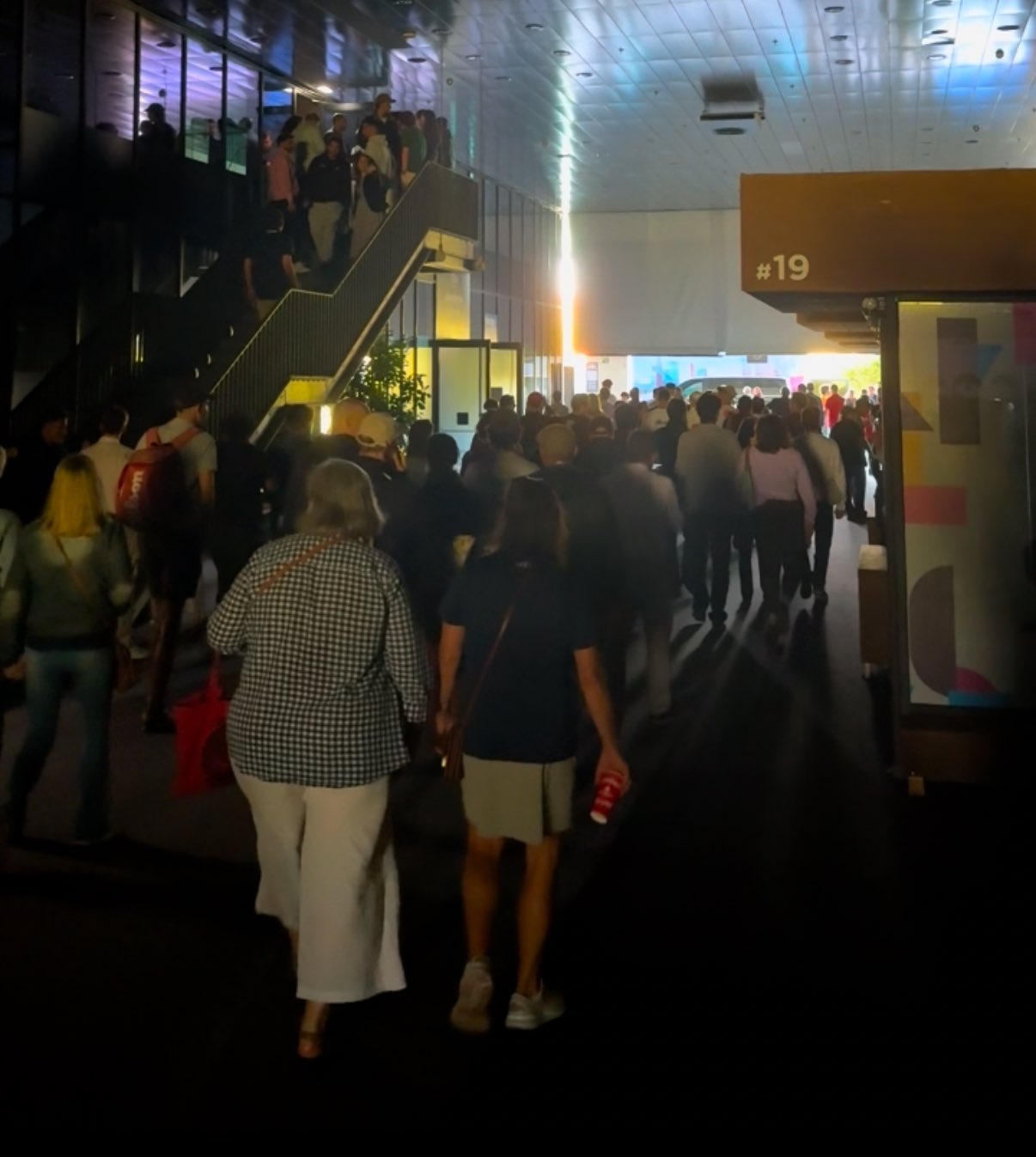
Buildings were plunged into darkness in Madrid
Spain’s Red Eléctrica said the blackout was “exceptional and totally extraordinary” and could take six to ten hours to repair.
According to Red Eléctrica, from 1pm onwards, voltage began to be restored in the north and south of Spain, which it said would help to progressively restore the electricity supply nationwide.
In Portugal, the blackout is also widespread. The government said the incident appeared to stem from problems outside the country.