
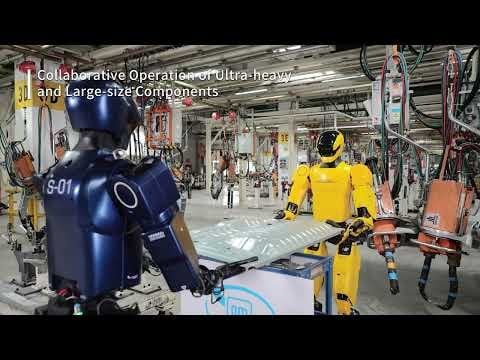
Some people still think useful general-purpose humanoid robots are decades away, but all the evidence is that they are much, much closer. Chinese car makers are a clear sign of this. There are almost a dozen now using humanoid robots. Popular robots are from UBTech, Unitree, and Xpeng, with car makers Audi, Volkswagen, BYD, Xpeng, Nio, Geely, Great Wall Motors, Dongfeng Liuzhou Motor, and Foxconn all using them.
GM has picked Kepler's K2 humanoid, which is priced at $20-30,000. This video shows them working at a slower pace than humans, but they will only ever get continuously better, and they're already cheaper to deploy.
General Motors joins almost a dozen car makers in China deploying humanoid robots and is using Kepler's K2 humanoid robots at its Shanghai factory.
byu/lughnasadh inFuturology
8 Comments
I continue seeing people claim that “we’re decades from humanoid robots” when it’s becoming more and more obvious that they’ll be deployed, in large numbers, by the end of the decade at the latest.
Tipping point cleared. Now that the bots are cheaper than humans we will see adoption spread faster than the vast majority can imagine.
Next, as soon as the out of touch people behind “AI” can convince or trick people with real world experience to train their LLMs to be passable to the minority still wary of them, and be able to run without needing subsidized energy to run, then we will see the majority of customer interacting jobs being snapped up by “AI”.
There’s a LOT of showboating in the humanoid robot space. This iteration is not much more advanced than Asimo (Honda, 2000) and although never stated publicly, Honda ceased working on that strand of research because it was pretty clear that the lessons learned were better applied to specific mechanical repetition robots.
Automated Storage/Retrieval Systems, robotic arms, smart conveyor belts, all things that make a production line much more efficient. A humanoid robot with a multitude of failure points, autonomous propulsion (ie. battery) and a wealth of sensors that can all get dirty, blocked or simply damaged are never going to improve on that productivity.
The work you see in the video OP linked is nonsense, there isn’t a (car) factory in the world that can afford for such slow handling speeds using such expensive (yes, even at 30k, what does maintenance cost?)) machines. You need PLCs that can be programmed to be reliable when dealing with hundreds if not thousands of movements a day.
Plenty of early adopters will be beginning to introduce them so they can learn their capabilities and plan how they can roll them out across the companies entire operation within the next 5 years, after that, robots will have become more refined and better at the jobs they are needed for and more companies will optimise their operations towards having humanoid robots on site.
“Slower” but they can be plugged in or do battery swaps to work almost 24 / 7
K2 was too much for me. I’m not sure I recommend using it while building cars..
great so no one is even going to get the damn factory jobs anywhere either.
this world just get worse and worse?
The picture looks like a band of dome-headed aliens playing a set of otherworldly jazz-style music.
“We don’t serve their kind in here.”