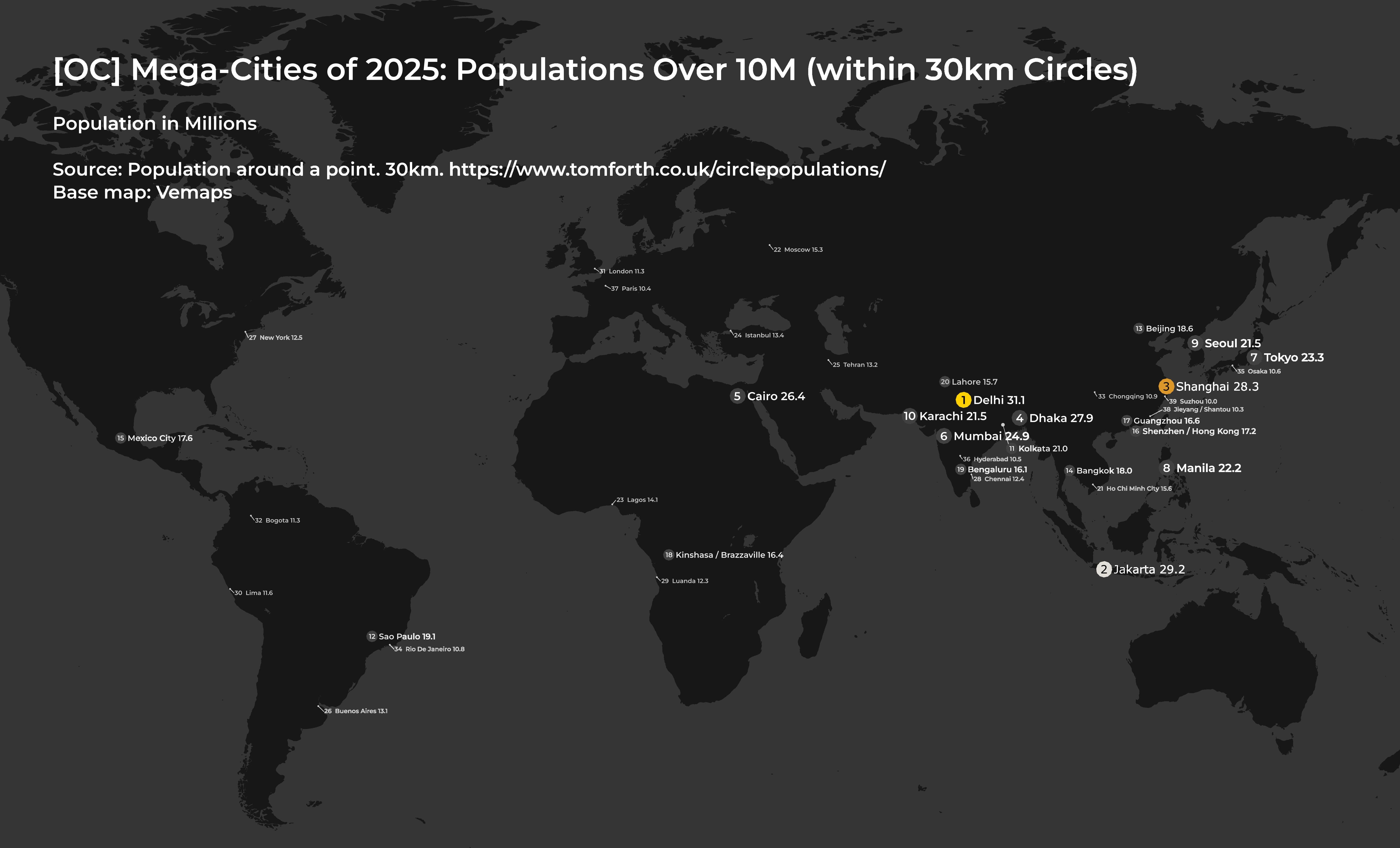
By using 30km circles for all cities worldwide, bias caused by different definitions of “city” is avoided (e.g. city limits, urban area, metro area, conglomeration, etc.)
**Method**: For each city, I’ve attempted to maximise the population by finding the “best possible 30km radius circle”. The population was counted manually using the website “Population Around a Point” and, as such, there may be mistakes. I also note that a 30km radius circle was insufficient for many of the listed cities: any city population that was not within the 30km circle was not included in the population calculation.
1. Delhi 31.1
2. Jakarta 29.2
3. Shanghai 28.3
4. Dhaka 27.9
5. Cairo 26.4
6. Mumbai 24.9
7. Tokyo 23.3
8. Manila 22.2
9. Seoul 21.5
10. Karachi 21.5
11. Kolkata 21.0
12. Sao Paulo 19.1
13. Beijing 18.6
14. Bangkok 18.0
15. Mexico City 17.6
16. Shenzhen/Hong Kong 17.2
17. Guangzhou 16.6
18. Kinshasa/Brazzaville 16.4
19. Bengaluru 16.1
20. Lahore 15.7
21. Ho Chi Minh 15.6
22. Moscow 15.3
23. Lagos 14.1
24. Istanbul 13.4
25. Tehran 13.2
26. Buenos Aires 13.1
27. New York 12.5
28. Chennai 12.4
29. Luanda 12.3
30. Lima 11.6
31. London 11.3
32. Bogota 11.3
33. Chongqing 10.9
34. Rio De Janeiro 10.8
35. Osaka 10.6
36. Hyderabad 10.5
37. Paris 10.4
38. Jieyang/Shantou31.1 10.3
39. Suzhou 10.0
**Note**: This is not intended to be a serious suggestion regarding the best method to measure cities. This is for fun and is a simple thought experiment. I quite like the results: it rewards denser cities (to an extent), it rewards conglomerations (to an extent), and it punishes “megalopoly” (endless suburban expansion).
filya on
This is “the population-density fallacy” when it comes to maps that show raw counts of something are basically just showing where the most people are — because more people = more events.
Oh, wait a second….
/s
Additional-War-837 on
I’m not really surprised seeing Kinshasa, London & cities in India but Tokyo? With their aging population? And also given that it’s an archipelago, wouldn’t people be better off spread across the land
baconator81 on
I am pretty sure it’s missing Taipei. a 30 km centered in Taipei would encapsulate the entire New Taipei city as well. .And I would say that probably yiels 14 million ppl at least (Taipei itself is 9 million).
g_spaitz on
Seems like this site exploded today everybody’s making these kind of maps.
But for mega cities why only 30km???
KudosOfTheFroond on
They should make a map like this with smallest cities
Mobius_Peverell on
I think the obvious improvement would be to make the circles scaled to the population size. As is, the really small ones might as well not even be there.
secretdrug on
These values are really scuffed. Some are using the city proper. Others use the greater metro area. For instance the entirety of chongqing has 30M+ ppl not 10M. Where as shanghai proper only has like 24M but shanghai greater has the 28-29M.
Jayswag96 on
New York felt so big and it’s one of the smallest here. I really wonder how these Asian cities feel in comparison. I couldn’t imagine all these people within like 30 min of each other
saurusautismsoor on
Lived in three of these mega cities
bobateaman14 on
30km circles is such an arbitrary way to define a city it has basically no meaning
AwesomeAsian on
I knew Cairo and Lagos would make it but never heard of Luanda.

![[OC] Mega-Cities of 2025: Populations Over 10M (within 30km Circles)](https://www.byteseu.com/wp-content/uploads/2025/04/1xtrs9v4fnxe1-1536x930.jpeg "[OC] Mega-Cities of 2025: Populations Over 10M (within 30km Circles)")
13 Comments
Not really that beautiful.
**[OC] Mega-Cities of 2025: Populations Over 10M (within 30km Circles)**
**Data Source**: Population Around a Point. [https://www.tomforth.co.uk/circlepopulations/](https://www.tomforth.co.uk/circlepopulations/)
**Description**: An attempt at an objective ranking of city populations, inspired by u/Frierfjord1’s post “[OC] 10 Largest Cities in Europe in 2025 (30km Population Circles)”. [https://www.reddit.com/r/MapPorn/comments/1k9u4i1/oc_10_largest_cities_in_europe_in_2025_30km/](https://www.reddit.com/r/MapPorn/comments/1k9u4i1/oc_10_largest_cities_in_europe_in_2025_30km/)
By using 30km circles for all cities worldwide, bias caused by different definitions of “city” is avoided (e.g. city limits, urban area, metro area, conglomeration, etc.)
**Method**: For each city, I’ve attempted to maximise the population by finding the “best possible 30km radius circle”. The population was counted manually using the website “Population Around a Point” and, as such, there may be mistakes. I also note that a 30km radius circle was insufficient for many of the listed cities: any city population that was not within the 30km circle was not included in the population calculation.
1. Delhi 31.1
2. Jakarta 29.2
3. Shanghai 28.3
4. Dhaka 27.9
5. Cairo 26.4
6. Mumbai 24.9
7. Tokyo 23.3
8. Manila 22.2
9. Seoul 21.5
10. Karachi 21.5
11. Kolkata 21.0
12. Sao Paulo 19.1
13. Beijing 18.6
14. Bangkok 18.0
15. Mexico City 17.6
16. Shenzhen/Hong Kong 17.2
17. Guangzhou 16.6
18. Kinshasa/Brazzaville 16.4
19. Bengaluru 16.1
20. Lahore 15.7
21. Ho Chi Minh 15.6
22. Moscow 15.3
23. Lagos 14.1
24. Istanbul 13.4
25. Tehran 13.2
26. Buenos Aires 13.1
27. New York 12.5
28. Chennai 12.4
29. Luanda 12.3
30. Lima 11.6
31. London 11.3
32. Bogota 11.3
33. Chongqing 10.9
34. Rio De Janeiro 10.8
35. Osaka 10.6
36. Hyderabad 10.5
37. Paris 10.4
38. Jieyang/Shantou31.1 10.3
39. Suzhou 10.0
**Note**: This is not intended to be a serious suggestion regarding the best method to measure cities. This is for fun and is a simple thought experiment. I quite like the results: it rewards denser cities (to an extent), it rewards conglomerations (to an extent), and it punishes “megalopoly” (endless suburban expansion).
This is “the population-density fallacy” when it comes to maps that show raw counts of something are basically just showing where the most people are — because more people = more events.
Oh, wait a second….
/s
I’m not really surprised seeing Kinshasa, London & cities in India but Tokyo? With their aging population? And also given that it’s an archipelago, wouldn’t people be better off spread across the land
I am pretty sure it’s missing Taipei. a 30 km centered in Taipei would encapsulate the entire New Taipei city as well. .And I would say that probably yiels 14 million ppl at least (Taipei itself is 9 million).
Seems like this site exploded today everybody’s making these kind of maps.
But for mega cities why only 30km???
They should make a map like this with smallest cities
I think the obvious improvement would be to make the circles scaled to the population size. As is, the really small ones might as well not even be there.
These values are really scuffed. Some are using the city proper. Others use the greater metro area. For instance the entirety of chongqing has 30M+ ppl not 10M. Where as shanghai proper only has like 24M but shanghai greater has the 28-29M.
New York felt so big and it’s one of the smallest here. I really wonder how these Asian cities feel in comparison. I couldn’t imagine all these people within like 30 min of each other
Lived in three of these mega cities
30km circles is such an arbitrary way to define a city it has basically no meaning
I knew Cairo and Lagos would make it but never heard of Luanda.