
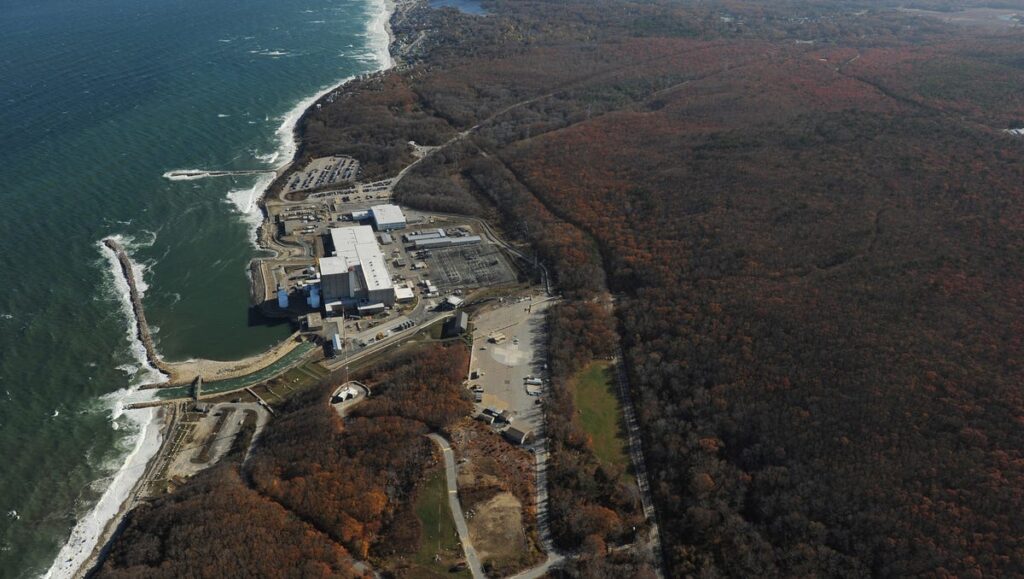
Over the next several weeks, voters in 14 Cape Cod towns, plus Plymouth and Scituate, will be asked to urge state officials to stop Holtec International from releasing wastewater vapor from the former Pilgrim Nuclear Power Station into the air. The nuclear power station in Plymouth has been closed since May 2019.
A nonbinding advisory question on town ballots urges Gov. Maura Healey, Attorney General Andrea Campbell, and other state leaders to take action against Holtec’s use of evaporation as a disposal method after the state Department of Environmental Protection last year denied its request to discharge the wastewater into Cape Cod Bay. The company is overseeing the plant’s decommissioning.
Holtec rejects the claims outlined in the ballot question.
Ballot question: Winds carry pollutants
The ballot question claims Holtec is releasing “untreated, radioactively and chemically contaminated” industrial wastewater into the atmosphere and asserts that prevailing winds could carry pollutants over nearby towns as well as into Cape Cod Bay.
Supporters of the question — including Cape Downwinders and Save Our Bay MA Coalition — say the evaporation method poses health and environmental risks, may violate state laws like the Massachusetts Ocean Sanctuaries Act, and deserves the same scrutiny as liquid wastewater discharges into the bay.
Last July, the state Department of Environmental Protection denied Holtec’s proposal to discharge up to 1.1 million gallons of industrial wastewater — treated beforehand, but still containing some radionuclides, like tritium — into the bay. The agency based its decision on identifying the bay as a protected ocean sanctuary as defined under the act, which prohibits industrial waste disposal into protected state waters.
Proponents: Raise the issue, hold elected leaders accountable
JoAnne Keenan-Wilson of Dennis called the referendum “critically important,” especially since many believe the issue was settled when the state denied Holtec‘s permit application to discharge the water into the bay. “Many people do not realize that the evaporation is even taking place,” Keenan-Wilson said.
Candace Perry of Wellfleet shares the concerns that putting any amount of radioactive particles into the air and water is not safe. She emphasized the state’s obligation “to hold Holtec to its responsibilities” to decommission the plant safely.
Diane Turco of Harwich agrees. “By voting, we will send a strong message of our shared responsibility to hold elected officials accountable to ensure a safe and sustainable future for everyone through enforcement of Massachusetts environmental laws.”
The petitioners said safer alternatives exist to dispose of leftover wastewater: storing it on-site or hauling it away to a licensed facility.
Holtec: Ballot question language ‘is false’
In an April 23 email, Holtec Director of Government Affairs and Communications Patrick O’Brien said the ballot question is “just another example of trying to scare the public without the actual facts.”
“The reality is that the language in the question is false and that the water at Pilgrim Station is constantly treated during the decommissioning process to ensure quality and clarity for our ongoing work and to remove as many impurities as possible, the same way we treated public drinking water when it entered the plant for power operations to an ultra-pure level,” he said.
He said the state ruled on the matter of evaporation in July 2024 and found that the amount of pollutants that could be evaporated would be around 28.14 pounds in a year, which falls below the state’s air quality permitting threshold of 2,000 pounds in a year. Radioactive particulate and tritium releases into the air also fall well below federal standards, according to the state Bureau of Air and Waste’s 2019 determination letter.
O’Brien also said that, according to Holtec’s evaluations, any radiation exposure from evaporation would be negligible and indistinguishable from natural radiation that reaches the Earth from space, as well as other manmade sources.
For the public, the estimated exposure in a hypothetical single-year release would potentially be 0.00032 millirem, O’Brien said. By comparison a chest X-ray gives about 10 millirem, he said. In actuality, he stated, the radiation leaving the building would be even smaller and would quickly fade in the open air.
Which towns are voting?
The advisory question will appear on ballots in Wellfleet on May 5, Sandwich on May 8, Mashpee on May 10; Dennis, Provincetown and Truro on May 13, Chatham on May 15; Plymouth on May 17; Bourne, Brewster, Eastham, Falmouth, Harwich, Orleans, and Yarmouth on May 20, and Scituate on May 31.
Duxbury Town Meeting has already adopted a resolution expressing the same intent as the referendum.
Barnstable is the only Cape town not featuring the measure on a spring ballot, due to its fall election schedule, but Turco said the groups are working through the Town Council for a vote.
The groups began organizing the referendum campaign in December, she said, and got early support from the Plymouth Select Board. After that, “we felt confident other towns would support giving their citizens an opportunity to voice their opinion on this serious matter — it’s a call from the grassroots to our state government to do their job and protect the public and environment, she said.
To qualify for the ballot, citizen petitioners in each town gathered signatures from at least 10 registered voters. According to Turco, town leaders often unanimously supported putting the question on their ballots.
Heather McCarron writes about climate change, environment, energy, science and the natural world, in addition to news and features in Barnstable and Brewster. Reach her at hmccarron@capecodonline.com.
Thanks to our subscribers, who help make this coverage possible. If you are not a subscriber, please consider supporting quality local journalism with a Cape Cod Times subscription. Here are our subscription plans.