
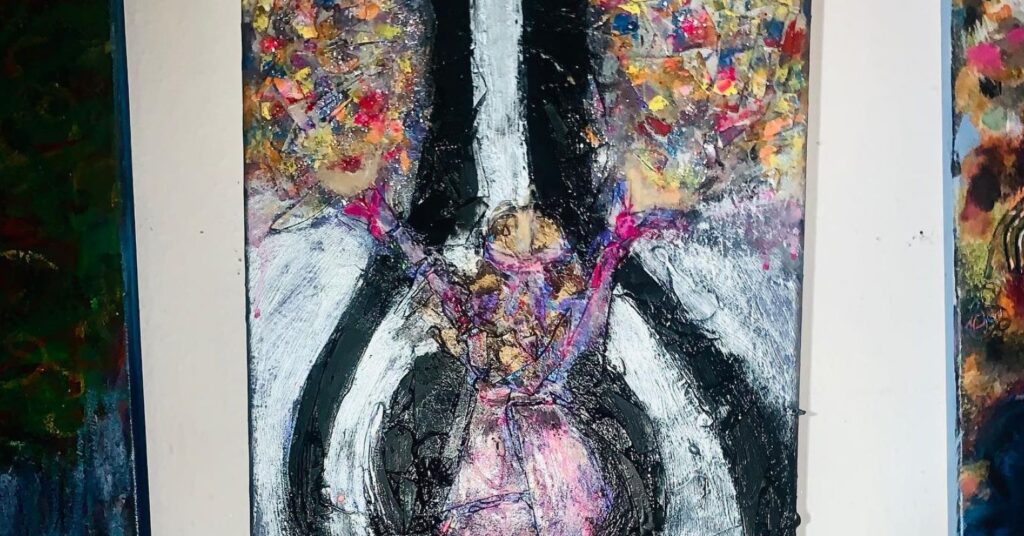
Kaleigh “Keekee/gypsy” Peery is an artist and mental health advocate. We met in 2016 working together in the mental health field. When we would talk about the creative interventions she would plan for the groups, her passion filled the space. In 2017, Kaleigh experienced one of the most painful events a person can walk through: the loss of her 1-month-old baby, Esmeralda (Ehzi) Phoenix Peery.
She created a stream of art pieces as she worked through her grief, eventually culminating in an art show, “Fearless Phoenix,” celebrating her daughter and exhibiting a kaleidoscope of emotions. I spoke with her to better understand the role art has played in her healing and to reflect on the power of creative expression in recovery.
An Anchor
I asked Kaleigh the origin of her interest in art. She shares, “When I was little, I was in the hospital a lot. And the only thing I remember, since I was in and out, was going to the art room there. For me, it was my anchor. No one could take it away from me because it was something of my own.” At a time when Kaleigh was ill, with an oxygen tank, taken away from her typical childhood life, and placed in these hospitals where so little was in her control, the art room offered her a portal to a space she could direct
She describes art as having been a companion to her.
Kaleigh lost her best friend at age 14, and she began to experience depression as a teen. She reflects, “I had these emotions where I didn’t understand what was going on. It was a whirlwind from all these different angles, and I remember art, again, being my anchor. Fast forward to these past 10 years, I’ve realized that art is how I grieve. It was the way I expressed myself emotionally. It grounded me.”
Esmerlda’s New Magic
Before all this, Kaleigh had a stillborn child and a miscarriage in her path. After losing her daughter, Kaleigh dove deep into creating art. Whether through glass, paint, words, or other means, Kaleigh sought to express. Among one of these is “Esmerlda’s New Magic,” with a girl dancing made from glass and paint. She also showcases a glass phoenix with a small semi-colon and a picture of a mother holding an infant daughter.
Kaleigh contemplates, “With her, I had just gotten on my path of healing. I was doing well and being the best version of myself. There was something about her and her energy. It reminded me that not only am I still a mom—I am a mom of three. Esmerelda was just magical. There was something about her that was different that changed me for the better.”
Kaleigh typically kept her art personal and to herself. She would put the paintings away when people came over. After the death, all this changed. Kaleigh sparks, “Art was, once again, my anchor. I turned her nursery into my art room. I closed my eyes and started painting. After her, it was like I had nothing left to fear. This had meant so much to me, but then it wasn’t about me anymore. That magic, I wanted everyone to feel.”
Art in Mental Health Services
As a peer support specialist working with individuals seeking addiction and mental health recovery, Kaleigh often integrated creative means into her work. She states, “When I would do these groups, it didn’t matter what type of person it was or what they were going through; they responded to art and writing exercises. I think that keeps people engaged and inspires people to keep doing more.”
Kaleigh emphasizes a rainbow of therapeutic uses for art, ranging from processing trauma to having something fun to do. She acknowledges that creativity can be a way for people to connect with others without words.
Kaleigh projects, “With art sometimes you don’t know that you are processing stuff, sometimes you just do. Some people also get more out of the writing part of it. It doesn’t just have to be drawing. Sometimes, if you step back and start thinking creatively, your problems seem less big, and you can find a solution. Sometimes, creativity helps me turn off my mind a bit. Everyone is different.”
Perception Is Everything
Often, people have anxieties about art. We worry about people judging our art, or we judge it ourselves.
Kaleigh believes that, “Perception is everything. With art it’s separate, but art can be anything you want it to be. You can do art for a career, yourself, to journal, or communicate.”
From Kaleigh’s eyes, no one is “good” at art. “Art is supposed to be you and whatever you do is good enough. Just do it, create. Who cares what everyone else thinks? Either no one is good at art or everyone is good at art.”
Trauma, Grief, and Mental Health
In terms of mental health, wishes for people to give a bit more compassion to others living with mental health conditions. She shares, “Stereotyping people without knowing their story or putting people in boxes gets in the way. Just because someone isn’t going through the symptoms you know of, it doesn’t mean that they aren’t suffering. Sometimes, it can look like a drop in productivity. I wish people would step back and wonder what that person is going through. Sometimes we put people in boxes because of their symptoms, or lack of.”
It’s more important to see the person rather than their diagnosis. She says, “You don’t know what people are going through, and you don’t know what people are capable of.”
She further elaborates on the overlaps between grief, trauma, and mental health with the following, “People in recovery from addictive behaviors and even people with serious mental illnesses like schizophrenia, there can be triggers of grief. There is so much unacknowledged and unhealed grief living inside people. Like for me, I have a partial genetic disorder, but I also experienced a lot of obscure deaths. It got to a point where I was sort of numb to it. I didn’t realize how bad that trauma amplified those symptoms. I wish there had been someone in my life growing up who acknowledged those connections.”
Closing
My office is decorated with Kaleigh’s art for a reason. Her work is a testimony of healing. Whatever medium we choose, art can be for all of us. It is a way I myself, and many others, have used to work through challenges. I am appreciative of this.