
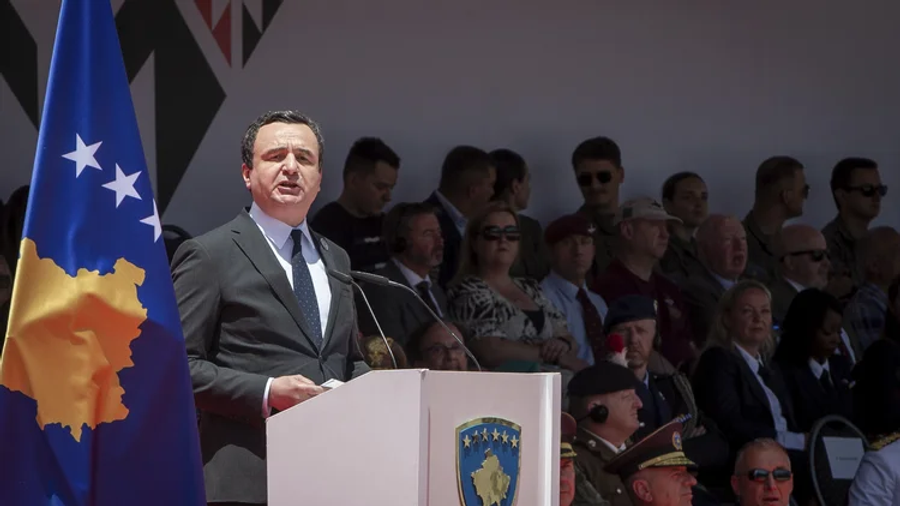

Albin Kurti, Prime Minister of Kosovo. © picture alliance / ASSOCIATED PRESS | Visar Kryeziu
Kosovar Albanians protested peacefully, but futilely. They organized an armed resistance, the Kosovo Liberation Army (KLA), in 1993. From 1995 to 1999, the KLA fought the Serbian Army for independence. As they had earlier done in Bosnia and Croatia, Serbian Army and militias used genocidal tactics against Kosovar Albanians, including murder, abduction, forced displacement, and mass rape,. The KLA employed similar tactics against Serbs, Roma, and Ashkali “Egyptian” Muslims. A few KLA leaders promoted a ‘greater Albania’ ideology.
Serb militias massacred over 10,000 Kosovar Albanians. 45 were killed in the Račak massacre. Serb militias forced over 14,000 Kosovar-Albanians to flee from their homes.
NATO claimed legal justification for its 1999 intervention under U.N. Charter ch. 8 art. 52, 53, & 54 which provides for enforcement action authorized by the Security Council by “regional arrangements or agencies” “for the maintenance of international peace and security.” NATO established a peacekeeping force, KFOR, which operates to this day. The U.N. established an interim government that lasted nine years.
Ethnic conflicts erupted in the 2020’s in Leposavić, Zvečan, Zubin Potok, and North Mitroviça. On April 23, 2023, Kosovar Albanians swept municipal elections that Serbs boycotted. A month later, Kosovo Police forcibly took over municipal buildings in Serb areas to install Kosovar Albanian mayors. These actions galvanized Serb protests, resulting in violent clashes with KFOR on May 29, 2023, leading to 82 injuries.
The US blamed the violence on Kosovo authorities. In April 2024, recall elections were held to depose Kosovar mayors in Serb municipalities, but only 253 people voted out of 46,000 registered, so the electoral commission held the elections to be invalid.
In November 2024, Kosovo Police raided northern Serb municipalities following an explosion that damaged the Ibar-Lepenc canal. Kurti accused Serbia of orchestrating a “criminal and terrorist attack,” a claim strongly denied by Vučić. No conclusive evidence of Serbian involvement has been found.
Genocide Watch considers Kosovo to be at Stage 3: Discrimination and Stage 6: Polarization.
Genocide Watch recommends:
● Serbia must officially recognize Kosovo as an independent sovereign nation.
● Kosovo should implement formation of the Association of Serb Municipalities in Northern Kosovo.
● Kosovo should reopen the Mitroviça bridge over the Ibar River after reconciling with northern Serbs.
● The EU should condition Kosovo’s membership on strengthening Kosovo laws to protect minorities.
● Kosovo and Serbia should step up negotiations to normalize diplomatic and economic relations.
Kosovo Country Report by Kolby Phillip May 2025.pdf
Download PDF • 53KB