
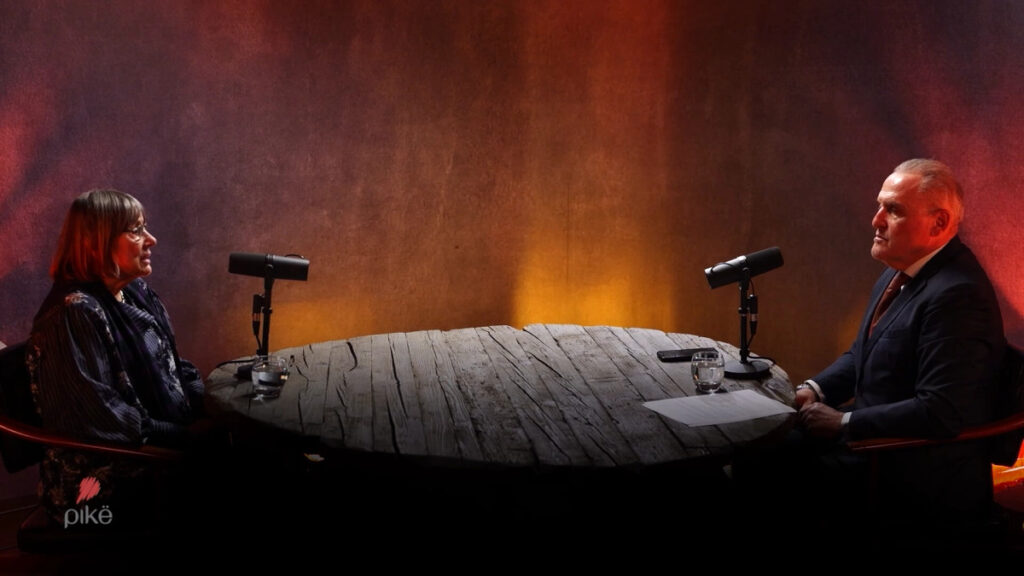
In the ninth episode of the PIKę podcast, publicist Veton Surroi discusses with the founder of the Humanitarian Law Center, Natasa Kandic, about Kosovo, Serbia, the region, how peace can be achieved, student protests and other issues.
2 h. ago / May 4, 2025 21:09
publicist Veton Surroi, in a conversation with Natasha Kandic on the PIKË podcast, said that the most optimistic scenario for Kosovo by 2030 is to become part of a European and Euro-Atlantic security umbrella that covers the entire region, as a guarantee for sustainable peace.
According to Surroi, security should not be defined simply as the absence of war.
“We must reach a period when we live not only in the absence of war, but in genuine peace,” he said.
For him, the biggest problem in the region is not the actual use of force, but the fact that the idea of war is still present in people’s collective thinking.
“We need to eliminate this reality from our minds,” Surroi said.
Surroi added that confronting the past, building honest relations between states, and economic cooperation are essential for peace. But he warned that this economic cooperation cannot replace unresolved political and historical processes.
“It’s always said that economic cooperation will solve everything – but that has never happened in the last 30 years,” he said.
If the situation remains unchanged, he warned, then even if Kosovo progresses economically, it will remain locked in an unfinished conflict, endangering its stability and that of the region.
When asked by Kandic whether there is a real risk of war in Bosnia or Kosovo, Surroi emphasized that the biggest risk is the very acceptance of war as a possibility: “Now, war is a possibility. And that is what needs to change.”
3 h. ago / May 4, 2025 20:55
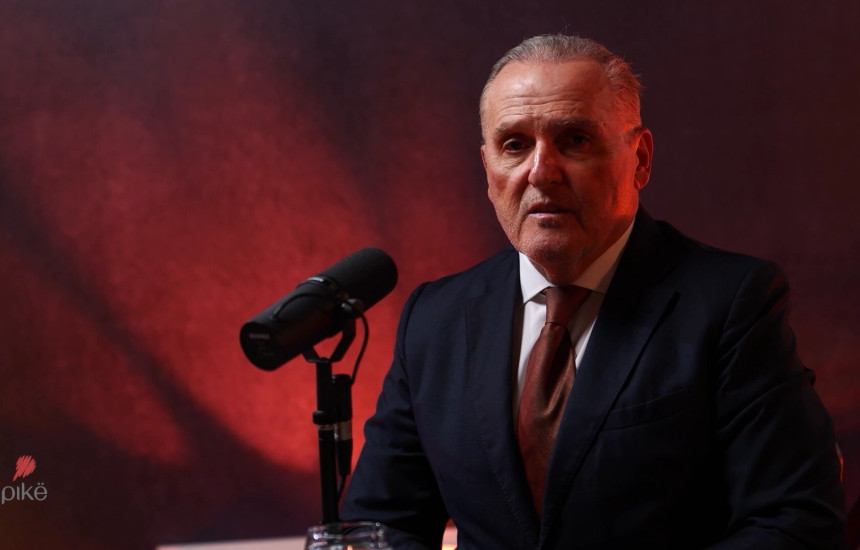
Publicist Veton Surroi has said that Serbia is going through a process similar to the peaceful overthrow of communism in Central Europe and that this historical moment should be used to improve relations between Albanians and Serbs in Kosovo.
In a conversation on the PIKË podcast with Natasa Kandic, founder of the Humanitarian Law Center, Surroi stated that the overthrow in Serbia is not just a matter of the change of power, but of its very nature – from an authoritarian system to a genuine democratic model.
“When this happens, the Serbs of Kosovo, who are still dependent in various forms on the power in Belgrade, can be freed from this dependence. New relationships will be created,” he stressed.
Kandic, meanwhile, pointed out that there is currently a political deadlock in Kosovo and that he had expected more from the acting Prime Minister Albin Kurti, especially in terms of integrating Serbs and treating minorities.
“When I was in Old Gracka this summer, Serbs told me: ‘We loved Thaci more than Kurti, because at least he came to us,'” she said.
She also criticized Serbian President Aleksandar Vučić, saying he publicly expresses hatred towards students and certain social groups, while institutions do not react.
“Students are determined for change, they have reached political articulation, but the system simply does not work,” Kandic emphasized.
Both interlocutors agreed that system change in Serbia and a more open and inclusive approach in Kosovo could pave the way for building new relations between the majority and non-majority communities, as well as for deeper confrontation with the past.
3 h. ago / May 4, 2025 20:39
Natasha Kandic, president of the Humanitarian Law Center, has said that if RECOM were to be revived – the initiative to create a regional truth commission about war crimes – it would fundamentally change the historical relations between Kosovo and Serbia.
In a conversation with the publicist Veton Surroi On the PIKË podcast, Kandic commented on a scenario imagined by Surroi, where in 2026 the new authorities in Belgrade and those in Pristina jointly decide to officially form RECOM.
“If it were to happen, this would truly change the historical relations between Kosovo and Serbia. The magnitude of what actually happened would be understood,” Kandic said.
She emphasized that, despite the reality of Kosovo’s statehood since the end of the war, Serbia still uses negative terms such as “provisional institutions” or “so-called prime minister”, which denies the political and institutional reality in Kosovo.
“We live in two separate states, and one day this will be accepted both politically and publicly,” Kandic declared, adding that propaganda rhetoric cannot replace facts on the ground.
3 h. ago / May 4, 2025 20:24
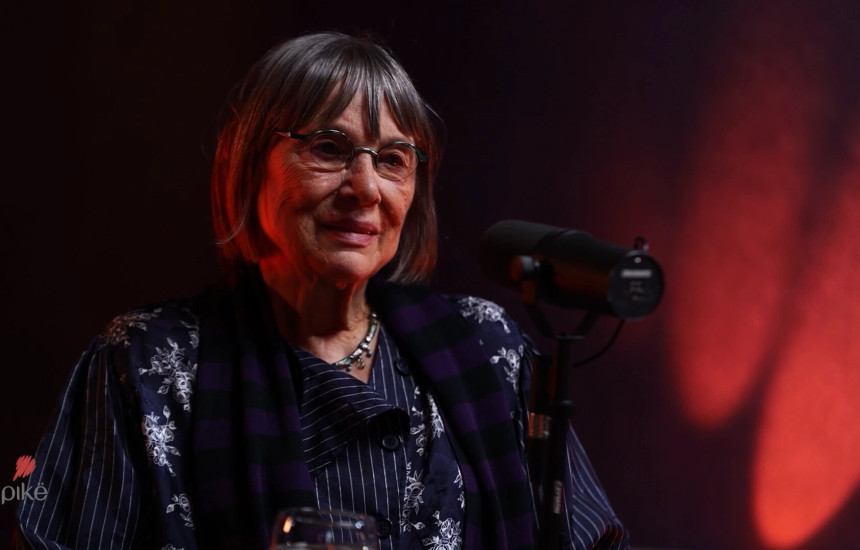
In the latest episode of the PIKę podcast, publicist Veton Surroi held a conversation with the founder of the Humanitarian Law Center, Natasa Kandic, about the possibility of a radical change in Serbia’s approach to the past, if students were to come to power.
Surroi raised a hypothetical scenario where the current Serbian president, Aleksandar Vučić, leaves power and is replaced by long-standing student protesters. He asked whether such a change would also bring about a real confrontation with the crimes of the past, including open issues such as the refrigerated trucks with corpses, the Bytyqi brothers’ case, or that of the Berisha family.
Kandic responded with skepticism, emphasizing that there are still big dilemmas about whether such a thing is possible. She brought concrete examples from a meeting with students from the former Yugoslavia, who were unaware of the Day of the Disappeared in Kosovo or of massacres like the one in Meja. However, she acknowledged that a small hope exists, fueled by new student contacts that transcend ethnic and historical divisions.
A particular case she mentioned was the crossing of Serbian student protesters to Croatia, where, despite their lack of knowledge about the painful past of cities like Osijek or Virovitica, they were welcomed by their Croatian peers and even local officials. This new communication, as she called it, is a beacon of hope for a generation that can build new relationships in the region, away from the legacy of conflict.
“I’m afraid to talk about this small hope, but it exists,” Kandic added.