
![[OC] California counties' 'living wage' and percent of workers earning below it](https://www.byteseu.com/wp-content/uploads/2025/05/ra44xafxnfze1-1024x791.png "[OC] California counties’ ‘living wage’ and percent of workers earning below it")
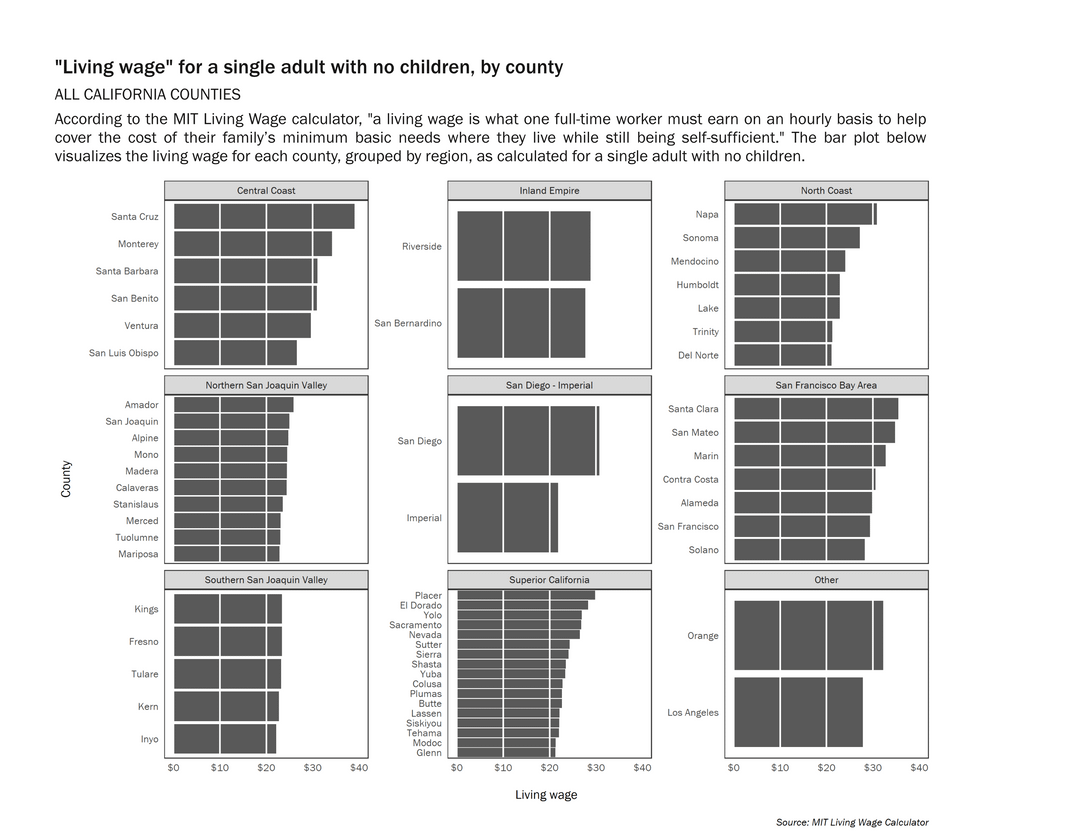
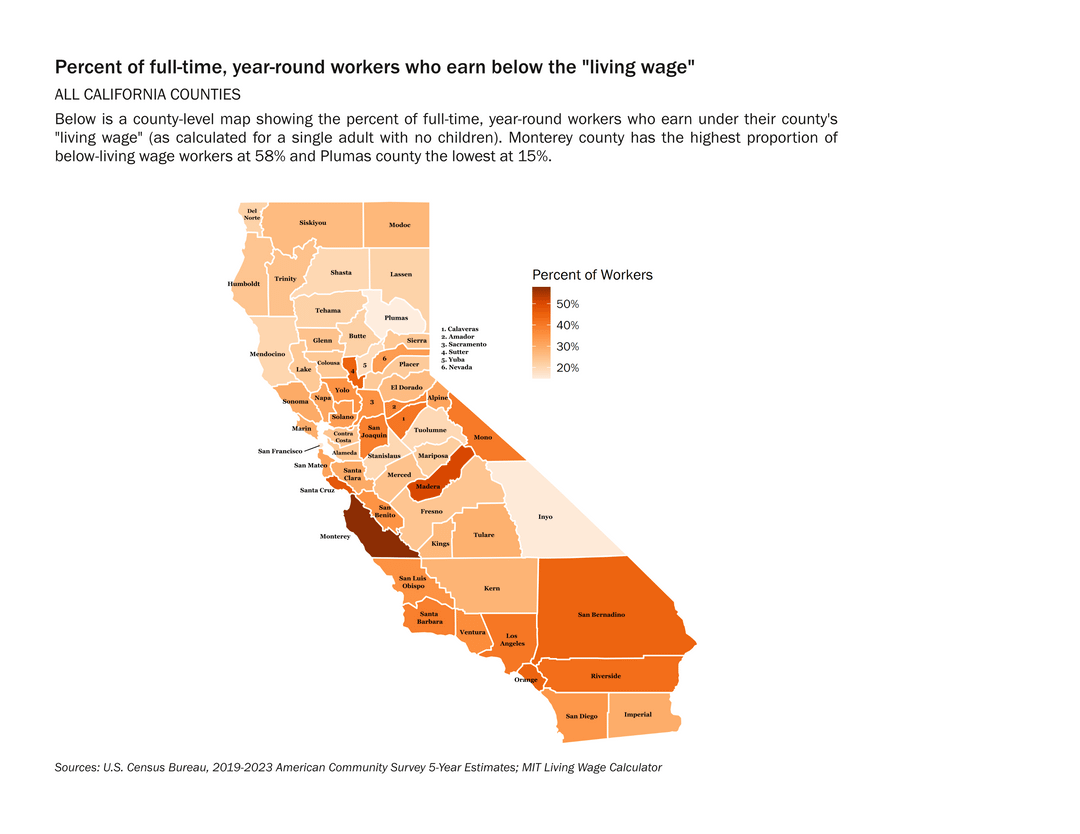
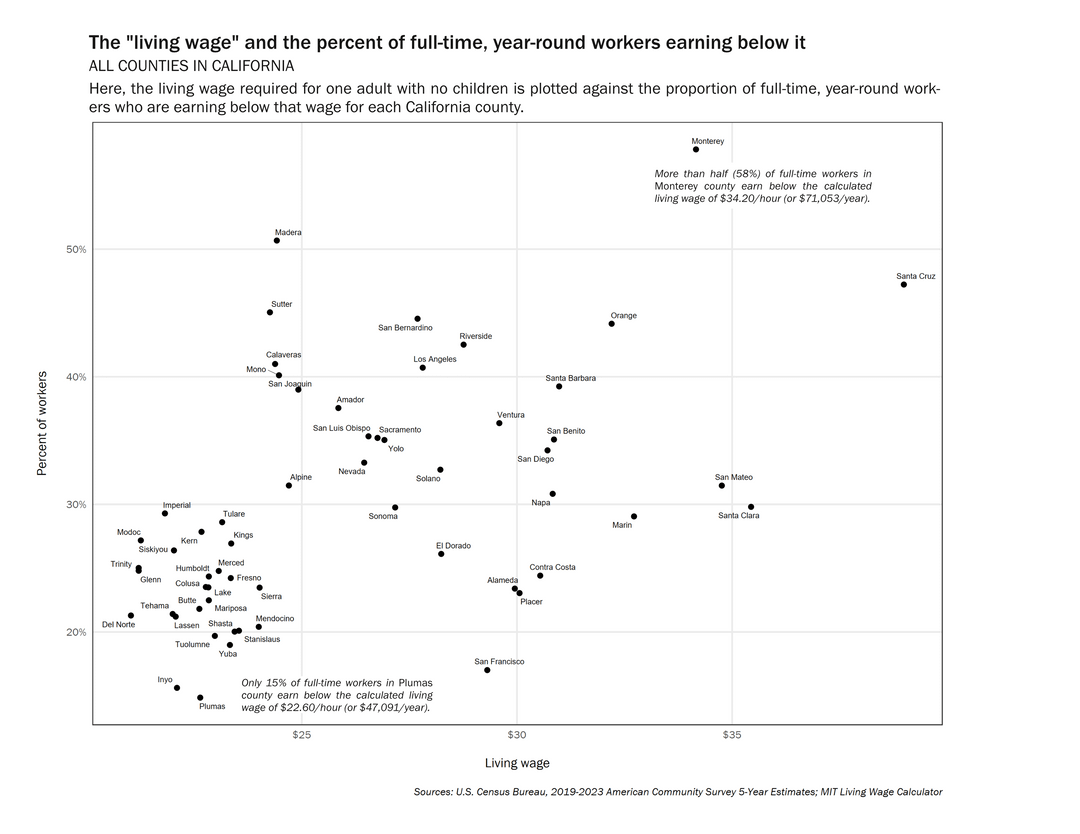
I would have liked to visualize all counties in the U.S., but the MIT Living Wage site discourages web scraping. Instead, here are the living wage calculations for all 58 California counties, as well as the percent of full-time, year-round workers who earn below the living wage for their county.
Counties are grouped in the bar chart according to California Complete Count Office, which "groups California’s 58 counties into 10 regions based on their hard-to-count populations, like-mindedness of the counties, capacity of community-based organizations within the counties, and state Census staff workload capabilities."
Living wage data of course comes from MIT Living Wage Calculator. Data on workers' earnings are from the S2001 table (Earnings in the Past 12 Months) of the 2019-2023 American Community Survey 5-Year Estimates.
Posted by theYode
6 Comments
Wow…a lot of these numbers are barely scraping by
Do I multiply that hourly wage by the amount of working adults in the home or all people in the home. I grew up in Santa Cruz. I make over $60 an hour. I couldn’t afford to rent a home there. I guess I could rent a room on that? But jeez, who wants to do that. If you add in hubbies wage we make about $80 an hour. There is no way we could afford to live in Santa Cruz. Period. It says you need to make $40 an hour. And there is ZERO chance we could afford to live in San Francisco. LOL
Inyo makes a lot of sense. Lots of opportunities in both farming and things to support them and a lot of tourism, yet rent and prices are lower than the rest of the state. Legit stayed in a three-bedroom with two coworkers for 1500 a month.
I have to say I’m surprised the living wage in SF is so low compared to some other counties. Makes me wonder if there are some factors skewing the data.
Monterey is rich people on the coast and migrant farm workers in Salinas. The difference between the two areas that are less than 20 miles apart is like visiting a different country.
“Percent of workers.” Where I live it’s not the workers that have it bad. It’s people on fixed incomes and there are a lot of people on fixed incomes.