
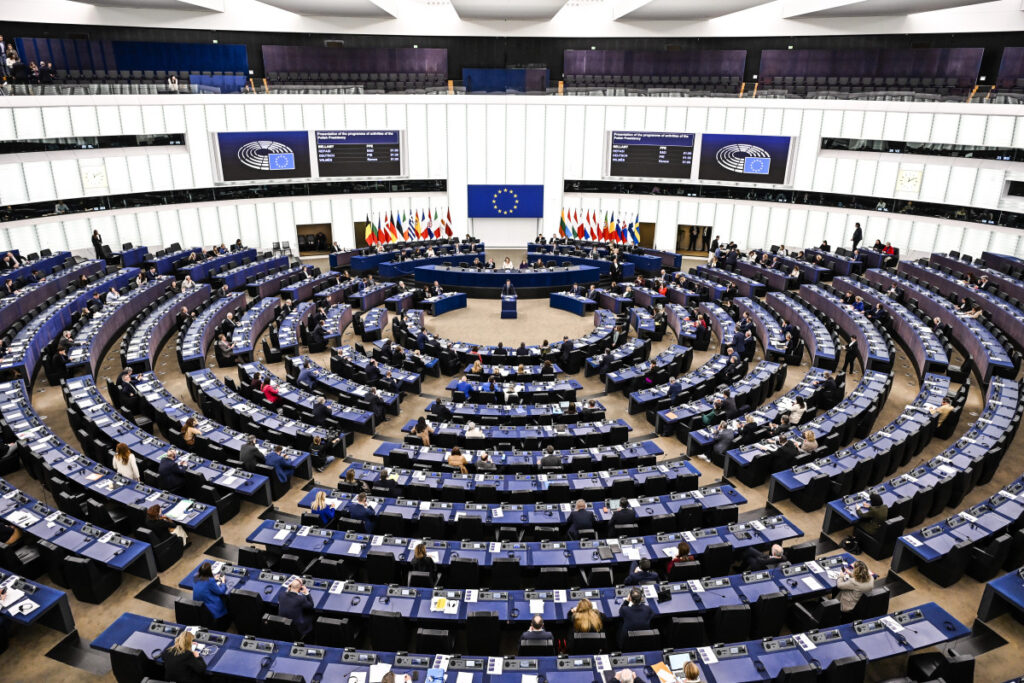
The resolution on Kosovo was approved by 353 votes in the European Parliament on Wednesday. The approval was preceded by a debate, which took place the night before and was also attended by EU Enlargement Commissioner Marta Kos. She said that it is in Kosovo’s interest to form institutions as soon as possible, highlighting the approval of an agreement related to the European Union’s Growth Plan.
With a majority of 353 votes in favor, 145 against and 78 abstentions, the European Parliament (EP) adopted the resolution on Kosovo in Wednesday’s plenary session.
This report encourages Kosovo to make reforms to move towards membership in the European Union (EU) but also urges both Kosovo and Serbia to open a new chapter in normalization talks.
“It is clear that Kosovo’s integration process needs a new momentum – we need a new chapter in the talks between Pristina and Belgrade. It is extremely positive that all major political parties in Kosovo strongly support EU integration. Kosovo’s future is in the European family and we will work together on the reform agenda because any future membership must be based on merit,” said Riho Terras, rapporteur for Kosovo in the EP.
According to the MEPs, the dialogue for the normalization of relations between Kosovo and Serbia “unfortunately has not produced the expected results”, as they have urged both sides to implement the Brussels and Ohrid agreements, including the establishment of the Association of Serb-majority Municipalities, and for Serbia not to oppose Kosovo’s membership in regional and international organizations.
And on the eve of the vote, a debate was held on Tuesday night, in which, in addition to the EP members, the EU Commissioner for Enlargement, Marta Kos, also participated. She said that it is in Kosovo’s interest to form the institutions as soon as possible.
“It is in Kosovo’s interest to form its own institutions as soon as possible to advance urgent European reforms,” Kos said, while also highlighting the signing and ratification of agreements related to the Growth Plan, which, according to her, will need to be treated as a priority by the new Government and Parliament. “This would enable the release of funds from this instrument, provided that all other criteria are met,” Kos said.
She also reiterated the need for Kosovo to fulfill without delay its obligations under the Ohrid Agreement, reached within the framework of the dialogue with Serbia.
Regarding Kosovo’s application for EU membership, Commissioner Kos stated that the Commission is ready to start work on drafting an opinion on Kosovo’s application as soon as it receives a mandate for this from the Council of the EU.
Meanwhile, the European Parliament report, which was previously approved by the Foreign Policy Committee, welcomes Kosovo’s application for EU membership and calls on member states to start work on examining this application. The European Parliament has also asked the five EU countries that have not recognized Kosovo to do so as soon as possible.
The European Parliament has also called for the lifting of the measures against Kosovo that the EU imposed two years ago. According to the MEPs, there is no longer any reason for such measures since Kosovo has met the conditions for their lifting.
Terras, who is an MEP from Estonia and the rapporteur for Kosovo, also called during Tuesday night’s debate for these measures to be lifted for Kosovo.
“We demand the immediate lifting of the European Union’s punitive measures. They have been unjust and unnecessary from the beginning. The EU finances many projects and programs designed to support Kosovo’s European agenda. This is why we must lift the measures and enable Kosovo to advance using the funds we provide,” he said.
The report also expresses concern about the security situation in northern Kosovo, especially after the armed attack in Banjska and the Iber-Lepenc canal. It reiterates the request addressed to Serbia to bring to justice the perpetrators of the attacks in Banjska, including their leader Milan Radoicic.
The report on Serbia, prepared by Croatian MEP Tonino Piculla, has sharply criticized Serbia for its relations with Russia and for its efforts to destabilize neighboring countries. The EP has also criticized the European Commission’s “patronizing policy” towards Serbia and has called on the Commission to “speak clearly” about Serbia, not trivializing the problems it faces.
Furthermore, the European Parliament has demanded that financial aid to Serbia be reconsidered if Belgrade’s relations with official Moscow continue.