
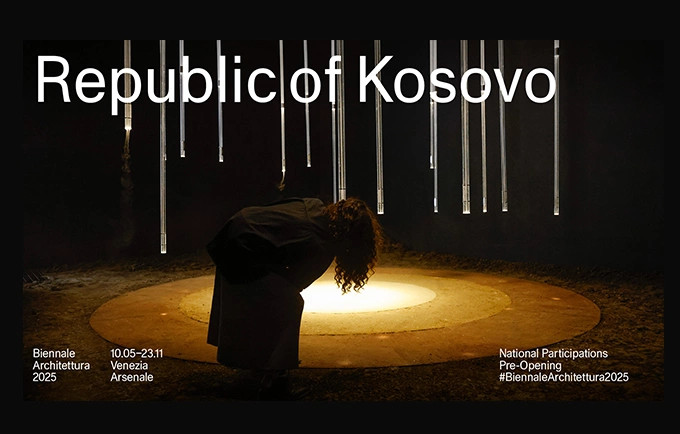
The Kosovo Pavilion entitled “The Snowdrop No Longer Blooms. Assembly in the Exhibition” has opened at the International Architecture Biennale in Venice. At 15:00 PM, the Pavilion opened its doors to visitors. In the first three days, visitors can be curators, architects, journalists and critics. In the 19th edition of the International Venice Biennale, Kosovo is represented by architect Erzë Dinarama.
Through the concept of Dinarama, visitors are introduced to an environment where climate change is experienced and it is shown that the crisis in this regard is already present everywhere. According to the Kosovo Pavilion team, the project traces a landscape in transition, where old crops such as wheat and beans are struggling, while new crops such as kiwi and figs are coming to life. According to the concept, based on complex field research, this change reflects the fading of sensory signs and seasonal indicators on which farmers have relied for decades, revealing the fragility of embodied forms of knowledge, while at the same time creating space for their recalibration.
Erzë Dinarama’s proposal was presented as a work on climate change and its impact on ecosystems, as early as January of this year when she was selected to represent the country at the major event, which is open to the public from May 10 to November 13. The theme of her installation fits the general theme of the Biennale, set by curator Carlo Ratti: “Intelligence. Natural. Artificial. Collective”. The five-member jury decided to represent Kosovo. The report of the Ministry of Culture stated that 11 projects had competed, while the determination of the Dinarama concept was written to have been made based on the innovative approach of the project, intellectual depth, compatibility with the theme of the Biennale and the commitment to addressing critical global and local issues through architectural research.
Kosovo’s relationship with the International Architecture Biennale in Venice began in 2012, when it debuted with “The Filigree Worker”, by curator Përparim Rama – now mayor of Prishtina – and architect Bekim Ramku was appointed as commissioner. The installation aimed to shed light on Kosovo’s cultural heritage. In 2014, Gëzim Paçarizi had represented Kosovo with “Visibility (imposed modernism)”. The tower made of 720 benches conveyed the architectural history of Prizren. Two years later, due to the Ministry of Culture’s dispute over the procedures, Kosovo was not represented, only to return in 2018 with Eliza Hoxha, with the work “The City is Everywhere”, which relocated the Kosovo house from the 90s there. In the 2020 edition, Maksut Vezgishi with “Containporary” explored the question of how we can live together. While in 2023, Poliksen Qorri-Dragaj and Hamdi Qorri with the theme “RKS2 Transcedent Locality” addressed the phenomenon of migration and its impact on the architecture of cities.
And, Kosovo’s “history” with the International Art Biennale in Venice began in 2013 with Petrit Halilaj, who presented the installation “I am humble with all my might. I am trying to find the words that satisfy me, but in the end there is nothing left but a closed circle. The irony is that you are not here, nothing is here”. In 2015, Kosovo was represented by artist Flaka Haliti with the work “Speculating in the blue”. In 2017, it was Sislej Xhafa with the work “Lost and Found”, a powerful appeal for the fate of those who disappeared during the war. With a history of war, Kosovo was also represented in 2019 by Alban Muja with “Family Album”. In 2022, Jakup Ferri will address “The Monumentality of Everyday Life”. Last year, at this Biennial, “The Resonating Silences of Metal and Leather” was the title of the work by the new generation artist, Doruntina Kastrati, curated by Erëmirë Krasniqi and commissioned by Hana Halilaj. It was the sixth representation of Kosovo at the Art Biennial that culminated in success. The Kosovo Pavilion, competing with 80 countries, received a “Special Recognition” in the 60th edition, where the “Golden Lion” was awarded to Australia.
This article is being updated with statements and data from the International Architecture Biennale in Venice while a special story will be broadcast on the “Express” show on KTV from 18:00 and on “Evening News” from 19:00.
#BiennaleArchitettura2025 | #PreOpening National Participations
8.05, 15: 00
REPUBLIC OF KOSOVO
THE FLOWER DOESN’T OPEN ANYMORE. EMERGING ASSEMBLAGES
Arsenale-2 days to #IntelliGens
Find out more and buy your tickets → https://t.co/WHUiNwogz4 pic.twitter.com/ALCDbe3Qov– The Venice Biennale (@la_Biennale) May 8, 2025