
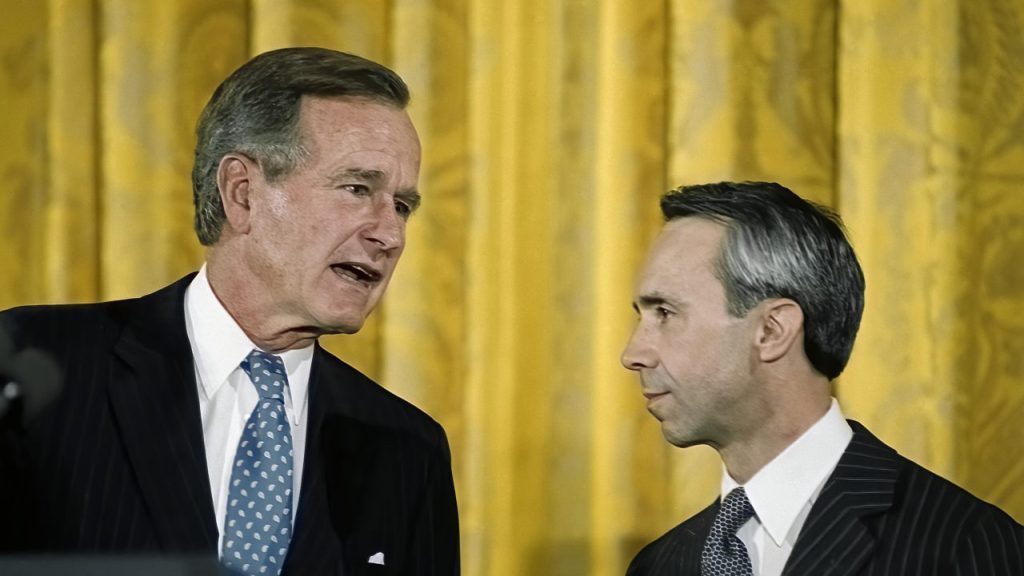
Retired U.S. Supreme Court Justice David Souter died Thursday at his home in New Hampshire, leaving behind a legacy of important opinions, including one that reshaped the relationship between high schools and state athletic associations.
Souter, who graduated from Harvard Law School, the University of Oxford and Harvard University, was 85 years old. Nominated by President George H.W. Bush in 1990, Souter had served as a judge on the U.S. Court of Appeals for the First Circuit, a justice on the New Hampshire Supreme Court and Attorney General of New Hampshire.
In 2001, Souter wrote the majority opinion in Brentwood Academy v. Tennessee Secondary School Athletic Association. Brentwood Academy, which has produced Miami Dolphins cornerback Jalen Ramsey and other NFL players, had won multiple state football championships and was accused of recruiting violations of eighth-grade athletes. Alleged violations included free tickets to a middle school coach with the intent the coach would bring players to the games and inviting incoming athletes to attend spring football practice. TSSAA found the school to have violated association rules. It issued penalties that included playoff bans and ineligibility of athletes who received free game tickets.
Brentwood Academy disputed the findings and argued TSSAA violated the U.S. Constitution in several ways, including by failing to provide due process. School officials and coaches insisted they were denied credible opportunities to challenge evidence as guaranteed by due process.
But TSSAA is a not-for-profit membership organization. Although almost every public school in Tennessee was a member of TSSAA, and although 84% of TSSAA’s voting members were representatives from public schools, TSSAA itself was not a public entity.
For an entity to be required to follow the Constitution, there must be “state action”—meaning acts by the government. That is why pro sports leagues, which are private membership organizations, don’t have to adhere to constitutional requirements, but public universities, which are arms of the state, do.
In a 5-4 opinion joined by Justices John Paul Stevens, Sandra Day O’Connor, Ruth Bader Ginsburg and Stephen Breyer, Souter held that TSSAA had engaged in state action because the “nominally private character” of TSSAA was “overborne by the pervasive entwinement of public institutions and public officials in its composition and workings.”
In addition to noting how public schools enjoyed a decisive majority of TSSAA voting members, Souter stressed linkages between the TSSAA and state agencies. For instance, TSSAA employees participate in the state retirement system, and public officials sit on TSSAA’s governing bodies.
Souter acknowledged a contrast between his opinion and that of Stevens in NCAA v. Tarkanian (1988). In that case, the Court held the NCAA—whose membership includes numerous public universities—is not a state actor, meaning it need not adhere to constitutional safeguards in how it disciplines member schools. Souter noted that the NCAA, a national organization with member schools in all 50 states, is not a surrogate for one state, whereas TSSAA arguably was.
In a dissent joined by Chief Justice William Rehnquist and Justices Antonin Scalia and Anthony Kennedy, Justice Clarence Thomas rebuked Souter’s analysis as unprecedented and at odds with previous holdings.
“We have never found state action based upon mere entwinement,” Thomas wrote. He also argued that state action for private organizations should only arise under limited circumstances, such as being “created, coerced, or encouraged by the government.”
Six years later, the U.S. Supreme Court took up the dispute again, except that time ruled for TSSAA. By that point, the case was about whether the TSSAA violated the First Amendment. TSSAA found a letter by Brentwood Academy football coach to recruits to have broken rules. The Court, in an opinion by Justice Stevens, upheld TSSAA’s ability to restrict recruiting communications.
Fast forward to 2025, and high school recruiting is even more of a big business. Most states allow high school athletes to sign NIL deals, a trend that should only grow as the NCAA v. House settlement (if approved) would further morph college sports into something closer to pro sports. Souter’s reasoning makes clear that while athletics may be a business, the associations that govern athletics may have to adhere to the Constitution when they run up too close to the government.