An interstellar voyage into the Fermi Paradox, the Great Filter, and the big cosmic question: where are all the aliens out there?
https://open.substack.com/pub/vincentl3/p/the-stillest-hour-leaking-a-highly?r=b9rct&utm_medium=ios

An interstellar voyage into the Fermi Paradox, the Great Filter, and the big cosmic question: where are all the aliens out there?
https://open.substack.com/pub/vincentl3/p/the-stillest-hour-leaking-a-highly?r=b9rct&utm_medium=ios
4 Comments
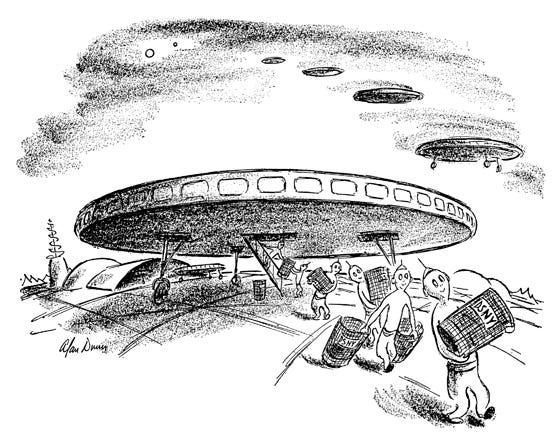
What we can’t see in shoddy photographs of UFOs—namely any direct and reliable evidence of E.T.s far from home—is much more alienating than what we can see.
An exploration of the Fermi Paradox, the Great Filter, the absence of detectable alien life, and what this all can tell us about the future fate of all civilisations, including our own.
I never understood how the probability of technological civilization is supposed to be significantly more than zero. The article says that Fermi himself did a quantitative estimate. How did he estimate the probability of life producing a technological civilization?
We seem to make the bold assumption that other advanced civilizations are anything like us and care to find us.
How many of us try to inject ourselves into more primitive groups of animals or even remote tribes of humans? Not many! For every Jane Goodall or uninvited missionary to remote islands, there are billions of us going about our day.
Why would another civ be any different?
I think life is going to end up fairly common, but life of the type that wants to and can leave their planet is going to be pretty rare.
For literally hundreds of millions of years, the apex creature even on Earth was the dinosaurs, and it was only a freak accident that ended up with social primates taking over (eventually). There is a hump of evolutionary pressure where big brains don’t actually help you if you’re, say, a triceratops or a T Rex. There’s no reason to really expect dinosaurs would have developed space ships even if given an additional 66 million years.
AND life on Earth did start relatively quickly, that’s why I think life may be common, but that’s another reason we seem to be first. One can imagine a world that is less hospitable for longer. Or on the other side, a world with more extinction-level events because of a lack of moons or happenstance of location, so intelligence never has time to take off.