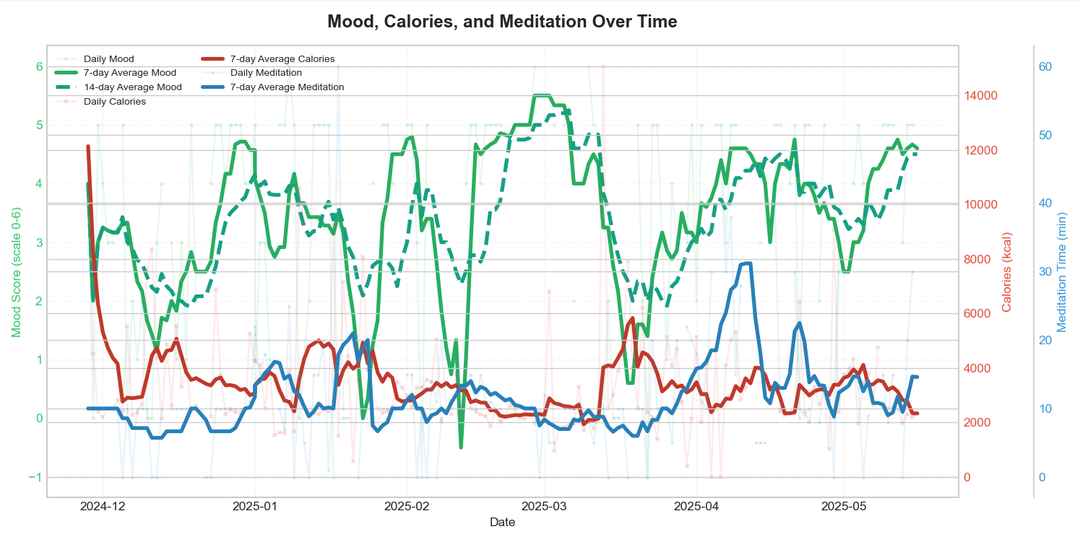
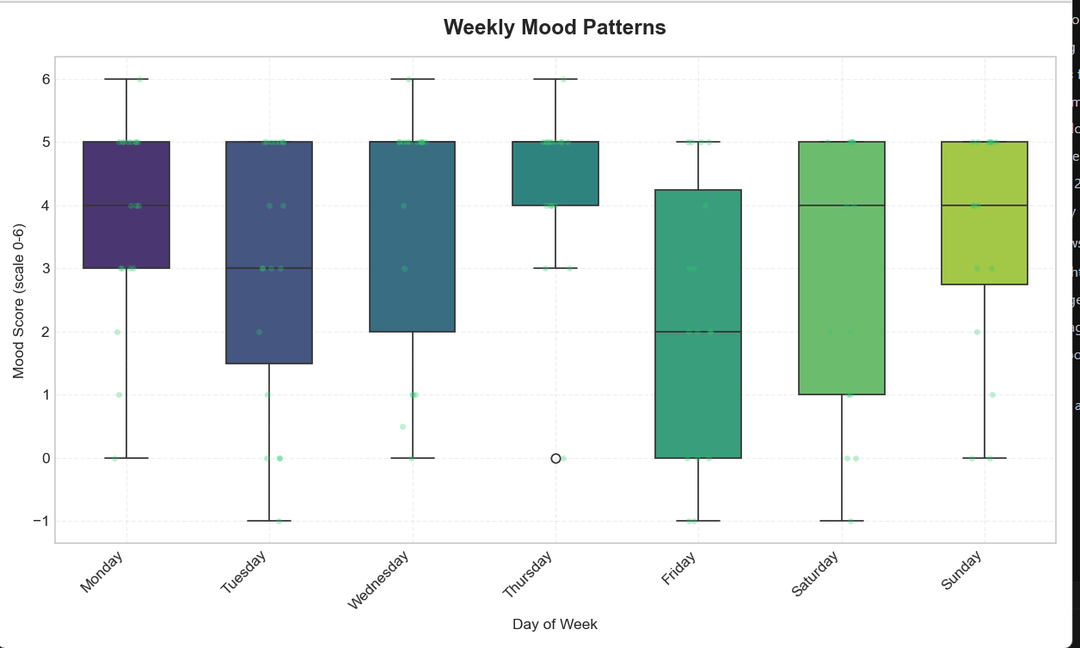
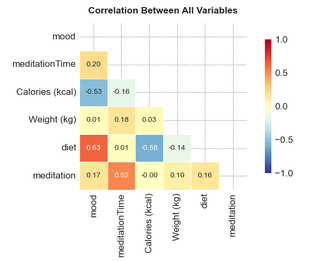
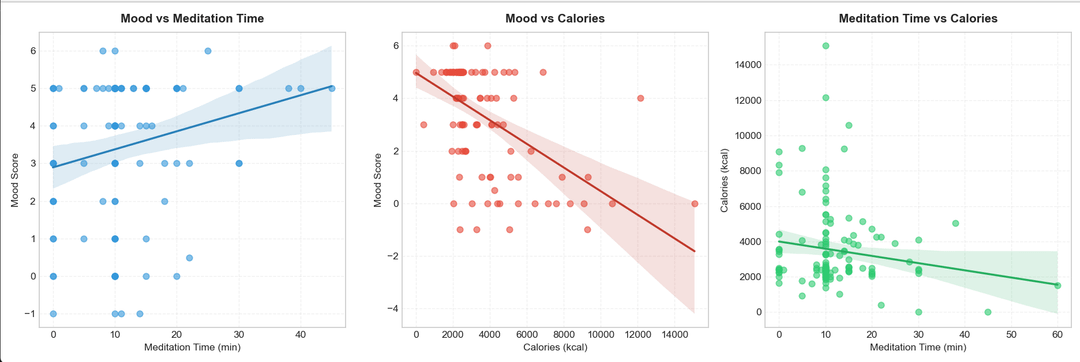
I recorded my calories, meditation time and mood over a period of 6 months. Here is my data and my findings
Posted by jinstronda

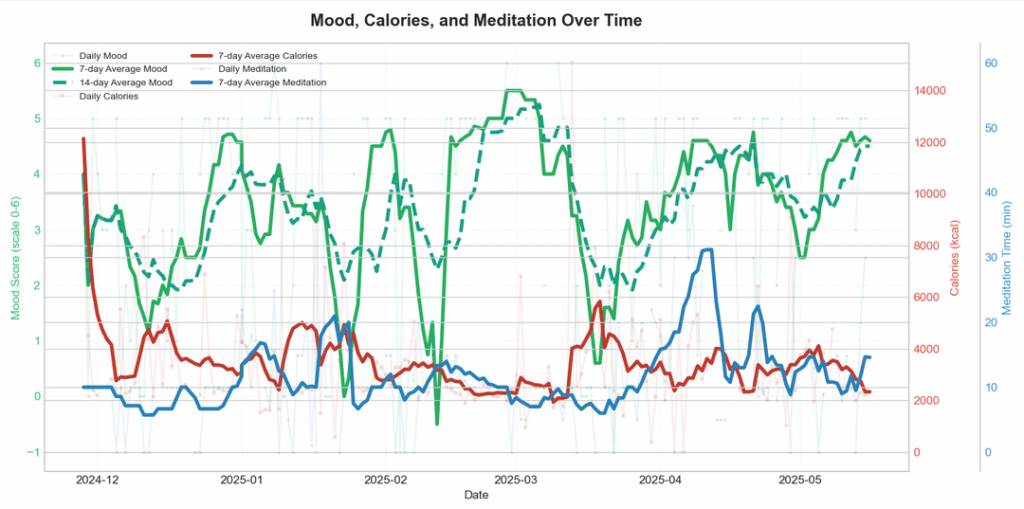
I recorded my calories, meditation time and mood over a period of 6 months. Here is my data and my findings
Posted by jinstronda
6 Comments
I respect the analysis but am apparently too thick to find meaning in the metrics
Meditation is a coping mechanism for stress and you forget about it otherwise?
That’s all the data I wanted to track. I’ve been thinking about this for a long time. Thanks a lot! What about how mood and exercise intensity are connected?
Really interesting experiment. Kudos to you for actually tracking all the data.
From a data analysis perspective, I have a few questions, though. Please excuse the nerdiness, it’s not meant to diminish your accomplishments.
1) in the correlation plot, you have diet and meditation popping up in there, that are not mentioned elsewhere. What’s the difference between meditation and meditation time. Did you try different types?
2) are any of the correlation values statistically significant? The main response variable you’re looking at is mood. I’d argue that mood is a quantify that is at least to a degree autocorrelated (today’s mood depends on yesterday’s mood), so that needs to be taken into account (the data points are not independent, so a simple p value using n-1 dof won’t be correct). So even a correlation of 0.5 could be coincidence.
3) same about the trends. You show an envelope around the linear trends that probably somehow relates to a confidence interval of the slope. But how is it calculated? What assumptions were made? What made you chose linear relationships, could be exponential or something else.
4) most importantly: what the hell do you do on Thursdays and can you please tell me your secret? That looks like a consistently and significantly better mood than any other day of the week.
Pretty sure your units for calories are wrong
Generally you are eating more calories and meditating less when you’re in a bad mood.
Unclear if its the activities associated with the heavier eating that puts you in a bad mood (and less time to meditate) or if you are eating to cope with being in a bad mood.
What is the mood scale? Good to bad? Or tired, angry depressed, etc..
Thanks for sharing.